Retatrutide Research Peptide: Synthesis, Purity and Evidence
September 29, 2026 · 15 min read
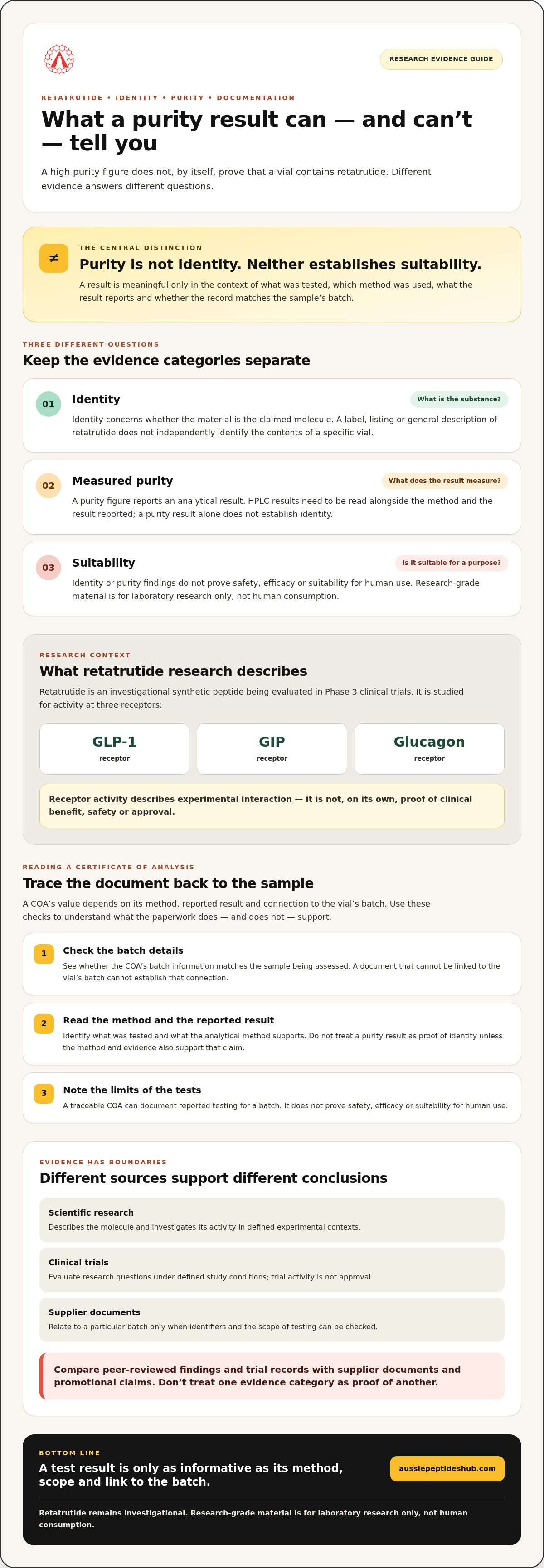
Can a high purity result prove that a vial contains retatrutide? No. A retatrutide research peptide may be described by its receptor activity or an impressive assay figure, but those details answer different questions. Identity, measured purity and suitability for a specific research purpose aren’t interchangeable.
It’s reasonable to expect a certificate of analysis (COA) to settle the question, but its value depends on the method used, the result reported and whether the document can be linked to the vial’s batch. Retatrutide is an investigational synthetic peptide being evaluated in Phase 3 trials. It acts on GIP, GLP-1 and glucagon receptors. Research-grade material is for laboratory research only, not human consumption.
This article explains retatrutide’s research context, how synthesis and analytical testing are described, and what HPLC results can and can’t establish. It also shows how to check whether batch documentation matches a sample, and why even a traceable COA does not prove safety, efficacy or suitability for human use. The focus is on distinguishing documented evidence from claims that go beyond it.
Key Takeaways
- Consider the retatrutide research peptide in its investigational context, without treating research interest as evidence of an approved treatment.
- Distinguish peptide sequence, molecular structure and receptor activity. Each describes a different aspect of the research.
- Check what a purity result measures, then see whether the analytical method also supports claims about identity.
- Match a certificate of analysis to the sample by checking its batch details, and note the limits of the tests reported.
- Compare peer-reviewed findings and trial records with supplier documents and promotional claims before drawing conclusions.
What is the retatrutide research peptide?
Retatrutide is an investigational peptide studied for activity at three metabolic hormone receptors: GLP-1, GIP and glucagon receptors. A peptide is a molecule made from a chain of amino acids. A receptor is a protein on or within a cell that responds to particular chemical signals. These terms describe the molecule and its biological targets, not a treatment claim.
The term retatrutide research peptide refers to the molecule in a research context. It doesn’t identify a particular vial, manufacturing batch, test method or analytical result. Those details need to be established separately through traceable sample records and relevant testing. Research-grade material is for laboratory research only, not human consumption.
What does the name retatrutide refer to?
Retatrutide is the name used for a peptide molecule studied in scientific research. The name alone says nothing about the contents or quality of a specific sample. A label or online listing does not show that a vial’s contents have been independently identified or that its test documentation matches its batch.
Keep these questions separate: molecular identity concerns what the substance is, while a batch record connects a particular sample to its documentation. Neither the keyword nor a general description of retatrutide substitutes for that evidence.
Why is retatrutide being studied?
Researchers are examining retatrutide’s activity at the GLP-1, GIP and glucagon receptors. Receptor activity describes how a molecule interacts with biological signalling systems. It does not, by itself, demonstrate a clinical benefit, establish safety or show that a substance is suitable for human use.
As of September 2026, retatrutide remains investigational and is being evaluated in Phase 3 clinical trials. Trial activity means questions are being studied; it isn’t approval. For a broad overview of the molecule and its reported mechanism, see Retatrutide. This overview is background reading, not a substitute for primary trial records or analytical evidence about a specific research sample.
Keep the evidence categories distinct. Scientific descriptions explain the molecule. Clinical trials investigate effects under defined study conditions. Supplier documents relate to a particular batch only when their identifiers and testing scope can be checked. None of these categories proves the others.
How retatrutide research examines synthesis and molecular activity
Understanding a peptide sample means separating three related but distinct ideas: its amino-acid sequence, its molecular structure and its biological activity. Synthesis describes how a molecule is assembled. Analytical testing examines characteristics of the resulting material. Neither step, on its own, establishes every claim that might be made about a sample.
From peptide sequence to a research sample
A peptide sequence is the order of its amino-acid building blocks. Synthesis joins those building blocks into a chain through a defined process intended to produce the target molecule. Solid-phase peptide synthesis is one approach described for retatrutide. This is a high-level description, not a laboratory procedure; manufacturing conditions and controls depend on the process used.
Sequence is not the same as three-dimensional structure, and neither establishes what is in a particular vial. Synthesis concerns how material is made; subsequent analytical methods assess properties of a sample. When evaluating the retatrutide research peptide, look for evidence that relates to the sample and batch in question. A general description of synthesis cannot verify a supplier’s manufacturing process or a vial’s contents.
What triple-receptor activity means
Retatrutide is studied for activity at the GLP-1, GIP and glucagon receptors. In plain terms, receptor activity means a molecule can interact with a cellular target and produce a measurable response under defined test conditions. Its sequence and molecular structure help describe the molecule; receptor assays investigate how it behaves in a particular experimental system.
Those findings have limits. The receptor pharmacology reported by Coskun et al. supports describing retatrutide as a triple agonist, but laboratory receptor activity alone cannot establish clinical efficacy or safety in people. The study’s mechanistic evidence should be interpreted in its experimental context, not as proof of outcomes beyond the research performed.
This distinction matters when comparing evidence. A proposed mechanism can help researchers form a hypothesis. Receptor-assay results can test aspects of that hypothesis in the assay used. Clinical outcomes require separate investigation, and results from one experimental system should not be presented as if they answer every biological or clinical question.
For an example of research-material documentation, review the retatrutide research material and check how sample records connect to batch details. Documentation can support traceability; it doesn’t turn a mechanistic claim into evidence of human suitability.
Retatrutide purity, identity and COA results are not interchangeable
A certificate of analysis (COA) is useful when its reported tests and sample identifiers are clear. A purity percentage, an identity result and a matching batch record answer different questions. Interpret each result within the limits of the method used.
| Evidence | What it can indicate | What it cannot establish by itself |
|---|---|---|
| Identity | Whether a suitable analytical test supports the claimed molecular identity. | That the whole sample is pure, safe or suitable for a particular use. |
| Purity | The proportion of detected components reported under the stated method and calculation basis. | Confirmed identity, absolute content, safety or clinical effect. |
| Batch matching | Whether the document’s lot identifier corresponds to the vial being reviewed. | That every vial has been tested individually or that the document’s claims are independently verified. |
| Limitations | The test method, sample and reporting details that define how to interpret a result. | Claims beyond the scope of the documented analysis. |
What HPLC can show, and what it cannot
High-performance liquid chromatography (HPLC) separates components in a sample as they pass through a column under specified conditions. The resulting chromatogram can help assess detected components and report a purity value according to the method’s stated basis. Results depend on the method, the sample tested and how the result is calculated and reported.
A purity percentage describes the result of a defined analysis; it doesn’t, on its own, confirm identity, safety or human suitability. A high chromatographic purity figure isn’t proof that the material is retatrutide or that it meets a clinical standard. Check the COA for what was tested and how. Research-grade material is for laboratory research only, not human consumption.
How to connect a COA to a vial
Start with the lot number printed on the vial. Check that it matches the batch identifier on the COA, then review the test date, method, reported result and issuing laboratory. A generic specification or promotional statement without a matching lot number is not equivalent to a batch-specific COA.
For a related example of batch-document checks, see the BPC-157 research sourcing and verification guide. The same principle applies when assessing documentation for a retatrutide research peptide: connect the record to the sample, then interpret only what the listed tests support.
A practical framework for evaluating retatrutide research evidence
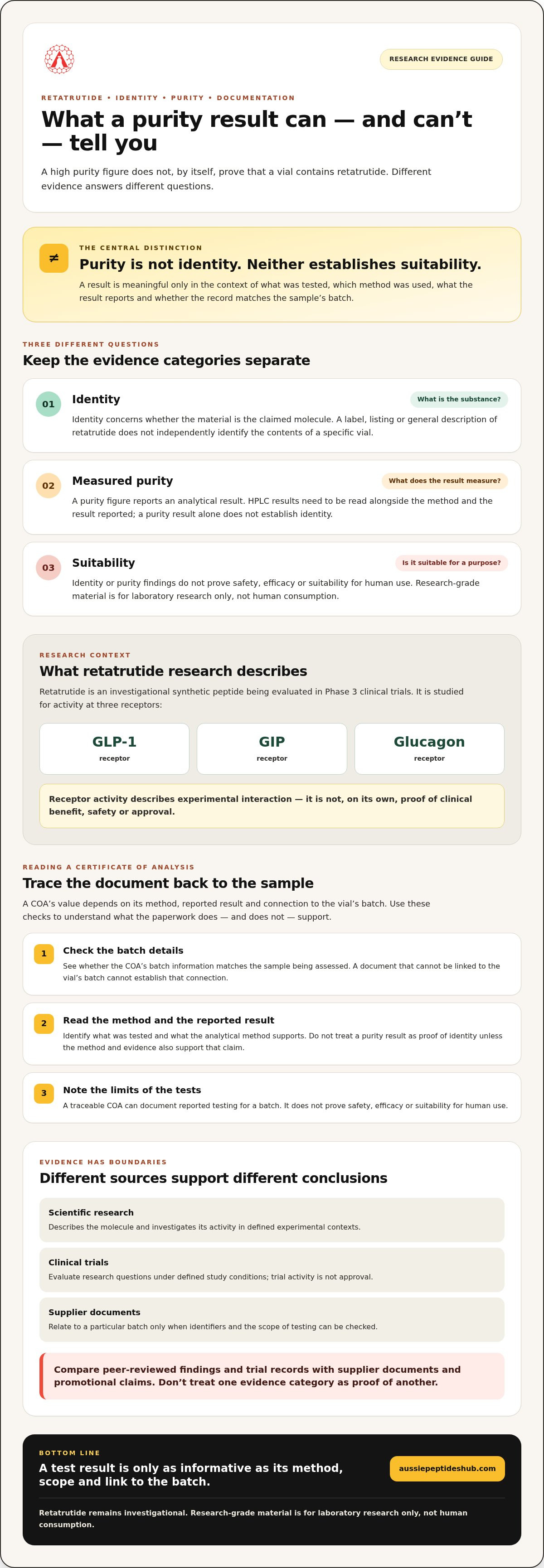
Assess each claim against the evidence that could support it. A peer-reviewed paper, a clinical-trial record, a supplier certificate and a promotional statement serve different purposes. Don’t treat one as a substitute for another. For the retatrutide research peptide, use this sequence:
- Identify the source. Is it a scientific publication, trial record, supplier document or promotional claim?
- Define the sample or study. Check what material or population was examined and whether the evidence applies to the claim.
- Review the method. Confirm what was measured and whether the method can support the stated conclusion.
- Limit the interpretation. Separate the reported result from claims about other samples or people.
How to assess a research claim
First identify whether the evidence comes from an in-vitro assay, animal research or a human study. Then check the publication date, study design and measured outcome. A receptor response in a laboratory model is not a clinical outcome. A result from one study also doesn’t establish that every sample, setting or person will show the same result.
Compare the conclusion with the methods and results, not just the abstract or a supplier’s summary. Trial records describe planned or registered studies; they don’t, by themselves, prove a treatment benefit. Promotional wording that expresses more certainty than the underlying evidence warrants caution.
How to assess analytical documentation
For a certificate of analysis (COA), match the vial’s lot number to the document before interpreting its results. Note who performed the analysis, the test date, the method and the reported result. Then ask whether that method supports the specific claim being made, such as identity or chromatographic purity.
If the method is missing, the lot numbers differ or the report’s scope is unclear, pause and record the information as unknown. An absent result is not a positive result, and a batch-matched document still supports only conclusions within its stated analytical scope.
Keep the review focused on evidence, not rankings or purchase decisions. Research-grade material is for laboratory research only, not human consumption. To review the supplier’s research-only retatrutide information and available batch documentation, visit Aussie Peptides’ retatrutide research information.
Research-only boundaries and transparent retatrutide documentation
Research-grade retatrutide is for laboratory research only, not human consumption. A research-use label describes the intended research context; it isn’t a statement that the material is suitable for human use. Analytical paperwork doesn’t change that boundary.
A certificate of analysis (COA) records specified tests and reported results for a sample or batch. It cannot establish clinical safety, efficacy, regulatory approval or suitability for diagnosis, treatment or prevention. Even a batch-matched COA with a high purity result supports only conclusions within the scope of its methods. It isn’t a substitute for clinical evidence or regulatory assessment.
What research-grade labelling does and does not mean
Read “research-grade” as a category of material supplied for laboratory research, not as a measure of human-use quality. Don’t infer that a research label, product listing or test result makes a substance a medicine or supports personal use. This article doesn’t provide medical advice or instructions for dosing, administration or self-experimentation. For personal health questions, speak with an appropriately qualified health professional.
What transparent batch documentation should contain
Begin with the vial’s lot number and confirm that the COA carries the same identifier. Then check the test method, reported result and laboratory that issued the document. A generic specification without a matching batch identifier doesn’t establish that it relates to the vial in hand. Unclear details should remain unknown, not be treated as evidence of a favourable result.
Aussie Peptides states that its research-grade peptides are independently HPLC-tested, supplied with matching COAs and traceable through the vial lot number. These are documentation and analytical measures. HPLC results describe what the specified analysis reports; they don’t independently prove human safety, efficacy or approval. The same limit applies to any supplier’s documentation.
Packaging or dispatch in Australia can describe where those activities occur. It doesn’t establish clinical approval or human-use suitability. Keep product-handling records, batch identifiers and analytical documents connected, and interpret each record only within its stated scope.
For an example of the supplier’s research-only documentation and batch details, review Aussie Peptides research documentation. Use it to understand the records provided, not as evidence of clinical benefit or suitability for human use.
Keep the evidence connected to the sample
Retatrutide research is easiest to interpret when the scientific claim, analytical method and sample documentation remain distinct. Receptor activity describes a research finding, while a purity result reports what a specified analysis measured. Neither establishes clinical safety, efficacy or suitability for human use.
For a retatrutide research peptide, check that the Certificate of Analysis (COA) matches the vial’s lot number, then review the method and reported results. Aussie Peptides states that its products undergo independent HPLC testing and are supplied with matching COAs, with batch details checkable using the vial lot number. These records support traceability, not human-use suitability. Research-grade material is for laboratory research only, not human consumption.
To review the research-only product information and batch documentation, visit Aussie Peptides research documentation. Check what the evidence shows, note what it cannot establish, and keep your conclusions within those limits.
Frequently Asked Questions
What is retatrutide?
Retatrutide is an investigational peptide studied for activity at GLP-1, GIP and glucagon receptors. It is being examined for how it interacts with these biological targets, but research interest is not proof of human benefit. Nor does it mean retatrutide is an approved medicine. Its clinical-trial and regulatory status can change, so check current primary sources, including official trial records and regulator information, before publication or relying on a status claim.
Is retatrutide approved for human use in Australia?
As at 29 September 2026, verify retatrutide’s status directly against current Therapeutic Goods Administration (TGA) information, including the Australian Register of Therapeutic Goods (ARTG), before stating whether it is approved. Trial activity, product listings and research-grade labels do not establish TGA approval. The available information for this FAQ doesn’t include a dated TGA record confirming approval, so no approval claim should be inferred. This article isn’t medical advice and doesn’t recommend use.
What does retatrutide purity mean on a COA?
A purity result on a certificate of analysis (COA) reports what an analytical method found in the sample tested, under the stated conditions and reporting basis. It isn’t a universal measure independent of method or sample. Purity alone doesn’t prove molecular identity, safety, efficacy or suitability for human use. Check that the COA matches the vial’s batch, then review the analytical method and the result’s stated scope before drawing conclusions.
Can HPLC confirm retatrutide identity?
High-performance liquid chromatography (HPLC) separates and assesses components under a defined analytical method. A chromatographic purity result shouldn’t automatically be treated as confirmation that a sample is retatrutide. Check the COA to see what the method measures and whether supporting analytical evidence for identity is reported. If the document lists only a purity figure, don’t assume it establishes identity or proves safety, efficacy or human-use suitability.
How do I check whether a retatrutide COA matches a vial?
Compare the lot number printed on the vial with the batch identifier on the COA. If they don’t match, the document doesn’t verify the specific vial. Then review the test date, analytical method, reported result and issuing laboratory. A generic specification or undated document may describe a product category, but it doesn’t establish that the tested sample corresponds to the batch in your possession.
What does research-grade retatrutide mean?
Research-grade retatrutide is designated for laboratory research only, not human consumption. That label doesn’t establish clinical suitability or mean the material is an approved medicine. Research documentation, including a COA, reports specified analytical information; it cannot establish clinical safety, efficacy, prescription status or regulatory approval. Interpret the label and documents within their stated scope, and don’t treat them as evidence supporting personal use.
What is the difference between retatrutide research and clinical evidence?
Laboratory research examines effects in controlled test systems, while animal studies examine responses in animals. Clinical trials study outcomes in people under defined protocols, and regulatory decisions assess evidence against relevant approval requirements. Each evidence type addresses different questions. Findings from an in-vitro assay or animal study can’t automatically establish human outcomes, and trial activity alone doesn’t confirm approval, safety or efficacy for a particular use.