Third-Party Tested Peptides Australia: What the Evidence Shows
September 28, 2026 · 15 min read
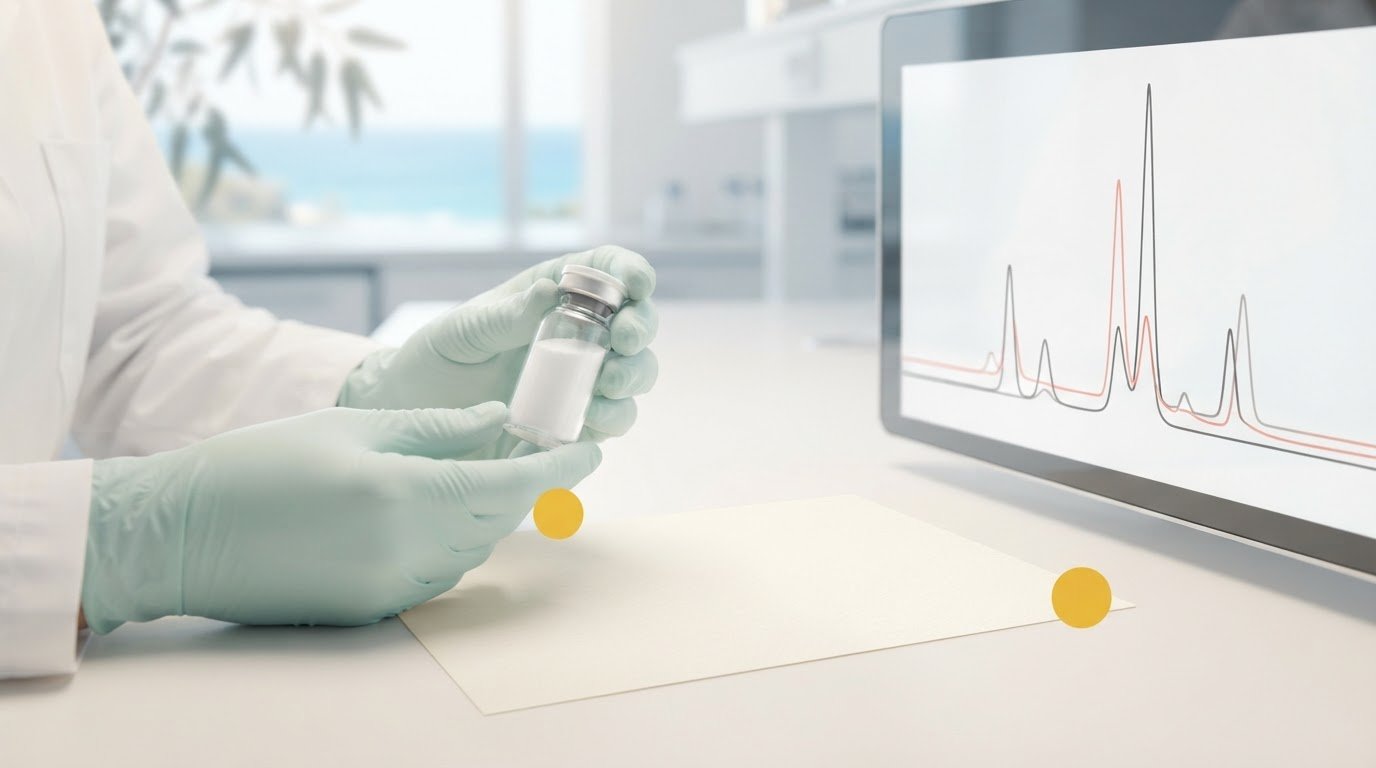
A purity percentage can look conclusive while answering only a narrow question. When assessing third party tested peptides australia, check whether the method, laboratory and batch connection can be verified. A testing claim is meaningful when it is supported by evidence, not just a number on a product page.
This article explains how to assess independent testing and what to look for in a batch-specific Certificate of Analysis. Check whether the report identifies the analytical method, laboratory, test date and batch or lot number. Then confirm that those details match the product being offered. A certificate without a clear batch link leaves an important gap.
Analytical results also have limits. A purity result does not, by itself, confirm identity, sterility, endotoxin levels, safety or suitability for human use. Any peptides discussed here are for laboratory research only and are not for human consumption. The focus is on traceable documentation and careful interpretation, not treating a testing claim as a guarantee.
Key Takeaways
- For third party tested peptides australia, distinguish a supplier’s claim from documentation that identifies the laboratory, method, sample and tested batch.
- Read HPLC results in context. Method settings, reference standards and reporting conventions affect what a reported purity figure means.
- Use the vial lot number to find the matching Certificate of Analysis, then compare batch identifiers and test details.
- Keep analytical evidence separate from handling information. Australian packaging and cold-chain dispatch describe processes, not test results.
- Aussie Peptides states that it commissions synthesis, conducts independent HPLC testing and provides batch-matched certificates. Its peptides are for laboratory research only, not human consumption.
What does third-party tested peptides mean in Australia?
For Australian laboratory research buyers, “third-party tested” should mean that an external laboratory or analytical provider performed the test, rather than the seller’s own quality-control operation. The phrase alone proves nothing. Supporting evidence should identify who performed the analysis, which method was used, what sample was tested and how that sample links to the batch being offered.
That distinction matters when assessing third party tested peptides australia. An external laboratory may still be engaged and paid by the supplier, so look for clear disclosure of its role. A logo or certificate layout does not establish independence on its own. Analytical testing also does not establish human-use safety, efficacy or regulatory approval. Research-grade peptides are for laboratory use only and are not for human consumption.
What makes a peptide test independent?
An in-house quality-control check takes place within the seller’s own testing operation. Third-party analysis is carried out externally. To assess the distinction, look for the laboratory’s name and evidence of its involvement in the report, not just a logo on a product page. If accreditation is claimed, check whether the relevant accreditation scope covers the specific analysis. A general accreditation statement may not cover every method.
Manufacturing controls and analytical testing are separate types of evidence. Good Manufacturing Practice (GMP) describes quality systems for production, but a test report alone does not demonstrate that a manufacturer operates under GMP or that those controls were independently assessed.
What a test result can and cannot tell you
A reported result applies to the sample received and the analytical method stated in the report. Its relevance to a product batch depends on traceability. The documentation should connect the tested sample to an identifiable batch or lot. Without that link, the result may not establish anything about the vial being considered.
Interpret each result within its stated scope. For example, an HPLC report may provide chromatographic data and a reported purity figure, but it does not automatically establish identity, sterility, endotoxin levels or stability. Those attributes require appropriate evidence and methods. An analytical result also does not establish whether a substance is suitable for human use.
One assay cannot establish every quality attribute. Treat each result as evidence for a defined measurement, not as a general certificate of safety or quality. Before drawing conclusions, check the method, report details and batch link.
How peptide testing methods support different claims
A test result supports only the claim the method was designed to assess. For buyers comparing third party tested peptides australia, match the reported result to the stated method rather than treating one figure as a complete quality assessment.
High-performance liquid chromatography (HPLC) separates components in a sample and records their detector response. The resulting chromatogram shows signals associated with components under the conditions used. It can support assessment of a sample’s component profile and a reported purity value, but the result needs context. Method settings, reference standards, sample preparation and reporting conventions all affect interpretation.
What HPLC evidence may show
A chromatogram is not a standalone quality guarantee. A reported area percentage typically describes the share of detected signal assigned to a particular peak under that method. It does not necessarily equal the proportion by mass of the target substance in the sample. Different components can produce different detector responses, so the report should make its calculation and any exclusions clear.
Check what the certificate actually states. Does it show a chromatogram, identify the method, explain the reported value and link the result to the relevant sample or batch? Do not assume an impressive percentage means the same thing across different reports. A single universal purity threshold should not be applied to every peptide or research question.
When additional analytical evidence may matter
Purity and identity are separate questions. Mass spectrometry can provide complementary evidence related to molecular mass or identity, but its suitability depends on the analyte, method and interpretation. The report should identify the test performed and its scope. The name of a technique alone does not confirm what was established.
Chromatographic purity describes a measured profile; it does not, by itself, confirm molecular identity. Sterility, endotoxin and stability are also distinct attributes. Where they matter to a research protocol, look for appropriate, separate evidence rather than inferring them from an HPLC result. Analytical testing does not establish human-use safety, efficacy or regulatory approval. For broader Australian health context, Healthy Male outlines the risks of unapproved peptides.
Apply the same method-focused approach to any supplier’s documentation. Aussie Peptides states that its research-grade peptides undergo independent HPLC testing and that batch details can be checked using the vial lot number. Products are for laboratory research only and are not for human consumption. Readers assessing those claims can review the available peptide research information and compare each document with the stated test scope.
How to assess a third-party peptide testing claim
For anyone assessing third party tested peptides australia, the useful question is not whether a supplier uses the phrase. It is whether the available record links a stated test to the specific batch under consideration. A general claim such as “independently tested” gives you little to assess unless the underlying documentation is available and sufficiently detailed.
A Certificate of Analysis (COA) is evidence to review, not automatic proof of authenticity, completeness or relevance. Compare its sample or lot identifier with the vial and supplier’s batch record. Check whether the report names the laboratory, method, test date and result. If those details are missing, note what remains unverified rather than filling the gaps with assumptions.
Evidence to look for in a testing record
Traceability depends on matching identifiers. A report for a different lot, or one with no identifiable sample reference, may not relate to the batch being offered. Check the units and acceptance criteria where they are reported. Missing criteria or unclear units are questions to resolve; on their own, they do not prove that a test failed.
Laboratory identity and involvement should be explicit. A logo or supplier statement is not enough to establish who performed the analysis. If the report omits the laboratory, test date or method, ask whether those details can be provided. Treat any response as additional information to verify, not as a substitute for the report.
Claims that need careful interpretation
Purity percentages are method-specific results, not universal rankings between suppliers. Different methods and reporting conventions can produce figures that are not directly comparable. Read the stated method and result together, and avoid interpreting a single percentage as evidence of every quality attribute.
The table separates what a document may support from what still needs checking. Even a detailed report does not establish safety for human use or regulatory approval.
| Documented evidence | Questions to resolve | What cannot be concluded |
|---|---|---|
| Sample or lot identifier | Does it match the vial and batch record exactly? | That a result applies to a different or unidentified batch |
| Named method and reported result | Are units, criteria and reporting basis clear? | That a purity figure is comparable across methods |
| Laboratory details and test date | Can the laboratory’s involvement and report be verified? | That a logo or certificate alone proves independent testing |
A supplier’s statement can point you towards evidence, but it does not replace examining the batch-linked report. Assess the document’s scope and traceability separately from any broader claim about product quality.
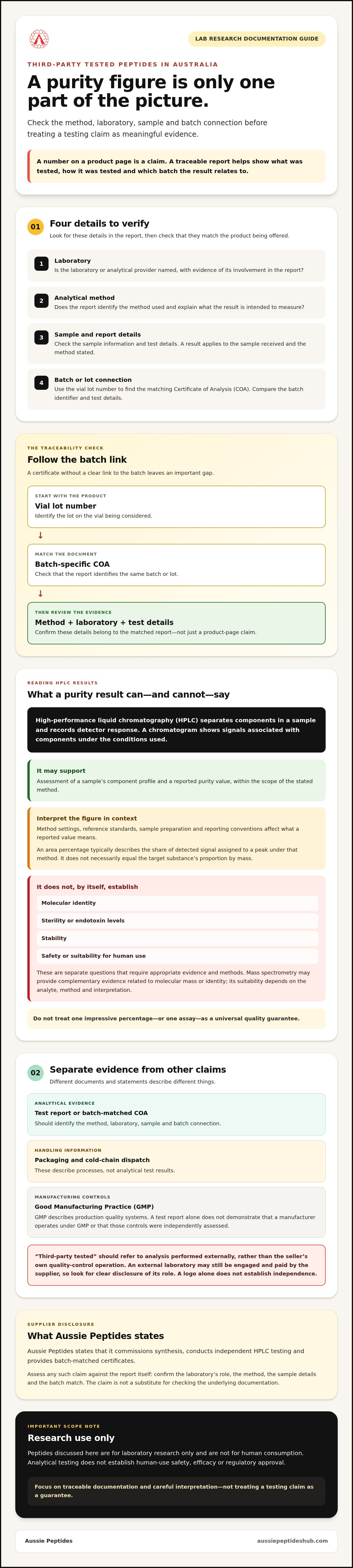
A practical checklist for verifying batch-linked peptide documentation
Use this workflow before relying on a testing record for laboratory research procurement. First check that the certificate corresponds to the vial. Then assess separately whether the method is suitable for the research purpose.
Match the vial, lot number and certificate
- 1. Record the vial details. Copy the product name and lot number exactly as printed. Do not rely on a similar-looking code or the product name alone.
- 2. Locate the matching certificate. Find the batch or sample reference on the Certificate of Analysis (COA). Compare it character by character with the vial lot number and the supplier’s batch record.
- 3. Check the test record. Confirm that the product name, sample identifier and reported result correspond to the same batch. Note whether the report identifies the analytical method, laboratory and test date.
- 4. Log discrepancies. Record missing details, conflicting identifiers or unclear references. Ask the supplier to clarify them before relying on the result. Do not treat an unexplained mismatch as a match.
Aussie Peptides states that customers can use a vial lot number to verify batch details online and that its Certificates of Analysis match product batches. Treat this as a stated verification process: compare the online record with the physical vial and certificate, and note any difference.
Record gaps and follow up before relying on results
Batch matching establishes document traceability, not method suitability. A report may correspond to the vial yet leave questions about what was measured, how the result was reported or whether the analysis answers a particular laboratory question. Check the method and stated scope against the requirements of the research protocol.
If the document does not identify the laboratory, test date or method, note that the information is unavailable and request clarification. Do not infer that an unlisted test was performed or assume that one result covers other attributes. Keep the COA and your comparison notes with the procurement record so unresolved points remain visible.
This checklist is a first-pass traceability check, not a complete guide to interpreting every COA field. Any peptides discussed are research-grade, for laboratory use only and not for human consumption. To review the supplier’s stated batch-verification process and research-only information, see peptide batch verification information.
What transparent Australian peptide sourcing should disclose
For buyers researching third party tested peptides australia, transparency means being able to follow the documentation from the batch offered to the stated analysis. A supplier should explain where synthesis is commissioned, what testing is reported, how batch records are matched and what Australian handling steps occur. These are separate parts of the supply chain, and none should substitute for another.
A clear account also defines the limits of each claim. An HPLC result describes the analysis reported, while a lot number supports traceability and cold-chain packaging describes handling. Neither Australian packaging nor temperature-controlled dispatch independently verifies peptide identity, purity or other analytical properties.
Traceability from contract manufacture to Australian packaging
Aussie Peptides states that peptide synthesis is commissioned from contract manufacturers rather than performed in-house. The company reports that it conducts independent HPLC testing, packages products in Australia and ships nationally using cold-chain packaging. It also states that Certificates of Analysis (COAs) match product batches and that customers can check batch details online using the vial lot number.
These are distinct disclosures. Contract manufacture describes who produces the material; reported HPLC testing describes an analytical step; Australian packaging and cold-chain delivery describe subsequent handling. Domestic handling does not independently validate the synthesis or analytical result. Products are research-grade, for laboratory use only and not for human consumption.
A documentation-first next step for research buyers
Before procurement for laboratory research, inspect the batch-linked documentation and confirm that the vial identifier corresponds with the certificate. Then review the stated method and the scope of the reported result. If the laboratory, test date, method details or acceptance criteria are not available, note the gap and seek clarification rather than assuming what was tested.
Online lot verification can make a supplier’s stated batch record easier to check, but the process still depends on comparing identifiers and report details. Assess the evidence on its own terms. Do not treat a handling description or a general testing statement as a substitute for batch-specific documentation, and do not interpret analytical evidence as proof of human-use safety, efficacy or regulatory approval.
For a direct review of the company’s research products and batch information, visit Review Aussie Peptides’ research products and batch information.
Make batch evidence part of your decision
Assessing third party tested peptides australia means checking more than a purity figure or the phrase “independently tested”. Match the vial’s lot number to the batch certificate, then review the stated method and what the result actually measures. A certificate can support a defined analytical claim, but it does not establish every quality attribute or human-use suitability.
Aussie Peptides states that its products are independently HPLC-tested and supplied with matching batch Certificates of Analysis. The company also states that vial lot numbers can be used to verify batch details online. Check these claims against the documentation. Its peptides are research-grade, for laboratory research only and not for human consumption.
Use a documentation-first approach: compare identifiers, note missing information and assess whether the test scope fits the research question. Clear records make it easier to evaluate what is evidenced and what remains unknown. To review the research products and batch information, visit Aussie Peptides’ research products and batch information.
Frequently Asked Questions
What does third-party tested mean for peptides?
Third-party tested generally means an external laboratory or testing provider analysed a sample, rather than the seller relying only on its own checks. The phrase alone does not identify the laboratory, method, sample or batch. For searches such as “third party tested peptides australia”, look for a report that links its result to a specific lot and states what the method measures. Testing does not establish human-use safety, efficacy or regulatory approval.
Does HPLC testing prove a peptide is pure?
No. HPLC can produce a chromatographic profile and a reported purity result under specified method conditions, but that figure is not automatically an absolute measure of every component. It also does not establish identity, sterility, endotoxin status or stability. Read the result alongside the method, report details and batch reference. If a certificate gives a percentage without analytical context, ask what was measured and how the value was calculated.
How can I check whether a peptide COA matches the vial?
Compare the vial’s lot number with the batch or sample identifier on the Certificate of Analysis (COA). Check that the product name and reported test also correspond to the item being assessed. If the identifiers differ, or the report lacks a clear batch reference, ask the supplier to explain before relying on it. A matching number supports traceability, but it does not verify every claim in the report.
Does third-party testing confirm peptide identity?
Not necessarily. Identity confirmation depends on the analytical method and the evidence documented in the report. A chromatographic purity result alone should not be treated as identity confirmation unless the report supports that interpretation. Look for the stated method and any identity-related evidence, then check whether the laboratory’s stated scope is relevant. If the documentation is unclear, record the uncertainty rather than assuming identity was tested.
Are third-party tested research peptides approved for human use?
No. A third-party analytical result alone does not establish human-use approval or suitability. Testing addresses only the attributes covered by the stated method and sample. Aussie Peptides describes its products as research-grade, for laboratory research only and not for human consumption. Do not interpret a COA, purity percentage or supplier description as medical advice, a prescription or evidence of therapeutic safety. Consult an Australian-registered medical practitioner about health concerns.
What should a peptide testing report include?
A useful report may identify the product or sample, batch reference, analytical method, result, units, test date and laboratory. Exact details depend on the assay and report. Check whether the record relates to the lot being offered and whether the method addresses the research question. Missing information is a reason to seek clarification, not proof by itself that testing failed. Do not infer that an unlisted test was performed.
Does cold-chain shipping prove a peptide has been tested?
No. Cold-chain packaging concerns handling and transit; it does not show that an independent laboratory tested the product. Assess testing claims using batch-linked reports and method details. A test report, in turn, does not document every handling condition after testing. Keep analytical documentation, storage statements and delivery details separate when reviewing a supplier. Each supports a different claim and should not substitute for another.