BPC-157 Purity Test Results: How to Read the COA
September 29, 2026 · 15 min read
A high BPC-157 purity figure can still leave important questions unanswered. The bpc 157 purity test results on a Certificate of Analysis (COA) depend on the method used, and a percentage alone doesn’t show whether the report matches the vial in hand.
It’s reasonable to question a result when the method, chromatogram or batch details aren’t clear. This article explains what an HPLC purity result measures, how to check whether a COA is traceable to a specific batch, and what further evidence may be needed to assess identity and other quality attributes.
You’ll learn why chromatographic purity is not the same as confirmed identity or overall product quality, and what a COA cannot establish. For research-grade BPC-157 intended for laboratory use only, a matching lot number links the vial to its batch record. It’s a useful verification step, not a substitute for examining the analytical method and supporting data.
Key Takeaways
- Use the stated HPLC method and chromatogram to understand how the reported purity figure was produced.
- Read bpc 157 purity test results alongside the method details. A percentage alone provides limited context.
- Compare the vial’s lot number with the COA batch identifier, product name and sample description.
- Check the report date and available laboratory details when assessing traceability.
- Distinguish purity evidence from identity, concentration, sterility and suitability, which require different evidence.
What BPC-157 purity test results mean and what they do not
A purity percentage is a measurement produced under a defined analytical method. It isn’t a complete assessment of a material’s identity, composition or quality. Interpreting bpc 157 purity test results means looking beyond the number printed on a Certificate of Analysis (COA) to the method, sample description and report context.
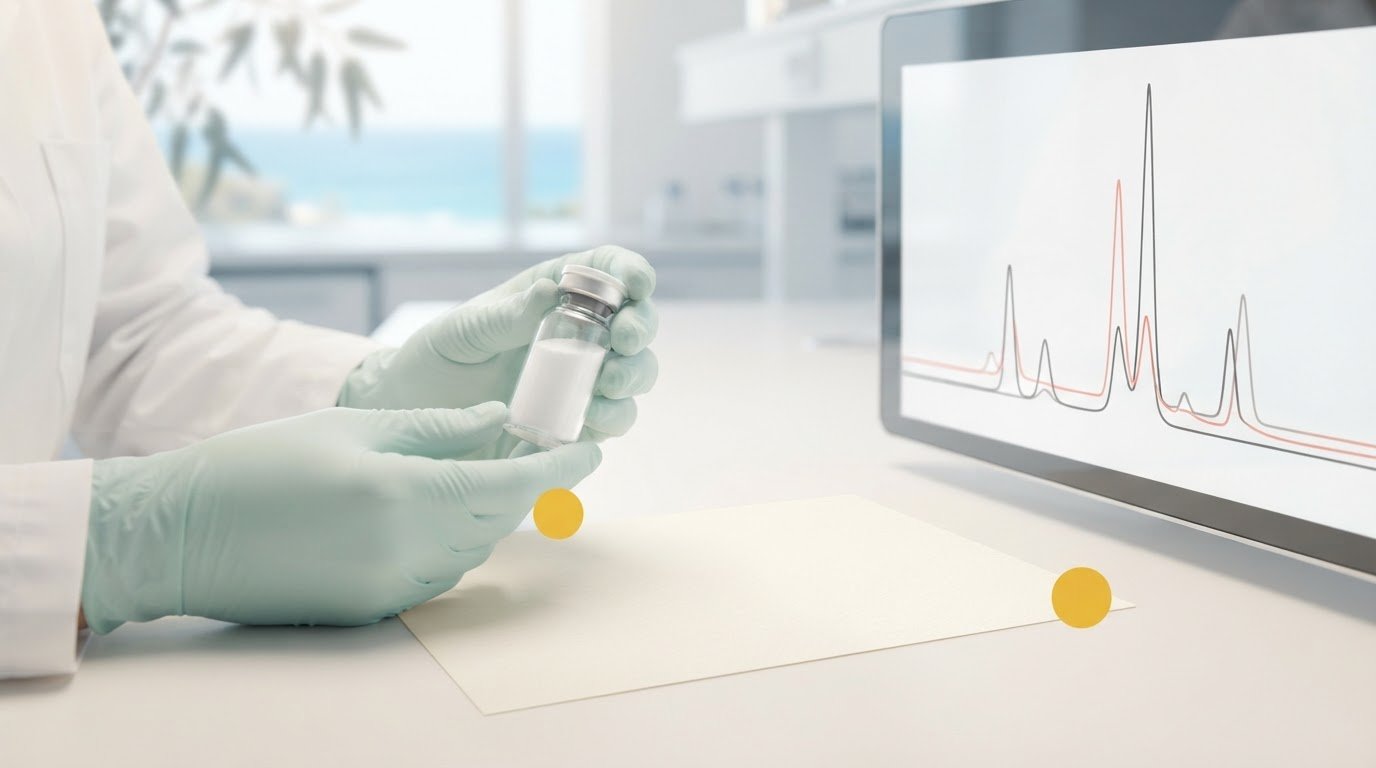
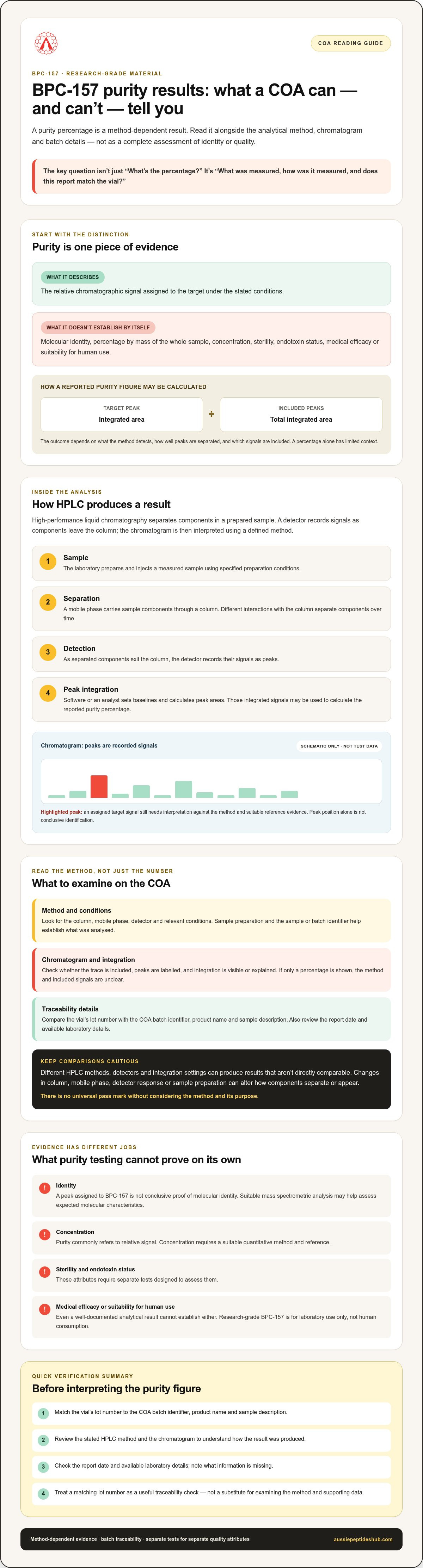
In chromatography, a sample is separated into components that appear as signals, or peaks, on a chromatogram. A laboratory may calculate a percentage by dividing the integrated area of the peak assigned to the target by the total area of the peaks included in the calculation. The result depends on what the method detects, how well peaks are separated and which signals are included. A compound the method doesn’t detect, or a signal that overlaps another peak, may not be represented clearly in the calculation.
What does a BPC-157 purity percentage describe?
It describes the relative chromatographic signal assigned to the target under the stated conditions. It doesn’t necessarily represent the percentage by mass of the entire sample. Different methods, detectors and integration settings can produce results that aren’t directly comparable. Check the method and chromatogram before treating a figure as meaningful. There is no universal pass mark that can be applied without considering the method and its purpose.
Purity is not the same as identity or overall quality
A peak assigned to BPC-157 is not, by itself, conclusive proof of molecular identity. Separate evidence, such as suitable mass spectrometric analysis, may help assess whether the material has the expected molecular characteristics. For general background on the peptide and its research context, see BPC-157.
One chromatographic assay also doesn’t automatically establish concentration. Purity commonly refers to relative signal, while concentration requires a suitable quantitative method and reference. Nor does a purity result establish sterility or endotoxin status. Those attributes require separate tests designed to assess them.
A purity percentage is a method-dependent estimate of detected chromatographic signals, not a complete quality assessment.
Keep the result tied to its sample and report. Confirm that the COA identifies the relevant material and batch, then review the stated method and available supporting data. Even a well-documented analytical result cannot establish medical efficacy or suitability for human use. BPC-157 offered as a research-grade product is for laboratory use only, not human consumption.
How HPLC produces a BPC-157 purity result
High-performance liquid chromatography (HPLC) separates components in a prepared sample so a detector can record signals as they leave the column. The resulting chromatogram is interpreted using a defined method. Retention behaviour, meaning when a signal appears under those conditions, can help compare a sample with suitable reference evidence. It isn’t standalone identification.
From sample injection to chromatogram
The analytical sequence is straightforward, but each stage can affect the result:
- Sample: The laboratory prepares and injects a measured sample using specified preparation conditions.
- Separation: A mobile phase carries sample components through a column. Components interact differently with the column and separate over time.
- Detection: As separated components exit the column, the detector records their signals as peaks.
- Peak integration: Software or an analyst sets baselines and calculates peak areas. Those integrated signals may then be used to calculate a reported purity percentage.
A peak’s position alone doesn’t establish that it is BPC-157. Assess its assignment against the method and appropriate reference evidence. The FDA analysis of BPC-157 discusses analytical challenges for peptides, including the potential need for multiple methods. This reinforces why a single HPLC trace should be read within its stated scope.
Which method details help interpret the result?
Review the COA for the column, mobile phase, detector and relevant conditions. Sample preparation and the sample or batch identifier also help establish what was analysed. Details vary between reports, so note both what’s provided and what’s missing.
A chromatogram makes the reported result easier to examine. Check whether the trace is included, peaks are labelled, and integration is visible or explained. If the COA gives only a percentage, ask what method produced it and which signals were included. HPLC names an analytical technique, but doesn’t prove that all quality attributes have been assessed.
Results from different HPLC methods aren’t directly comparable unless their conditions, detection and integration approach are sufficiently aligned. A change in column, mobile phase, detector response or sample preparation can alter how components separate or appear. Compare results cautiously unless the method information supports the comparison.
For research-grade BPC-157 intended for laboratory use only, a matching COA and vial lot number provide a practical starting point for reviewing the relevant batch record. You can also check the research-grade BPC-157 details and available batch information before assessing the method.
How to assess bpc 157 purity test results and chromatograms
A COA’s headline figure is only one part of the evidence. Read it alongside the chromatogram, method details and sample identifier. Together, these help establish what was measured and whether the trace appears to support the reported result. They don’t justify conclusions beyond the test’s scope.
Read the number beside the chromatogram
First, check that the reported value refers to the same sample and chromatogram shown on the report. Peak area is the detector signal accumulated across a peak. The baseline is the reference line used to separate that signal from background. Integration sets peak boundaries and calculates the area. Those choices can affect an area-based percentage.
A visible peak is a signal, not a name. Don’t identify a compound from its position alone. Look for the method and suitable supporting evidence for the peak assignment.
| COA element | What to check | What it can tell you |
|---|---|---|
| Reported percentage | Is it tied to the identified sample and stated method? | The calculated result under the report’s conditions, not a universal quality score. |
| Chromatogram | Are the trace, peaks and integration boundaries visible or explained? | How detector signals were separated and included in the calculation. |
| Method details | Are conditions, detection and reporting conventions provided? | Whether the result can be interpreted or compared with another report. |
| Batch identifier | Does the sample or lot identifier match the relevant vial record? | Whether the report is traceable to the batch being assessed. |
Compare reports only when methods are comparable
Different column conditions, detectors, sample preparation or integration conventions can change the trace and area calculation. A percentage from one method may therefore not be directly comparable with a percentage from another. Check the disclosed conditions before drawing comparisons.
An unexplained secondary peak or missing method note is a reason to request clarification, not proof of a particular contaminant or a failed batch. The peak may need further identification, or the COA may simply omit details. Ask what the signal represents, how it was integrated and whether supporting data are available. Avoid ranking batches or suppliers by a single number without comparable method and sample evidence.
A chromatogram records an observed analytical result. It is not, by itself, a complete conclusion about product quality. For bpc 157 purity test results, assess the percentage, trace, method and batch link as one evidence set.
A batch check checklist for a BPC-157 COA in Australia
A Certificate of Analysis (COA) is useful only if you can connect it to the vial and understand what the report covers. Use this checklist to assess whether the paperwork traces to the batch in front of you. A matching identifier supports traceability, but doesn’t validate the analytical method or every result on its own.
Match the COA to the vial
- Compare the lot number. Check the number printed on the vial against the batch identifier on the COA. Confirm the characters match exactly, including any letters, numbers or hyphens.
- Check the product and sample description. The report should identify BPC-157 and describe the tested sample clearly enough to connect it to the product. Query a generic description that leaves the material uncertain.
- Review the report date. Note when the analysis was reported and whether the record is presented as applying to the batch shown on the vial.
If a lot number is missing, differs from the vial or appears alongside an unclear sample description, treat the match as unverified. Ask the supplier to clarify the discrepancy before relying on the document.
Assess the documentation trail
- Identify the laboratory. Look for a laboratory name and report reference where available. A supplier statement that testing occurred is not the same as details visible on the report.
- Find the method. Check whether the COA names the analytical method and provides enough information to understand what was measured.
- Look for supporting records. A chromatogram, integration details or relevant identity data may help assess the reported result. Note what is included and what remains unavailable.
- Separate claims from evidence. Distinguish information printed on the COA from additional supplier descriptions. An online batch lookup can help locate records, but it doesn’t replace interpreting the method and data.
Australian packaging or dispatch describes handling or fulfilment, not necessarily where synthesis occurred. It also doesn’t establish that a test method is appropriate or that an analytical result is valid. Check origin and testing claims separately, and don’t treat one statement as evidence for another.
For bpc 157 purity test results, a lot-number match is the start of the review, not the end. Aussie Peptides provides batch details online using the vial lot number. Review batch information and compare the available record with the vial and COA.
What BPC-157 purity testing cannot prove and what to check next
A high purity result alone doesn’t prove that a material is safe, effective or suitable for use in people. HPLC can support a conclusion about the detected chromatographic profile under the stated method. It cannot turn that result into a general assurance about the product or its use.
What one purity result cannot establish
HPLC purity alone doesn’t confirm molecular identity, concentration, sterility or endotoxin status. Identity requires suitable supporting evidence; concentration requires an appropriate quantitative measurement. Sterility and endotoxin status each require separate testing designed for that purpose.
For a laboratory, the next evidence to check depends on the attribute being assessed. A purity trace cannot substitute for an identity result, and neither demonstrates sterility. Don’t infer human-use suitability or medical efficacy from bpc 157 purity test results, regardless of the reported percentage. Research-grade BPC-157 is for laboratory use only, not human consumption.
What to do when the evidence is incomplete
Check whether the report identifies the sample and batch, describes the method, and includes a chromatogram or other relevant supporting data. If a detail is absent, ask the supplier for clarification. For example, request the method conditions if they aren’t shown, or ask how the report’s batch identifier connects to the vial’s lot number. If the identifiers don’t match or one is missing, treat the connection as unresolved until clarified.
Keep supplier statements distinct from information you can verify in the report. A claim that testing was conducted doesn’t provide the method, trace or sample record itself. If a specific quality attribute matters to a laboratory, check whether separate evidence addresses it rather than treating the purity result as a proxy.
For questions about Australian regulatory status, consult current guidance from the Therapeutic Goods Administration (TGA) and other relevant Australian authorities. A COA is analytical documentation, not regulatory advice, and it doesn’t establish that a product is approved or appropriate for a particular use.
Aussie Peptides states that its research-grade BPC-157 is independently HPLC-tested, supplied with matching Certificates of Analysis, and has batch details that can be checked online using the vial lot number. Review the available record against the specific vial, then assess the method and evidence for yourself. Check available batch documentation.
Make the COA evidence work for you
A purity percentage is interpretable only alongside its method, chromatogram and sample details. HPLC can support a finding about detected signals under the stated conditions, but it doesn’t establish identity, sterility, concentration or suitability for human use. Match the COA’s batch identifier to the vial lot number before relying on the report.
Assess bpc 157 purity test results as one part of a documented record, not a complete quality verdict. Aussie Peptides states that its research-grade BPC-157 products are independently HPLC-tested, supplied with matching COAs, and have online batch details that can be checked using the vial lot number. Vialling and cold storage are conducted in Australia. These details support traceability, while the report’s method and evidence still need to be examined.
For laboratory research only, review the available record against the specific vial and note any unanswered questions. Review available batch documentation to check the batch details. A careful document check gives you a clearer basis for evaluating what the results do, and don’t, show.
Frequently Asked Questions
What do BPC-157 purity test results mean?
They report the relative chromatographic signal assigned to BPC-157 under a specified analytical method. The calculation often uses integrated peak areas, so the result depends on what the method detects and how signals are separated and measured. Read the percentage alongside the method details, chromatogram and sample identifier. It doesn’t automatically establish molecular identity, concentration, sterility or overall product quality.
Is an HPLC purity result enough to verify BPC-157?
No. HPLC can show how components in a sample separate and produce detector signals under the stated conditions, but a peak’s position alone doesn’t confirm its identity. Suitable supporting evidence, such as mass spectrometric analysis, may help assess identity. Check that the sample and batch details match the report, and review which methods and records are available for the material.
Can a BPC-157 COA prove the vial is authentic?
A Certificate of Analysis (COA) can support batch traceability, but it can’t by itself prove that the vial contains the tested sample. Compare the vial’s lot number with the report’s batch identifier, and check the product name, sample description, report date and laboratory details where available. If identifiers are missing or differ, treat the connection as unverified and request clarification.
How much BPC-157 purity is considered acceptable?
There isn’t a universal pass mark that can be applied without knowing the method, reporting basis and intended laboratory requirements. A purity percentage is method-dependent, and results from different analytical conditions may not be directly comparable. Don’t judge a batch by a threshold alone. Check how the result was calculated, whether a chromatogram is available and what specifications apply to the relevant research protocol.
What should a BPC-157 HPLC chromatogram show?
It should present the detector response as a trace, with separated components appearing as peaks. Review whether the report identifies the sample, describes the method and shows how peaks were integrated. A baseline helps distinguish peak signals from background, while integration calculates peak areas. An unexplained secondary peak or missing trace warrants a question, but doesn’t identify a compound or prove contamination on its own.
What happens if the COA lot number does not match the vial?
The batch link is unresolved until the discrepancy is explained. Check for transcription differences, then ask the supplier to confirm which report applies to the vial and provide matching batch documentation. Don’t assume that a similar product name or nearby report date establishes a match. Keep the vial and COA identifiers together in your records, and rely only on documentation that clearly relates to the sample in question.
Does a high BPC-157 purity result prove it is safe for human use?
No. A high result doesn’t establish safety, efficacy or suitability for human use. HPLC purity testing addresses a limited analytical measurement; it doesn’t by itself confirm identity, concentration, sterility or endotoxin status. BPC-157 sold by Aussie Peptides is research-grade and intended for laboratory use only, not human consumption. For Australian regulatory questions, consult current guidance from the Therapeutic Goods Administration.