Bacteriostatic Water vs Sterile Water for Peptides: A Research Comparison
September 28, 2026 · 15 min read
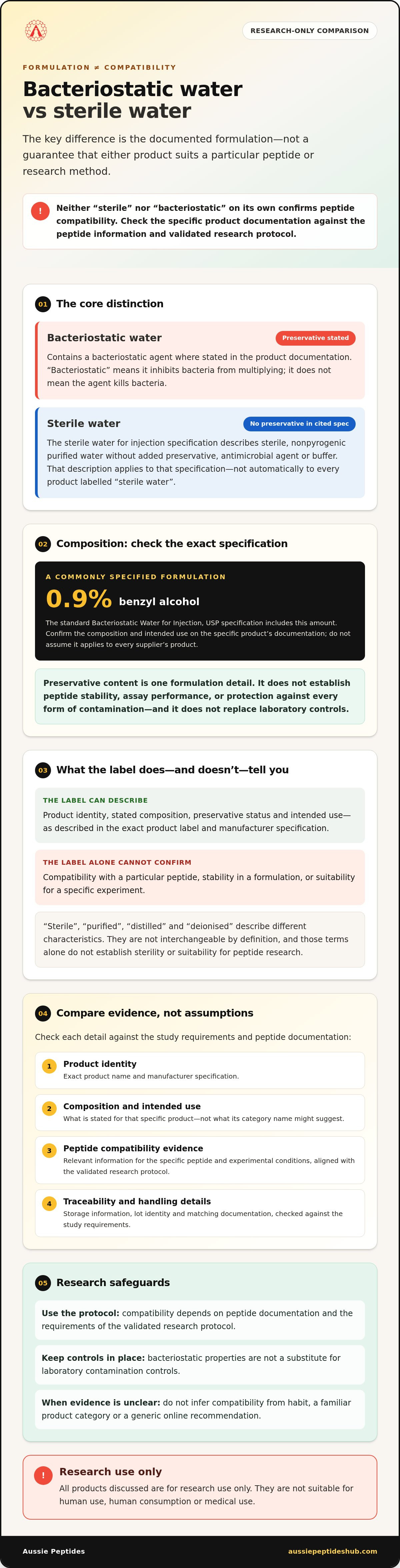
“Sterile” doesn’t tell you whether a water is compatible with a particular peptide or research method. The key distinction in bacteriostatic water vs sterile water for peptides is formulation: bacteriostatic water contains an antimicrobial preservative, while sterile water has none under the relevant product specification. Neither label, on its own, confirms suitability for every research application.
If product names have made sterility and preservation seem interchangeable, the uncertainty is understandable. Compatibility depends on the peptide documentation and the requirements of the validated research protocol, not on habit or a generic label. Both products discussed here are for research use only and are not suitable for human use.
This comparison explains the documented formulation and labelling differences, shows which product details to check, and outlines what to do when compatibility evidence is unclear. It also covers traceability, including lot details and matching documentation, so decisions rely on verifiable information rather than unsupported online claims.
Key Takeaways
- In the bacteriostatic water vs sterile water for peptides comparison, distinguish preservative status from evidence of peptide compatibility.
- Check the study protocol and peptide documentation before selecting a research water. Don’t substitute a generic online recommendation.
- Compare the product label, composition, intended use, storage information and lot identity with the study requirements.
- Treat bacteriostatic properties as one formulation detail, not a replacement for laboratory contamination controls.
- Check research supplies using traceable batch information and matching documentation. All products discussed are for research use only, not human consumption.
Bacteriostatic Water vs Sterile Water for Peptides: What Is Being Compared?
The labels describe different product characteristics, not automatic peptide compatibility. Sterile water is labelled for sterility; bacteriostatic water is labelled as containing an agent that inhibits bacterial growth. Neither label confirms compatibility with a particular peptide or experiment. This comparison is strictly for laboratory research. These products are not for human consumption or medical use.
A product name doesn’t establish its full formulation. Check the exact product label, manufacturer specification and intended-use statement, then compare them with the peptide documentation and research protocol. Don’t infer compatibility from a familiar product category or a general online recommendation.
What does sterile water mean on a product label?
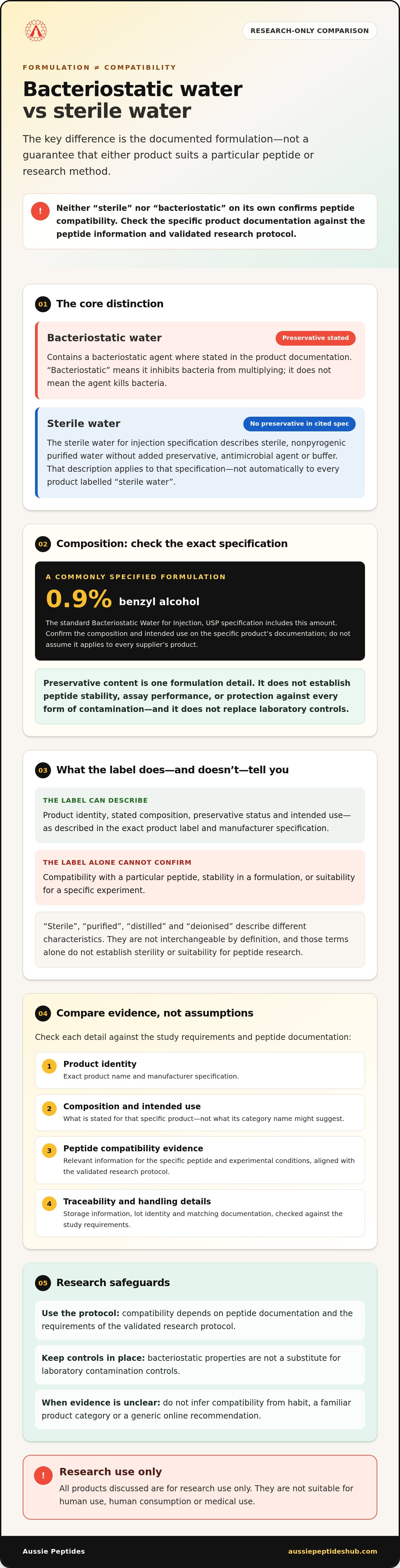
“Sterile” identifies a product characteristic; it doesn’t mean the water suits every experimental method. Formulations may differ, so don’t treat all products bearing the term as identical. For example, the specified composition of sterile water for injection is sterile, nonpyrogenic purified water without added preservatives, antimicrobial agents or buffers. That description applies to that product specification, not automatically to every product labelled sterile water.
Read the manufacturer’s documentation for the exact product name, composition and intended use. Sterile water is not interchangeable by definition with purified, distilled or deionised water. Those terms describe different characteristics and don’t establish sterility or suitability for peptide research.
What makes bacteriostatic water different?
Bacteriostatic water is a product labelled with bacteriostatic properties. A bacteriostatic agent inhibits bacteria from multiplying; it doesn’t mean the agent kills bacteria. The term describes the action of the preservative, not proof that a peptide will remain stable in that formulation. See the explanation of a bacteriostatic agent for the underlying principle.
The commonly specified bacteriostatic water formulation contains 0.9% benzyl alcohol, but confirm the composition and intended use on the specific product’s documentation before relying on that figure. Don’t assume it applies to every supplier’s product. The presence of a preservative does not establish peptide compatibility, prevent every form of contamination or replace laboratory controls. Compatibility must be supported by relevant peptide information and a validated research protocol.
In practice, the question isn’t “which label sounds safer?” It’s whether the documented formulation matches the study’s requirements. Check product identity, composition and intended use separately, then assess compatibility using evidence for the specific peptide and experimental conditions.
How Preservative Content and Peptide Compatibility Change the Comparison
Composition changes the comparison, but it doesn’t establish which water will work with a peptide. A microbial-control claim concerns bacterial growth. It isn’t evidence of chemical stability or assay performance. To assess bacteriostatic water vs sterile water for peptides, check both the water’s documented formulation and compatibility evidence for the specific research sample.
Sterility describes a product’s specified microbial status; bacteriostatic preservation describes an agent’s ability to inhibit bacterial multiplication. These are distinct characteristics, and neither establishes peptide stability. The United States Pharmacopeia (USP) sets specifications for Bacteriostatic Water for Injection, USP. The Therapeutic Goods Administration’s sterility-testing guidance aligns with the British, European and US Pharmacopoeias. These references concern product standards and testing, not compatibility with every research peptide.
Can a preservative affect a peptide research sample?
That depends on the specific peptide and research method. Don’t assume a preservative is harmless, harmful or universally compatible. Compare the water’s documented composition with manufacturer information for the peptide and the validated protocol. If compatibility evidence is absent or unclear, don’t treat a generic product description as a substitute for study-specific verification.
Why do peptide specifications matter more than a generic rule?
Peptide molecules differ, and formulation and experimental conditions can affect stability and measured results. A general statement about a water type cannot establish how a particular sample will behave or whether an assay endpoint will be affected. Look for evidence that relates to the relevant peptide, formulation and method. Don’t apply shelf-life or storage-duration claims from one product or study to another without supporting documentation.
For a research-only supply, review the current label and batch documentation before assessing fit. Aussie Peptides’ bacteriostatic water information can help identify product details, but the study protocol and peptide-specific evidence remain decisive.
Which Research Water Fits the Study? Compare Evidence, Not Assumptions
There’s no universal winner in the bacteriostatic water vs sterile water for peptides comparison. The study protocol, the water’s documented composition and peptide-specific compatibility evidence should determine the selection. A generic online recommendation cannot override materials specified by a validated protocol.
What should researchers check before selecting a product?
Review the complete ingredient or composition statement, product specification and intended-use information. Compare those records with the study protocol and the peptide manufacturer’s documentation. Make sure the evidence refers to the actual product under consideration, not merely to a similarly named water type.
For traceable records, log the product name and lot identifier, then retain applicable batch documents. A Certificate of Analysis or other batch record can support product identification, but it doesn’t by itself prove compatibility with a particular peptide or assay.
When is there not enough evidence to decide?
There isn’t enough evidence when compatibility data are missing, ambiguous or specific to a different peptide, formulation or method. Don’t infer suitability from the words “sterile” or “bacteriostatic”, and don’t assume either option is automatically better for all peptides.
Pause the selection and refer the question to the laboratory supervisor or qualified research lead. Don’t improvise a substitution or workaround. The appropriate decision is the one supported by the protocol and relevant documentation. This framework concerns laboratory research only; products discussed here are not for human consumption or medical use.
Research-Only Handling: Documentation, Contamination Controls and Common Errors
Good selection depends on a traceable record, not just a product name. In the bacteriostatic water vs sterile water for peptides comparison, a bacteriostatic label doesn’t eliminate contamination risk or excuse inadequate laboratory controls. It also doesn’t establish compatibility with a particular peptide or assay.
Product labels and validated protocols govern research selection. Treat this as a documentation check, not a substitute for your laboratory’s approved procedures. The checklist below concerns research supplies only. These products are not for human or veterinary administration.
Which documents should accompany a research supply?
Before accepting a supply for a study, check that its identity and documentation can be matched to the intended research use. Review:
- Product identity: Confirm the full product name and that the container label matches the accompanying records.
- Composition: Check the stated ingredients or formulation. Don’t infer a preservative, concentration or other specification from a general product category.
- Intended use and handling statements: Read the manufacturer’s information and compare it with the laboratory’s requirements.
- Lot identity: Record the lot number and retain relevant product and batch documentation with the research records.
- Protocol alignment: Confirm that the documented product matches the material specified in the study protocol and peptide documentation.
Unsupported seller claims remain unverified until they can be matched to relevant documentation. A batch record can help establish product identity and traceability, but it doesn’t by itself demonstrate compatibility with a specific peptide or method.
What common assumptions should researchers avoid?
“Sterile” doesn’t mean compatible with every peptide or assay. “Bacteriostatic” doesn’t mean a product is contamination-proof, including after opening. The preservative claim concerns inhibition of bacterial multiplication; it doesn’t replace the laboratory’s contamination controls. Follow the applicable product handling statements and approved laboratory procedures.
Online advice may omit the product specification, peptide identity or study context. Don’t use it to justify a substitution or override validated protocol requirements. If the label, lot records or compatibility evidence are incomplete, pause and refer the question to the responsible laboratory lead.
For research-only supplies, review the current product information before assessing fit. Review bacteriostatic water research-supply information and verify its details against your protocol. No product should be treated as suitable for human or veterinary use.
Assessing Bacteriostatic Water for Peptide Research Supplies in Australia
Supplier information is one input, not the selection rule. For the bacteriostatic water vs sterile water for peptides decision, the study protocol and peptide-specific compatibility evidence remain primary. Aussie Peptides lists bacteriostatic water among its research supplies, but that doesn’t make it a universal solvent or establish compatibility with every peptide or experimental method.
Aussie Peptides states that its peptide batches undergo independent HPLC testing and are supplied with matching Certificates of Analysis (COAs). These documents relate to the relevant peptide batch. They should not be treated as test results or certification for a separate water product unless the documentation explicitly identifies that product and its lot.
How can readers assess traceability claims?
Start with the identifier on the product. Check that the water’s lot number matches the available batch information and retain the applicable records. Aussie Peptides provides lot-number lookup for batch-detail verification. Use it to confirm the details associated with the identified product rather than assuming one document applies to all supplies.
A peptide COA doesn’t automatically document a separate water product. Likewise, a supplier’s stated process and independent evidence about a particular water batch are distinct claims. Check what each record covers, which lot it applies to and whether it provides the information required by the study. For more context on peptide records and sourcing checks, see the BPC-157 Australia research sourcing and verification guide.
What is the responsible next step before a research purchase?
Confirm which material the study specifies, then verify that the product’s current composition, intended use and documentation align with the protocol and peptide information. If a detail is missing or compatibility remains uncertain, pause and ask the responsible laboratory lead. You can also ask the supplier to clarify unanswered product specifications, then assess the response against the product documentation.
Use traceability to verify what you’re considering, not to infer suitability. Aussie Peptides’ products, including bacteriostatic water and peptides, are supplied for laboratory research only and are not for human consumption or medical use. Review the current product information and batch details before deciding whether a supply meets your research requirements.
Make the Selection Evidence-Led
The distinction in bacteriostatic water vs sterile water for peptides is about documented formulation and preservative status, not automatic peptide compatibility. Neither label makes a product the right choice for every study. Prioritise the study protocol, verify the specific water’s current composition and intended use, and look for compatibility evidence that applies to the peptide and research method.
Traceability supports informed review. Aussie Peptides states that its peptide batches undergo independent HPLC testing and are supplied with matching Certificates of Analysis. Lot-number lookup can support checks against available batch details. These peptide records don’t certify a separate water product, so assess water documentation independently. All products are for laboratory research only, not human consumption or medical use.
Before making a research selection, confirm the protocol requirements and resolve any gaps with the responsible laboratory lead. For a closer review of available research supplies and product records, review Aussie Peptides research supplies and product documentation. A careful, documented decision gives your research a more defensible starting point.
Frequently Asked Questions
Is bacteriostatic water the same as sterile water?
No. The terms describe different product characteristics. Bacteriostatic water is labelled as containing an agent that inhibits bacterial multiplication. Sterile water describes a product’s specified sterility, and its formulation depends on the exact product. For example, sterile water for injection is specified without added preservatives, antimicrobial agents or buffers. Check the manufacturer’s label and documentation rather than assuming the terms are interchangeable or confirm peptide compatibility.
Can bacteriostatic water be used with every research peptide?
No. Bacteriostatic water isn’t automatically compatible with every peptide, formulation or experimental method. Compatibility needs support from information relevant to the specific peptide and study protocol. Check the peptide documentation and the water product’s stated composition and intended use. If the evidence is missing or unclear, pause and consult the responsible laboratory lead rather than relying on a general online recommendation.
Does sterile water contain a preservative?
Not necessarily; check the exact product specification. Sterile water for injection is specified as having no added preservatives, antimicrobial agents or buffers. However, “sterile water” alone may not provide enough information to establish a product’s full formulation or intended use. Review the manufacturer’s documentation for the specific supply. Don’t infer its composition from the word “sterile” or confuse it with distilled or deionised water.
Does bacteriostatic water keep a peptide solution sterile?
No. A bacteriostatic preservative inhibits bacterial multiplication; it doesn’t establish that a peptide solution remains sterile or contamination-proof. Product labelling doesn’t replace laboratory contamination controls, and preservative presence doesn’t prove peptide stability or assay compatibility. Follow the validated research protocol and product handling statements. Don’t treat a bacteriostatic label as evidence that contamination cannot occur, particularly where the product or sample has been handled.
How do I choose peptide reconstitution water for a research study?
Start with the study protocol, then compare its specified material with the water’s documented composition and intended use. Check whether compatibility evidence applies to the specific peptide, formulation and research method. The question of bacteriostatic water vs sterile water for peptides has no universal answer based on product name alone. If evidence is absent, ambiguous or relates to another formulation, pause and ask the laboratory supervisor or qualified research lead.
Can a peptide Certificate of Analysis verify bacteriostatic water?
Not unless it explicitly identifies and documents that water product and its lot. A Certificate of Analysis for a peptide applies to the peptide batch it names; it doesn’t automatically verify a separate research supply. Check the water’s own product documentation and lot identifier. Aussie Peptides states that its peptide batches undergo independent HPLC testing and have matching Certificates of Analysis, with lot-number lookup supporting peptide batch-detail checks.
Are research-grade peptides and bacteriostatic water for human use?
No. Aussie Peptides supplies its peptides and bacteriostatic water for laboratory research only, not for human consumption or medical use. Research-grade labelling and peptide testing don’t make a product suitable for human or veterinary administration. Keep selection decisions within the scope of the research protocol, and don’t use research supplies as a substitute for products or advice intended for medical care.