
Certificates of
Analysis.
Every lot we release is tested by HPLC and confirmed by mass spectrometry before it reaches the freezer. Your vial carries a lot number — quote it and we'll send you the exact report for the material in your hand, not a generic sample document.
HPLC main-peak purity. Lots that don't meet it don't get sold — they get rejected.
Enter the lot number from your vial.
It's printed on the label under the compound name (for example 24·11-BPC). We reply with the signed PDF for that specific batch, usually within one business day.
How every batch is tested
1 · Synthesis & intake
Each lot arrives sealed and is quarantined until its identity paperwork is matched against the order.
2 · HPLC purity
High-performance liquid chromatography measures purity as an area-percentage of the main peak. We release at ≥99%.
3 · Mass spectrometry
Molecular weight is confirmed against the expected sequence mass so you know the vial holds what the label says.
4 · Cold-chain release
Released lots are stored at −20°C and dispatched with insulated packing and a lot number on every vial.
What's on a COA.
- Compound & sequence
- The full amino-acid sequence, so you can confirm identity independently.
- Lot / batch number
- Matches the number printed on your vial label — the key to requesting the right report.
- Purity (HPLC, area %)
- The main-peak percentage. Anything we release sits at 99% or above.
- Mass spec result
- Observed molecular weight vs. theoretical. These should agree within instrument tolerance.
- Appearance & solubility
- Lyophilised powder description and reconstitution notes for bacteriostatic water.
- Test date & lab
- When the analysis ran and which laboratory performed it.
How to read your batch CoA.
Walk through a real report layout, marker by marker. Download the example PDF and follow along — the document below is an illustrative sample, not a released batch.
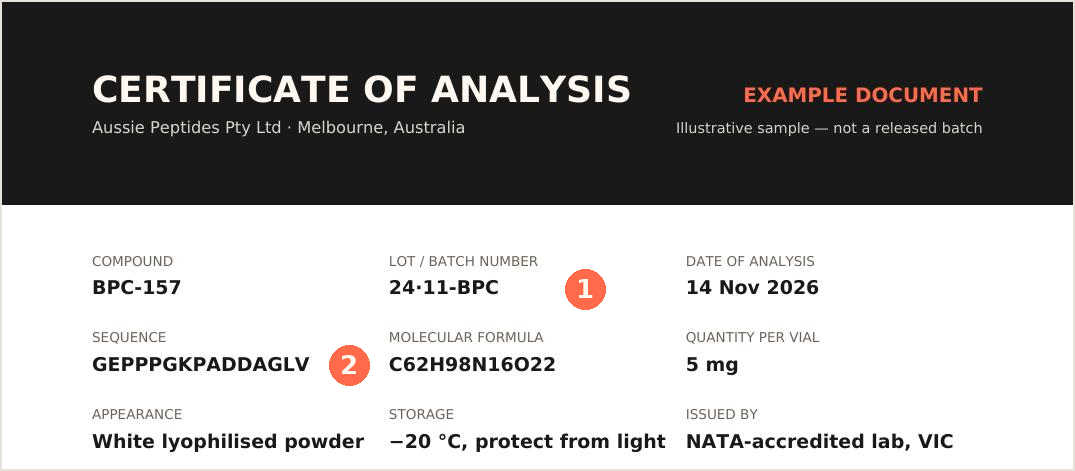
Step 1 — Match the header to your vial
- 1
Lot / batch number. This must be identical to the number printed on your vial label. If it differs, the report belongs to another batch and tells you nothing about the material you're holding.
- 2
Compound, sequence and date. The full amino-acid sequence lets you verify identity independently, and the analysis date should sit close to the manufacture date rather than years earlier.
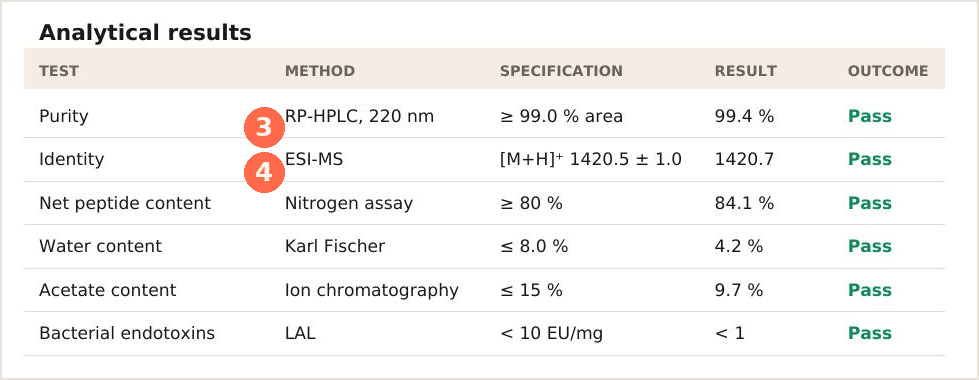
Step 2 — Read the results table
- 3
Purity by RP-HPLC. Reported as main-peak area percentage. Compare the result against the specification column — we release only at ≥99.0%.
- 4
Identity by mass spec. The observed mass should match the theoretical [M+H]⁺ within instrument tolerance. Purity without an identity test only proves the vial is consistently something.
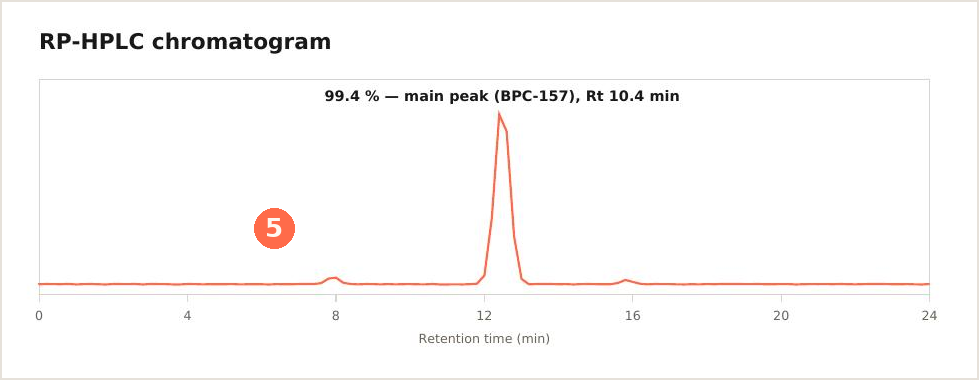
Step 3 — Sanity-check the chromatogram
- 5
One tall, sharp peak. A clean trace shows a single dominant, symmetrical peak with a flat baseline. Broad shoulders, a split tip, or several peaks of similar height mean impurities the summary number may be hiding.
Red flags to check for
- No lot number, or a lot number that doesn't match your vial label.
- No test date, no laboratory name, and no signature or report ID.
- A purity figure with no chromatogram image to back it up.
- HPLC only, with no mass-spec identity confirmation.
- The same PDF supplied for every order — a CoA is batch-specific by definition.
- Numbers that don't tie together, such as a 99.9% claim beside a visibly noisy trace.
A Certificate of Analysis confirms chemical purity — it is not a safety or therapeutic approval.
All products are supplied for in-vitro laboratory research only. They are not medicines, are not TGA-approved, and are not for human or veterinary use.