Retatrutide Australia: 2026 Research Supply Buying Guide
October 1, 2026 · 15 min read
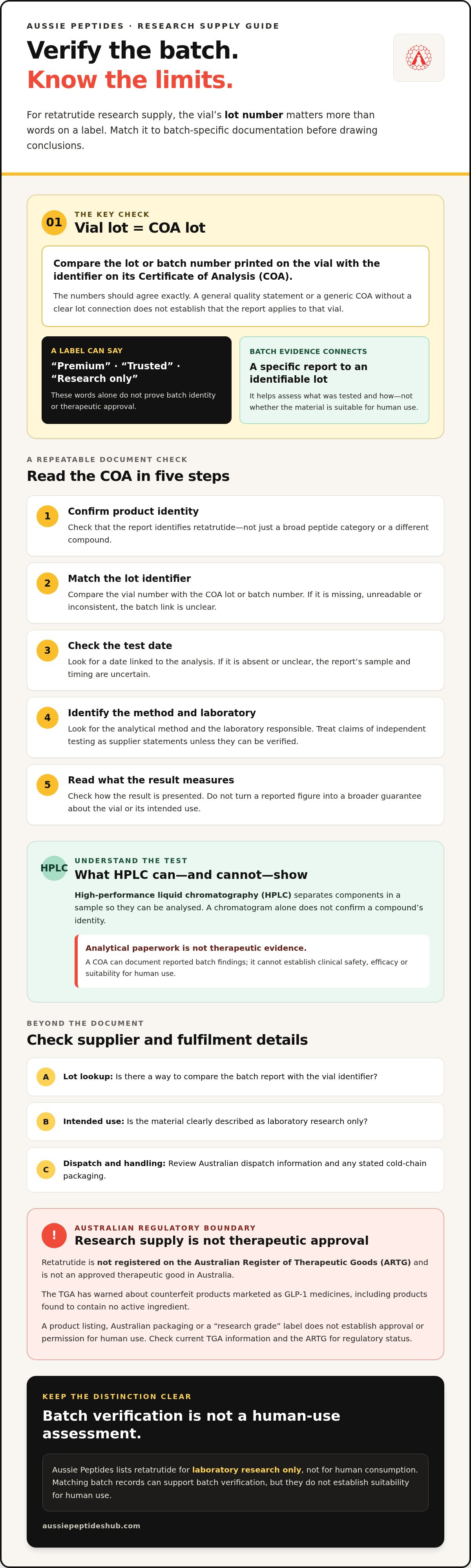
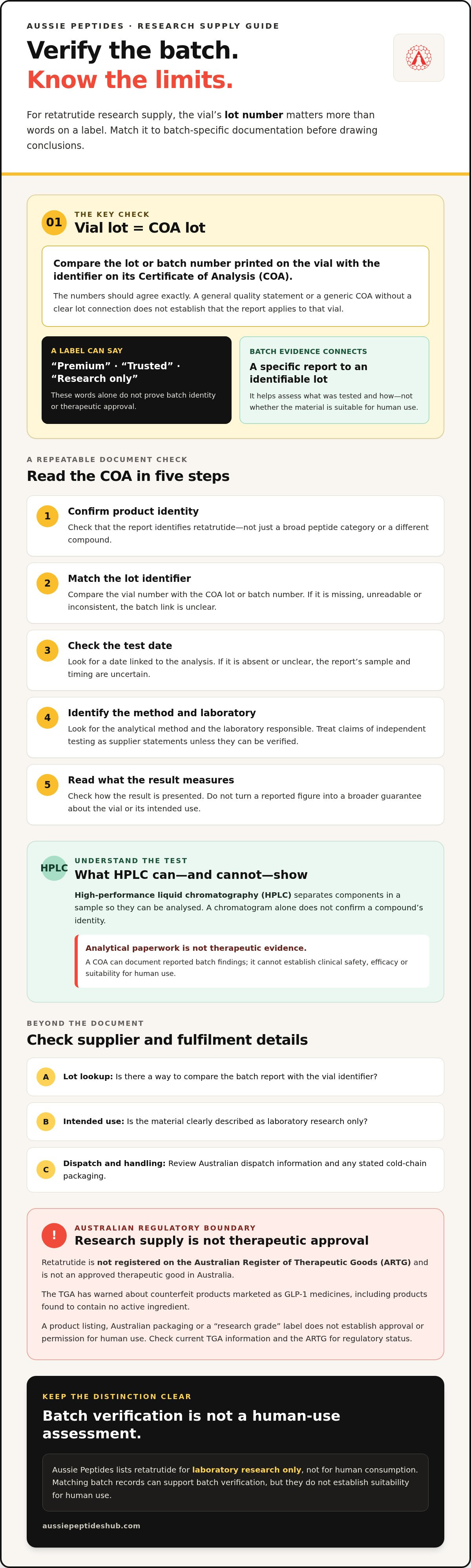
What matters most when assessing a retatrutide vial may not be its label, but whether its lot number matches the batch documentation. For anyone comparing retatrutide australia options, that distinction matters. A product listing or “research only” statement isn’t proof of batch identity, and it doesn’t establish therapeutic approval.
It’s reasonable to want clear information about Australian regulatory status and how to check a Certificate of Analysis (COA). As of October 2026, retatrutide isn’t registered on the Australian Register of Therapeutic Goods (ARTG), and research supply isn’t an approved medicine or a pathway for human use. The TGA has also warned about counterfeit products marketed as GLP-1 medicines, including products found to contain no active ingredient.
This guide offers a repeatable way to assess research-supply claims: match the vial’s lot number to its COA, review the stated testing method and results, and check the handling and Australian dispatch information. These records can support batch verification, but they don’t demonstrate suitability for human use. Retatrutide discussed here is for laboratory research only, not for human consumption.
Key Takeaways
- For retatrutide australia research supply, compare verifiable records rather than relying on labels such as “premium” or “trusted”.
- Check the COA for product identity, a matching vial lot number, the test date, analytical method and reported result.
- HPLC can separate components for analysis, but a chromatogram alone doesn’t confirm a compound’s identity.
- Assess supplier information on lot lookup, intended use and fulfilment, including any stated cold-chain packaging.
- Aussie Peptides lists retatrutide for laboratory research only, not human consumption. Batch testing doesn’t establish suitability for human use.
Retatrutide in Australia: Research Supply Is Not Therapeutic Approval
Retatrutide is an investigational peptide studied for activity at the GLP-1, GIP and glucagon receptors. It is being developed as a potential medicine, but an online catalogue entry doesn’t change its regulatory status. The overview of Retatrutide (LY-3437943) provides background on its triple-agonist mechanism and clinical development. It should not be treated as an Australian regulatory source.
Citation-ready definition: Research-grade retatrutide is a supplier-listed material intended for laboratory research. Its listing, label or analytical paperwork does not make it an approved therapeutic product, a treatment recommendation or evidence of suitability for human use.
What does a retatrutide research listing actually mean?
A catalogue entry tells you that a supplier offers a product for a stated research purpose. It doesn’t establish that the product is approved as a medicine or should be used to treat a health condition. Keep the distinction clear: laboratory research is not clinical care.
A Certificate of Analysis (COA) can document reported findings for a batch, but it cannot establish clinical safety, efficacy or suitability for human use. A matching lot number and stated analytical method are quality-control evidence, not therapeutic approval. Retatrutide sold by Aussie Peptides is described as for laboratory research only, not for human consumption.
What should Australian readers verify about regulatory status?
As of October 2026, retatrutide is not registered on the Australian Register of Therapeutic Goods (ARTG) and is not an approved therapeutic good in Australia. The TGA has issued warnings about unapproved peptide products, including a March 2026 warning about counterfeit weight-loss products. Check current TGA information and the ARTG before publication or making a decision, as status and official guidance can change.
Domestic availability, Australian packaging and a supplier’s use of terms such as “research grade” don’t establish therapeutic approval or settle every legal question about a particular transaction. Don’t infer permission for human use from a product listing. For regulatory questions, consult the TGA or another relevant Australian authority. For medical concerns, speak with a registered clinician. Product documentation cannot replace those sources.
How to Verify Retatrutide Batch Evidence and a Certificate of Analysis
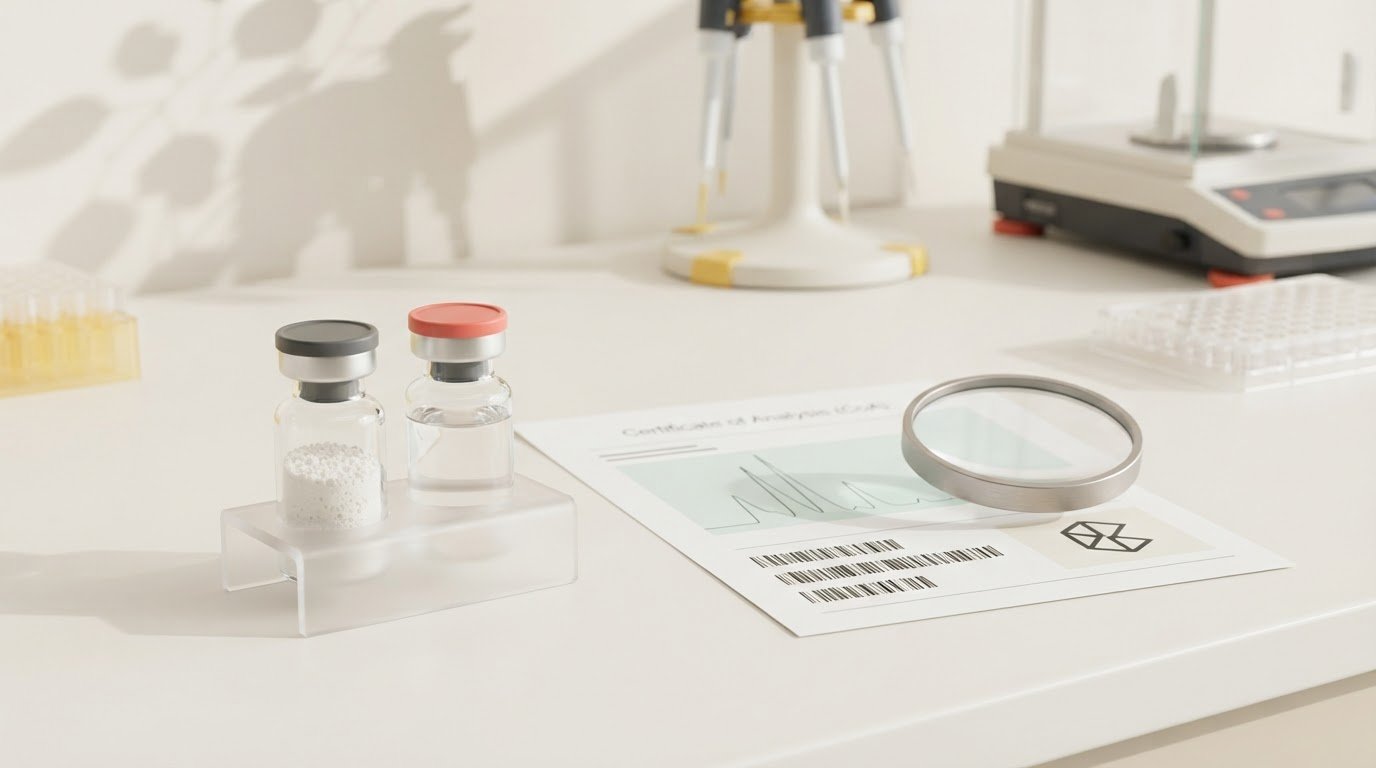
A Certificate of Analysis (COA) is useful only if it can be linked to the specific batch being assessed. A general quality statement is a supplier claim; a laboratory report adds analytical information. Batch-specific evidence connects that report to an identifiable product lot and provides details to assess what was tested and how.
Use this document check for retatrutide australia research supply:
- 1. Confirm product identity. Check that the report identifies retatrutide, not just a broad peptide category or a different compound.
- 2. Match the lot identifier. Compare the COA’s lot or batch number with the identifier printed on the vial. The numbers should agree exactly.
- 3. Check the test date. Look for a date linked to the analysis. If it’s absent or unclear, ask what sample the report covers and when it was tested.
- 4. Identify the method and laboratory. The report should state the analytical method and identify the laboratory responsible for the results. Note whether testing is described as independent, and distinguish that supplier statement from evidence you can verify.
- 5. Read the reported result. Check what was measured and how the result is presented. Don’t turn a reported figure into a broader guarantee about the vial or its intended use.
Does the COA match the vial and lot number?
The lot number links the physical vial to its batch record. A supplier may provide an online lookup or another way to check batch details. Use it to compare the displayed report with the vial identifier. If the number is missing, unreadable or inconsistent, pause and ask the supplier to clarify before proceeding. A generic COA without a clear lot connection doesn’t establish that it applies to the vial.
What can HPLC and other analytical results establish?
High-performance liquid chromatography (HPLC) separates components in a sample so they can be analysed. A report may state an HPLC result, but a chromatogram alone doesn’t confirm complete molecular identity. Review the method, sample identification, laboratory details and test date together. If the report names other methods, check what each is stated to measure rather than assuming a list of techniques proves every quality attribute.
A purity figure is limited to the reported test and sample. It doesn’t establish sterility, clinical suitability or safety for human use. Aussie Peptides states that its products receive independent HPLC testing and matching COAs, with batch details checkable using the vial’s lot number. Review the retatrutide batch documentation and check whether the current records provide the details above. Testing documentation supports research quality assessment, not therapeutic approval.
Compare Retatrutide Australia Suppliers With a Consistent Checklist
For retatrutide australia research supply, apply the same checks to every listing. Compare records you can inspect, not conclusions implied by words such as “premium”, “pure” or “trusted”. If a detail isn’t available, mark it as unknown. Don’t assume it meets a standard because a supplier makes a general quality claim.
Use this framework to compare the documentation and fulfilment information each supplier presents:
| Criterion | What to check | How to record it |
|---|---|---|
| Batch-matched COA | Is a retatrutide-specific report accessible, and does its lot identifier match the vial information? | Matched, mismatch, or unknown |
| Stated method | Does the report name the analytical method and identify what result it reports? | Method and result stated, incomplete, or unknown |
| Lot lookup | Can the batch record be checked using the lot number, or is the document supplied without a lookup process? | Lookup available, report only, or unknown |
| Intended-use notice | Does the listing clearly limit the product to laboratory research and exclude human use? | Clear, unclear, or absent |
| Fulfilment details | Are dispatch location, delivery scope and packaging description stated? | Details stated, partial, or unknown |
Which supplier details are verifiable before ordering?
Check whether product-specific documents are available before checkout rather than relying on a site-wide testing statement. Read the product description and intended-use notice together. If either is vague or inconsistent, ask for clarification. Supplier support may be able to explain where a batch record is found or what a document refers to. Support responses aren’t clinical advice and don’t establish therapeutic suitability.
Separate evidence from description. A visible report, lot identifier and named method are details you can inspect. Terms such as “premium”, “pure” and “trusted” are subjective unless tied to defined, accessible evidence. Ask each provider the same questions and mark unanswered items as unknown rather than treating them as compliant.
How should fulfilment and traceability affect the comparison?
Check whether the supplier states where orders are dispatched from, which parts of Australia are covered and how temperature-sensitive shipments are packaged. If cold-chain packaging is claimed, look for a clear description of the process and ask how dispatch is documented. Verify operational details rather than inferring them from a logo or general shipping statement.
These details help you assess traceability and logistics. They don’t prove the contents meet a particular quality threshold, and they don’t establish therapeutic approval or suitability for human use. Keep fulfilment evidence separate from analytical evidence in your comparison.
Australian Research Supply: Check Documentation, Handling and Boundaries
A useful pre-order review separates the stated research purpose, batch records and delivery process. For retatrutide australia listings, use the checklist below to identify what is documented and what still needs confirmation. This is an administrative check for laboratory research supply, not guidance for personal or veterinary use.
- Intended use: Confirm the listing explicitly states laboratory research only and not for human consumption. Treat unclear or contradictory wording as unresolved.
- Batch documents: Locate the product-specific Certificate of Analysis and check that it identifies the compound and relevant batch.
- Lot traceability: Find out how the vial’s lot number connects to the associated record. Check that the identifier is legible and consistent.
- Delivery information: Review the stated dispatch location, Australian delivery scope, packaging description and any temperature-control claims.
- Clarification: Ask the supplier to explain missing or ambiguous details in writing. Keep the response with the product and batch records.
What should buyers check before Australian dispatch?
Read the intended-use notice and fulfilment information before ordering. If a supplier states that it uses cold-chain packaging, treat this as a logistics claim. Check what the packaging description covers and whether the supplier explains how dispatch is handled. Cold-chain wording alone doesn’t verify a temperature history, guarantee stability or demonstrate product quality.
Aussie Peptides states that its retatrutide is for laboratory research only, is packaged in Australia and is shipped nationally in cold-chain packaging. Check the current product documentation and dispatch information against the questions relevant to your assessment. Keep delivery records separate from analytical records: one describes fulfilment, the other reports testing.
For additional scientific context, read retatrutide research peptide synthesis, purity and evidence. It can help frame questions about research materials, but it doesn’t replace batch-specific documentation or official Australian guidance.
What should readers do if claims or documents do not match?
Pause if the product listing, vial identifier and COA conflict. Request clarification about the exact batch and its testing record. A verbal assurance doesn’t resolve a discrepancy unless the supporting documentation can be checked. If the supplier can’t explain the mismatch or provide the relevant records, mark the information as unverified rather than assuming it is correct.
Research products are not for personal or veterinary use. Don’t attempt to prepare, reconstitute, dose, inject or self-experiment with them. To review the supplier’s stated product boundaries and records, see the retatrutide research supply information.
Aussie Peptides Retatrutide: Assess the Evidence Before You Decide
Before comparing any retatrutide australia listing, check four things: the stated research-only boundary, a retatrutide-specific Certificate of Analysis (COA), a lot number that connects the vial to its batch record, and clear fulfilment information. Assess each separately. A testing claim doesn’t verify dispatch procedures, and delivery details don’t establish analytical results.
Aussie Peptides lists retatrutide for laboratory research only, not for human consumption. The business states that its products undergo independent HPLC testing and are supplied with matching COAs. Assess these supplier-stated processes against the current listing and documents. Analytical records support batch review; they don’t establish clinical safety, efficacy or suitability for human use.
What documentation and fulfilment does Aussie Peptides state it provides?
The business states that the lot number printed on the vial can be used to check batch details online. Use that identifier to confirm the COA applies to the relevant lot. Before relying on the report, review the current document for its product identity, lot number, testing date, named method and reported results. Check the specific fields and results on the current retatrutide COA rather than assuming them from a general testing statement.
Aussie Peptides also states that its peptides are packaged in Australia and shipped nationally using cold-chain packaging. This describes a fulfilment process. It isn’t, by itself, evidence of a shipment’s temperature history or a guarantee of product stability or quality.
What is the appropriate next step for a research purchaser?
Review the current product listing, intended-use statement and batch-specific records together. Check that identifiers are consistent, and seek clarification if a document or fulfilment claim is incomplete. If the report doesn’t clearly correspond to the batch, treat that point as unresolved. Don’t interpret research supply as a route to medical treatment or personal use.
Retatrutide listed by Aussie Peptides is for laboratory research only, not human consumption. For research purchasers, inspect the available listing and evidence, then assess whether the information is sufficient for the stated laboratory purpose. Review Aussie Peptides' research catalogue.
Make Your Retatrutide Supply Decision Evidence-Led
For retatrutide australia research supply, use verifiable batch records and clear research-only boundaries as your decision criteria, not catalogue language alone. Match the vial’s lot number to its Certificate of Analysis, then review the stated testing method and results. These checks help assess the documentation. They don’t establish therapeutic approval or suitability for human use.
Aussie Peptides states that its products receive independent HPLC testing with matching COAs, and that vial lot numbers can be used to check batch details online. The business also states that products are packaged in Australia and shipped nationally using cold-chain packaging. Treat these as supplier-stated processes, and review current product-specific records and fulfilment information before deciding.
Retatrutide is listed for laboratory research only, not for human consumption. A research listing isn’t a route to medical treatment or personal use. Keep the intended-use boundary clear as you assess the available evidence.
To inspect the current listing and research information, review Aussie Peptides' research catalogue. Apply the same document checks to each batch, and base your decision on records you can verify.
Frequently Asked Questions
Is retatrutide approved for medical use in Australia?
No. As of October 2026, retatrutide is not registered on the Australian Register of Therapeutic Goods (ARTG) and is not an approved therapeutic good in Australia. A research listing, laboratory report or supplier disclaimer doesn’t change that status. Check current Therapeutic Goods Administration (TGA) information before publication or making decisions, as official guidance may change. For personal medical questions, speak with a registered clinician.
Can I buy retatrutide in Australia?
Some Australian-facing suppliers list retatrutide as a research product, but availability doesn’t establish therapeutic approval or permission for human use. Aussie Peptides describes its retatrutide as for laboratory research only, not for human consumption. If assessing retatrutide australia supply, check the current product description, intended-use statement and batch records. Don’t treat a research listing as a route to medical treatment or personal use.
How can I verify a retatrutide Certificate of Analysis?
Start by checking that the COA names retatrutide and that its lot number matches the identifier on the vial. Then review the report date, named laboratory, analytical method and stated result. Check whether the supplier offers a batch lookup and whether the report is accessible for the specific product. If identifiers are missing, unreadable or inconsistent, ask for clarification and don’t assume the document applies to that vial.
What does HPLC testing show for a retatrutide research peptide?
High-performance liquid chromatography (HPLC) separates components in a sample for analysis. A report may present a chromatogram or a result associated with the stated method, but the chromatogram alone doesn’t provide complete confirmation of molecular identity. Read what the report says was tested, which sample and batch it covers, and when the analysis occurred. Don’t interpret a reported purity result as proof of every quality attribute.
Does a research-grade retatrutide product mean it is safe for people?
No. “Research-grade” describes a supplier’s intended laboratory context, not a finding of safety for human use. A COA or HPLC result can document particular analytical findings, but it doesn’t establish clinical safety, efficacy, sterility or suitability for people. Retatrutide products discussed here are for laboratory research only, not for human consumption. Don’t use research products for personal or veterinary purposes; consult a registered clinician about health concerns.
How should I compare retatrutide suppliers in Australia?
Apply the same evidence checks to each supplier: look for a product-specific, batch-matched COA, a stated analytical method, an identifiable lot lookup and an explicit laboratory-research-only notice. Review dispatch and packaging information separately. Record details that are unavailable as unknown rather than assuming they meet a standard. Subjective terms such as “premium” or “trusted” aren’t substitutes for accessible batch records and clearly described processes.
Does Australian shipping confirm a retatrutide product's quality?
No. An Australian dispatch location or cold-chain packaging statement describes fulfilment, not the product’s analytical quality or therapeutic suitability. Check what the supplier says about packaging and delivery, and keep that information separate from the batch-specific COA and testing method. Aussie Peptides states that it packages products in Australia and ships nationally using cold-chain packaging. Those logistics claims don’t establish stability or suitability for human use.