How to Test Peptide Purity at Home: What You Can Actually Verify
September 29, 2026 · 15 min read
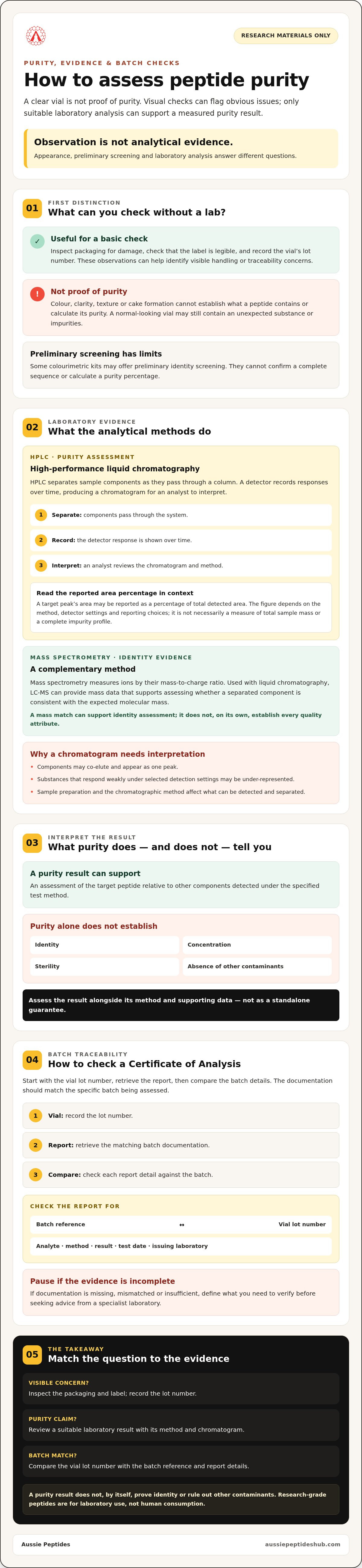
A clear vial is not proof of purity. Colour, clarity and appearance can flag an obvious issue, but they cannot establish what a peptide contains or measure its purity. If you’re searching for how to test peptide purity at home, the key distinction is between a basic observation and analytical evidence.
At-home checks have strict limits. Some colourimetric kits may offer preliminary identity screening, but they cannot confirm a complete sequence or calculate a purity percentage. Reliable purity analysis requires laboratory methods such as high-performance liquid chromatography (HPLC). Mass spectrometry can help assess identity, but neither result alone establishes every quality attribute.
This article explains what you can check without laboratory equipment, how to assess whether a Certificate of Analysis matches a vial’s batch, and when specialist testing may be needed. It also explains why a purity result does not, by itself, prove identity or rule out other contaminants. Aussie Peptides supplies research-grade peptides for laboratory use, not human consumption, with matching batch documentation that readers can assess for traceability.
Key Takeaways
- When considering how to test peptide purity, distinguish visual checks or preliminary screening from a measured laboratory result.
- Read an HPLC purity figure alongside its chromatogram and method. Area percentage depends on how the analysis was performed and reported.
- Check what the result covers. Purity alone does not establish identity, concentration, sterility or the absence of other contaminants.
- Record the vial lot number, retrieve its report, then compare the batch reference, analyte, method, result, test date and issuing laboratory.
- If documentation is missing, mismatched or insufficient, define what you need to verify before seeking advice from a specialist laboratory.
Can you test peptide purity at home? Separate observation from proof
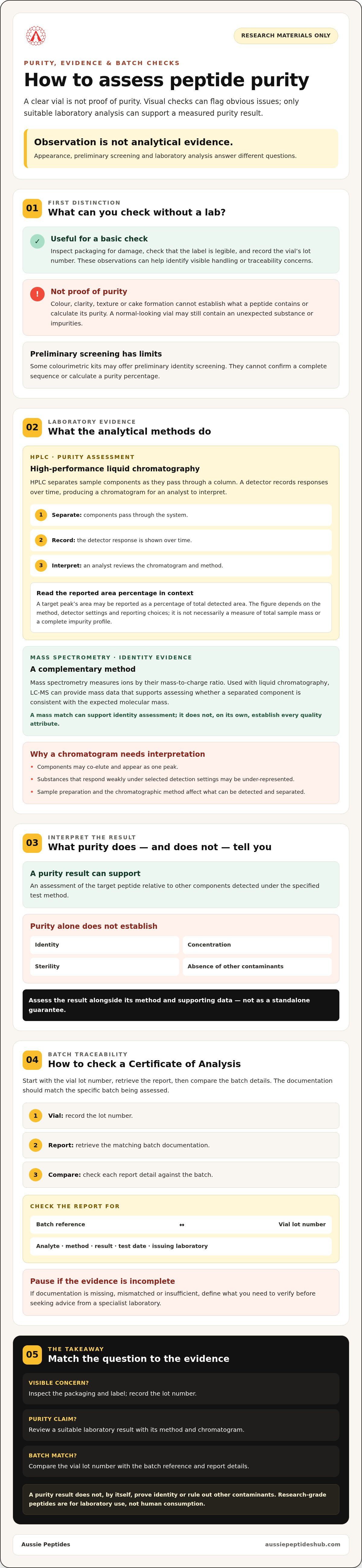
No household check can establish a reliable peptide purity percentage. Purity is an analytical result: it describes the proportion of the target peptide relative to other detected components under a specified test method. A supplier description or a vial that looks normal is not a measurement. Reliable claims require suitable laboratory methods, controlled conditions and qualified interpretation.
That distinction matters when considering how to test peptide purity. At home, you can inspect packaging and labels, then check whether the batch information is traceable. Those observations cannot determine chemical composition or calculate purity. Laboratory techniques such as High-performance liquid chromatography (HPLC) separate sample components for analytical assessment. The resulting data must be interpreted in the context of the method used.
This guidance concerns research materials only. Research-grade peptides are not for human consumption. Vial inspection is not a way to assess suitability for personal use or for self-testing.
What can a visual inspection tell you about a peptide vial?
Inspection can help identify visible handling or traceability concerns. Check whether the packaging is damaged, the label is legible and the vial’s lot number is present and readable. Record any discrepancy. These checks help you assess the item and locate its batch documentation, but they do not verify what is inside.
Colour, texture and cake formation are not assay results. Appearance can vary, and a vial that looks clear or intact may still contain an unexpected substance or impurities. An unusual appearance is a reason to pause and seek clarification, not proof of a particular chemical result. Do not infer identity or purity from appearance alone.
Why home purity tests have strict limits
A reliable purity result depends on more than observing a reaction or comparing a sample with a reference image. The laboratory needs an appropriate analytical method, controls and reviewable data. The report should make clear what was tested and how the result was calculated. Informal checks lack that analytical basis, so they cannot support a defensible percentage.
Some screening approaches may provide limited clues about identity, but screening is not equivalent to measuring purity. It does not establish the full composition of a sample or replace laboratory analysis. Treat observations as preliminary checks only. For a purity claim, assess batch-specific analytical evidence and the method behind it.
Appearance cannot establish peptide purity. A visual check can flag packaging or labelling issues. Only appropriate analytical testing can support a purity result.
How HPLC and mass spectrometry assess peptide purity
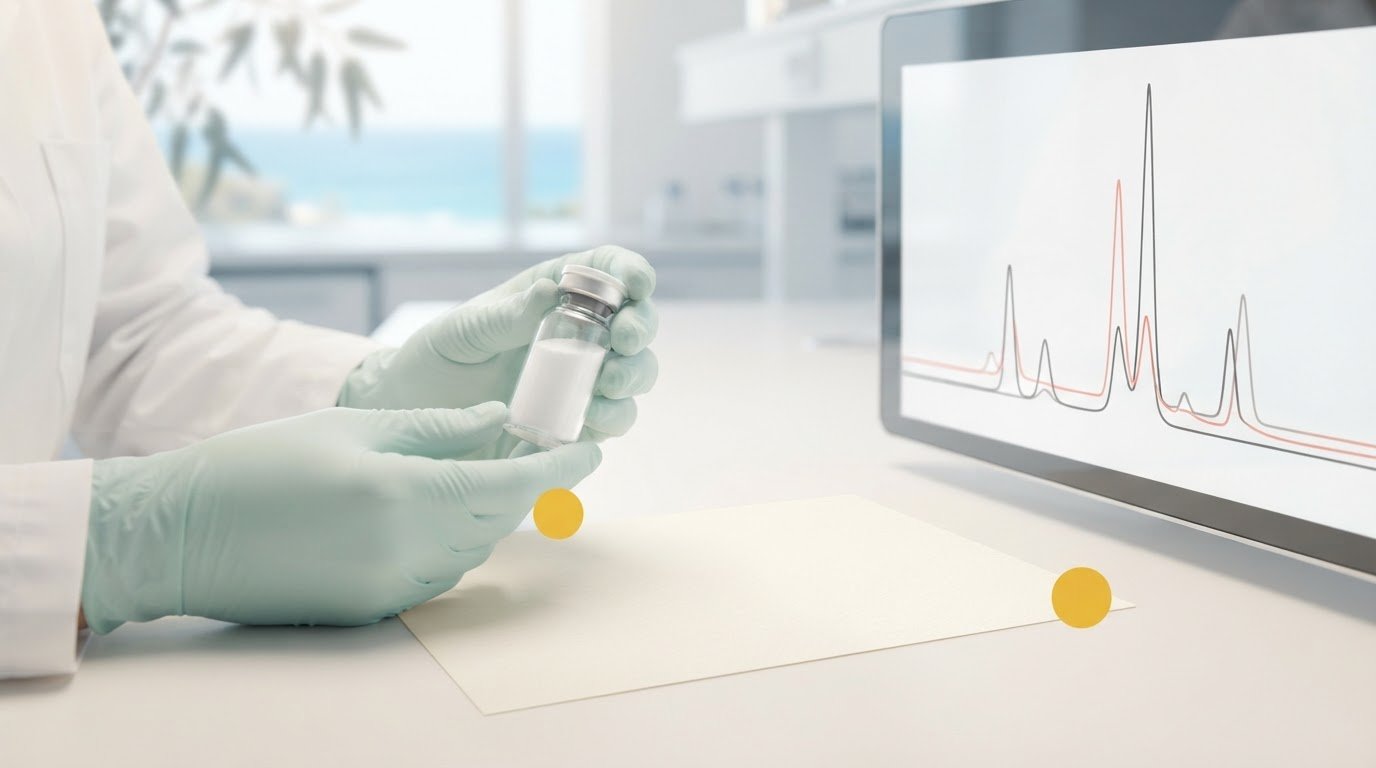
Laboratory analysis turns a sample into data, but the result is meaningful only when you understand what the method measured. High-performance liquid chromatography (HPLC) separates components in a sample as they pass through a column. A detector records the response over time, producing a chromatogram for an analyst to interpret. HPLC can support a purity assessment, but it does not automatically identify every peak or account for every possible impurity.
What an HPLC chromatogram can show
Each visible peak represents a detector response at a particular retention time, or how long a component took to pass through the system. The analyst integrates peak areas and may report the target peak’s area as a percentage of the total detected area. That figure depends on the method, detector settings and reporting choices. It is not necessarily a measurement of the sample’s total mass or a complete impurity profile.
Interpretation has limits. Components may co-elute, appearing as one peak, and substances that respond weakly under the selected detection settings may be under-represented. Sample preparation and the chromatographic method also affect what can be detected and separated. The FDA guidance on peptide impurities discusses analytical challenges and approaches for characterising peptide impurities. Read a reported purity percentage alongside the method and supporting chromatogram, not as a standalone guarantee.
When mass spectrometry adds useful evidence
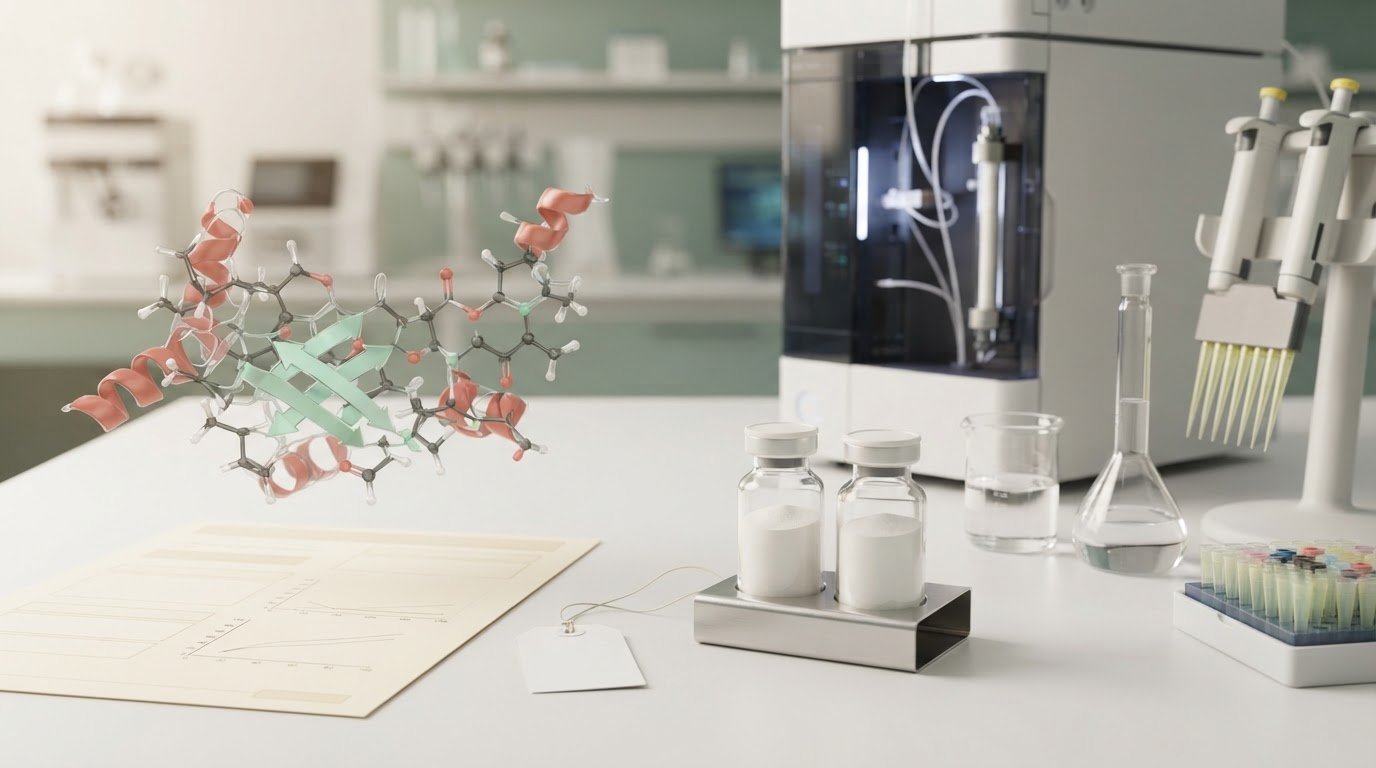
Mass spectrometry measures ions according to their mass-to-charge ratio. Used with liquid chromatography, LC-MS can provide mass data that supports an assessment of whether a separated component is consistent with the expected molecular mass. This is useful complementary evidence, but a mass match alone may not establish a complete structure or resolve every possible sequence or structural variant.
Chromatographic purity and confirmed identity are separate questions. HPLC can show how detected components separate under a specified method. Mass spectrometry can add evidence about molecular mass. Neither result alone establishes concentration, sterility, endotoxin levels, residual solvents or overall sample safety. The appropriate test depends on the research question and the analytes that need assessment.
When reviewing a report, check the analyte and batch reference, method, chromatogram or mass data, test date and named laboratory. Aussie Peptides states that its research-grade peptides are independently HPLC-tested and supplied with matching Certificates of Analysis. Products are for laboratory use, not human consumption. As a starting point, review the peptide batch information and compare the documentation with the vial lot number.
What a peptide purity result proves, and what it does not
A purity result answers a limited question: what proportion of the detected material was attributed to the target under a particular analytical method? It does not establish every quality attribute of the sample. If you’re working out how to test peptide purity, define the question first. Purity, identity, concentration and microbiological quality require distinct evidence. One reported percentage is not a universal pass mark.
Does a high HPLC purity percentage confirm everything?
No. An HPLC result applies to the sample tested and the method used. A high reported area percentage does not automatically confirm identity, quantify the amount in a vial or show that all impurities were detected. Some attributes require separate methods and specifications. Before deciding what the result supports, review the report’s method, batch reference, test date and description of the material tested.
Purity, identity and concentration are different questions
Purity describes the relative amount of detected components under the stated method. Identity asks whether the material is consistent with the intended compound. Concentration measures how much target material is present in a defined quantity or volume. For example, a sample may show a dominant HPLC peak, while separate evidence is needed to support its identity and the amount present.
Other quality questions need their own evidence. An HPLC purity percentage does not establish sterility, endotoxins or residual solvents. The method, sample scope and reporting determine what a result can support.
| Evidence type | What it may support | What it doesn’t establish on its own |
|---|---|---|
| HPLC chromatogram and area percentage | Separation and relative detector response of components under the stated conditions | Complete impurity profile, identity, concentration or safety |
| Mass spectrometry | Evidence consistent with a component’s molecular mass | Full purity, concentration or all structural features |
| Quantitative assay | Amount of target material in the tested sample, if the method is suitable | Sterility or identity beyond the assay’s scope |
| Specific microbiological or chemical tests | The particular attribute assessed, such as endotoxins or residual solvents | Attributes not included in that test |
Read the result as evidence with defined boundaries, not as a blanket quality statement. A laboratory measurement also says nothing by itself about human effects. Aussie Peptides supplies research-grade peptides for laboratory use, not human consumption.
How to verify a peptide batch using its documents
A Certificate of Analysis (CoA) is useful only if it relates to the vial being assessed. Treat verification as a traceability check first, then review what the analytical report supports. A familiar peptide name or a supplier’s general testing statement is not enough to establish that a document matches a specific batch.
Match the vial label to the Certificate of Analysis
Use this sequence:
- Record the lot number. Copy it from the vial label, preserving letters, numbers and any separators.
- Retrieve the batch report. Use the supplier’s stated lookup or document process. Do not assume a report found elsewhere applies to your vial.
- Compare the identifiers. Check the vial lot against the report’s batch reference, then confirm the analyte name and sample description correspond to the material.
A mismatch, missing lot number or report that identifies only a general product name leaves the batch connection unverified. Ask for clarification rather than assuming the document applies. Aussie Peptides states that customers can check batch details online using the vial lot number. Confirm the current lookup process and review the information shown before relying on it.
Review the method and report details
Check whether the report names the analytical method, records the result for that batch, identifies the issuing laboratory and gives relevant dates, such as the test date. Look for supporting data where available, not just a summary percentage. A report without a laboratory identity, method or batch reference provides limited evidence. A generic template or inconsistent identifiers also warrants follow-up.
Batch-specific verification means matching identifiers across the vial, report and batch record. This confirms traceability, not every attribute of the material. As discussed earlier, an HPLC result has defined limits. It does not independently establish identity, concentration, sterility or the absence of every contaminant.
For an Australian research context, the same document-checking discipline is relevant to the guide BPC-157 Australia: A Research-Only Sourcing and Verification Guide. Aussie Peptides supplies research-grade peptides for laboratory use, not human consumption, and states that products are independently HPLC-tested and supplied with matching Certificates of Analysis. These are records to assess, not a guarantee of every quality attribute.
Use the vial lot number to check peptide batch details, then compare the available record with the label before drawing conclusions.
When to use an independent laboratory, and what to do next
Seek advice from an analytical laboratory if a Certificate of Analysis is missing, the vial lot number does not match the report, or the available results do not answer your research question. Do not treat a generic document or an unexplained percentage as batch-specific proof. First define what you need to establish: identity, purity, concentration or another attribute. That question determines the method and evidence required.
Questions to ask an analytical laboratory
Before commissioning work, describe the material and the specific attribute you need assessed. Ask the laboratory:
- Which method is suitable for the identity or purity question, and what are its limitations?
- How much sample is required, and what packaging, storage or handling conditions apply?
- What will the report include, such as method details, chromatograms, results and sample identifiers?
- How are sample receipt and chain of custody recorded?
These questions help establish whether the proposed analysis can answer your query and how the sample will be tracked. Confirm the scope before sending material. A test for one attribute will not automatically provide evidence about others.
Use supplier evidence as a traceable starting point
Supplier documentation can provide an initial record to assess. Independent HPLC testing and a matching Certificate of Analysis (CoA) support batch traceability, but do not guarantee every quality attribute. Compare the vial lot number with the batch details in the report, then review the analyte, method, result, test date and issuing laboratory. If an identifier is absent or inconsistent, request clarification before relying on the record.
Aussie Peptides states that customers can check batch details online using the vial lot number. Use the stated lookup process and compare the available record with the vial label. Its products are research-grade peptides for laboratory use, not human consumption. This documentation is evidence to assess, not an endorsement for personal use.
For more context on research-only sourcing and verification, read the BPC-157 Australia: A Research-Only Sourcing and Verification Guide.
To inspect batch-specific records, review research peptide batch documentation and check that the vial’s lot number matches the available details.
Make batch evidence your next check
At-home inspection can help you check a vial’s condition and record its lot number, but it cannot establish a purity percentage. If you’re asking how to test peptide purity, the reliable answer is to assess suitable laboratory evidence. HPLC can support a purity assessment, while mass spectrometry can provide complementary evidence about molecular identity. Neither result proves every quality attribute.
Start with traceability. Match the vial lot number to the batch reference on the Certificate of Analysis, then review the analyte, method, result, test date and issuing laboratory. If a document is missing or does not match, seek clarification or specialist laboratory advice before relying on it.
Aussie Peptides states that its products are independently HPLC-tested, supplied with matching Certificates of Analysis, and searchable by vial lot number. These are records to assess, not a guarantee of every quality attribute. The products are research-grade and for laboratory use, not human consumption.
Review research peptide batch documentation and compare the available details with the vial label. A careful record check is a practical next step towards better-informed research decisions.
Frequently Asked Questions
Can you test peptide purity at home?
No reliable household check can establish a peptide purity percentage. Visual inspection may reveal damaged packaging or unclear labelling, but it cannot confirm chemical identity or quantify impurities. If you’re researching how to test peptide purity, treat home observations as basic condition checks only. For analytical evidence, review laboratory documentation that matches the vial’s batch, or seek specialist testing if the evidence is missing or insufficient.
Can you tell whether a peptide is pure by looking at it?
No. Colour, appearance and the shape of lyophilised material cannot establish purity or identity. A visible change may prompt a question about storage or handling, but it is not an analytical result. Check the vial’s lot information against its batch documentation. If the report is unavailable, identifiers do not match, or the material description is unclear, ask the supplier for clarification or seek qualified laboratory advice.
Does HPLC testing prove peptide identity?
Not by itself. HPLC separates sample components and produces a chromatogram, but a purity result does not necessarily confirm the target molecule’s identity. Interpretation depends on the method and any reference materials used. Mass spectrometry may provide complementary evidence about molecular mass. Review the actual report, including its method and data, rather than relying only on a general claim that a product is HPLC-tested. Check that the batch identifier matches the vial.
What does a peptide HPLC purity percentage mean?
An HPLC purity percentage is a reported value derived from the chromatographic method and integration of detected peaks. It describes the result under those specific conditions, not necessarily every impurity or quality attribute in the sample. Method design, detection settings and the material tested all affect interpretation. Read the percentage alongside the report’s method, batch identifier and scope. Do not treat it as a universal pass mark or a complete composition assessment.
Can a Certificate of Analysis be checked against a peptide vial?
Yes. Compare the vial’s lot number with the batch identifier on the Certificate of Analysis, then check the material description, method, result and report details. A document that cannot be linked to the specific vial batch provides limited traceability. If an identifier is missing or inconsistent, ask the supplier to clarify the discrepancy before drawing conclusions. A matching batch reference supports traceability, but does not prove every quality attribute.
Is a high peptide purity result proof that a sample is safe for human use?
No. A purity result does not establish suitability for human use, and other attributes may require separate testing or assessment. Aussie Peptides supplies research-grade peptides for laboratory use, not human consumption. Do not use analytical paperwork to infer a dose, safety profile or treatment effect. Interpret results only within the intended laboratory research context, and do not treat a purity percentage as evidence that a material is a medicine or suitable for personal use.
When should a peptide sample be sent to an independent laboratory?
Consider specialist laboratory testing when batch documents are unavailable, identifiers do not match, or the stated method does not address your research question. First define whether you need evidence about identity, purity or another attribute. Then ask the laboratory whether its method is suitable, how much sample is needed, what handling is required, what the report will include, and how sample receipt and chain of custody are documented.