High-Purity Research Peptides: 2026 Australian Buying Guide
September 30, 2026 · 14 min read
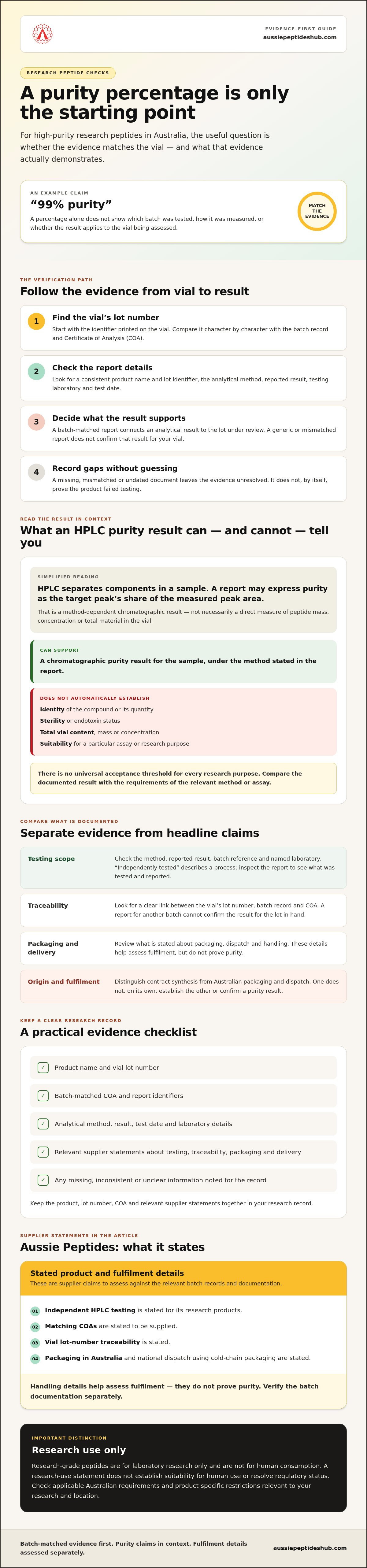
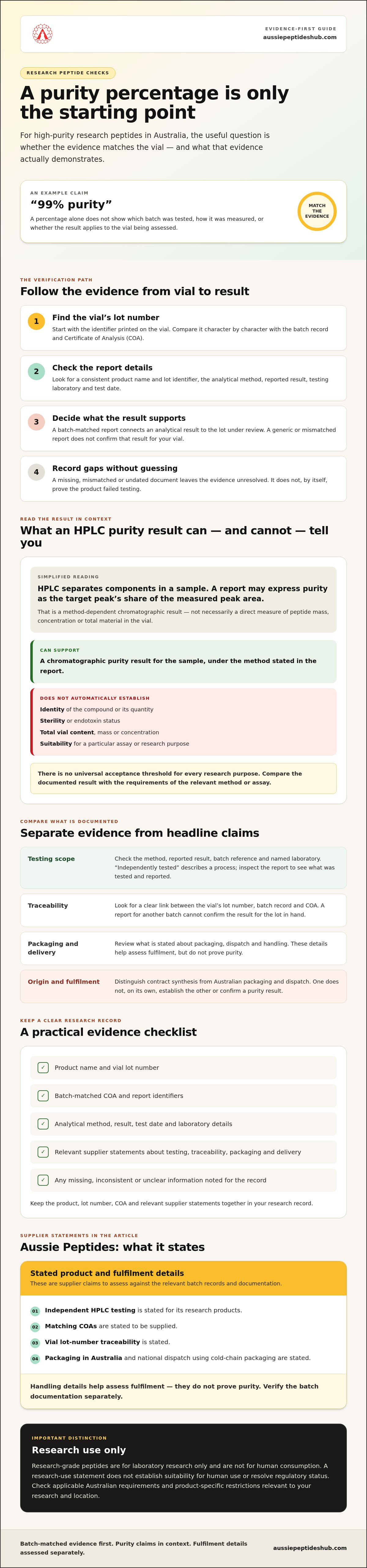
What does a “99% purity” label prove if the certificate can’t be matched to the vial? For anyone comparing high purity research peptides Australia, a percentage is only a starting point. Batch-specific evidence matters: the analytical method, test date and lot identifier should relate to the material being assessed.
This guide explains how to check that evidence. Match the Certificate of Analysis (COA) to the vial’s lot number, review what the HPLC result does and doesn’t establish, and distinguish independent testing from claims about identity, sterility or suitability for a particular assay. Documentation should be verifiable, not simply present.
Australian packaging and delivery are separate considerations. Aussie Peptides states that its research products are independently HPLC-tested, supplied with matching COAs, traceable through vial lot numbers, packaged in Australia and dispatched nationally using cold-chain packaging. Those handling details help you assess fulfilment, but they don’t prove purity. The sections ahead explain which records to inspect, the limits of purity claims and what Australian storage and delivery details to check before ordering. Products are for laboratory research only, not for human consumption.
Key Takeaways
- Assess high purity research peptides Australia by the batch evidence behind the claim, not the percentage alone.
- Check that the COA identifies the same lot as the vial, then review its method, results and stated limitations.
- Compare suppliers on testing scope, traceability, packaging and delivery details. Separate documented processes from unlinked claims.
- Keep a research record of the product, lot number, COA and relevant supplier statements.
- Distinguish contract synthesis from Australian packaging and dispatch. Handling information supports a fulfilment assessment, not a purity conclusion.
High-purity research peptides in Australia: what the claim does, and does not, tell you
A purity percentage is an analytical result, not a complete quality guarantee. When assessing high purity research peptides Australia, consider the method used, the sample tested and the report’s batch identifier alongside the number. Without those details, it’s difficult to determine what was measured or whether the result applies to the vial under review.
Purity, identity, content, sterility and endotoxin status are separate questions. A chromatographic purity result describes a sample’s profile under a particular method. It doesn’t automatically confirm the compound’s identity or quantity, establish sterility or endotoxin levels, or show suitability for a particular assay. Each requires appropriate evidence. A purity result alone also doesn’t establish the peptide’s mass or concentration, total vial content, or fitness for a specific research application.
For general background on peptide structure, see What are peptides. For comparing suppliers, however, general information is no substitute for batch-level records.
What does a peptide purity percentage measure?
Chromatographic methods such as HPLC separate components in a sample. A report may express purity as the target peak’s share of the measured peak area. This is a method-dependent result, not necessarily a direct measure of peptide mass, concentration or total material in the vial. Check the method and reported basis rather than interpreting the percentage in isolation.
There’s no universal acceptance threshold for every research purpose. Compare the documented result with the requirements of the relevant method or assay, and check that the report identifies the sample and batch tested.
Why research-only status matters when comparing suppliers
Research-grade peptides are for laboratory research only and are not for human consumption. A research-use statement doesn’t establish that a product is suitable for human use or resolve its regulatory status. Don’t treat supplier descriptions as a substitute for checking applicable Australian requirements.
Before ordering, verify current requirements and any product-specific restrictions relevant to your research and location. Keep your assessment focused on documented laboratory use, analytical evidence and traceability, not dosage, administration or health claims.
How to assess HPLC testing and a batch-matched Certificate of Analysis
A useful Certificate of Analysis (COA) lets you trace a reported result to the material being considered. When assessing high purity research peptides Australia, follow a consistent check: locate the report, match its batch identifier to the vial, inspect the method and result, then note what the document doesn’t establish.
A batch-matched COA is more informative than a generic sample report because it connects the stated analytical result to the specific lot under review. A report for another batch, or an example with no traceable identifier, can’t confirm the result for your vial.
Check the COA against the vial lot number
Start with the lot number printed on the vial. Compare it character by character with the online batch record and the COA. Check that the product name and any report identifiers are consistent across the records. If a supplier offers a lot-number lookup, use it to find the relevant batch details instead of relying on a general product page.
A missing, mismatched or undated document leaves the evidence unresolved. It doesn’t, by itself, prove the product failed testing. Record the discrepancy and ask for clarification before treating the result as applicable to that lot.
Read the method and reported result in context
Identify the analytical method, reported result, tested batch and laboratory named on the report. “Independently tested” describes a process, not the evidence itself. Check that the document relates to the specific batch, and review any available laboratory details to understand who performed the analysis and what was reported.
HPLC can support a chromatographic purity result under the stated method. On its own, it doesn’t establish identity, sterility, endotoxin status or suitability for every assay. Those questions require relevant evidence of their own. Treat a report that omits its method, batch reference or testing laboratory as limited documentation. Don’t infer results the report doesn’t show.
For a supplier comparison, record the vial lot number, COA, report date and any unresolved gaps. Aussie Peptides states that buyers can check batch details online using the vial lot number and that products are supplied with matching COAs. You can review its batch documentation information as part of your own verification.
Compare Australian research-peptide suppliers using evidence, not headline claims
When comparing high purity research peptides Australia, focus on what each supplier can document, not just the wording on a product page. Separate batch-level analytical evidence from traceability and fulfilment. Testing evidence, batch traceability and cold-chain handling answer different questions. None substitutes for the others.
| Comparison point | Evidence to look for | Question to resolve |
|---|---|---|
| Batch documentation | A product-specific COA or batch record that can be linked to the vial. | Does the lot identifier match, and is the report dated? |
| Testing scope | The stated method, result, tested batch and laboratory details. | What did the analysis measure, and what remains untested? |
| Lot lookup | A way to use the vial’s lot number to find relevant batch information. | Does the record identify the same product and batch? |
| Packaging and storage | A clear statement of where packaging and storage occur. | Is the location distinct from the synthesis location? |
| Delivery and handling | Information on dispatch, delivery coverage and any cold-chain packaging. | What handling details are documented for transit? |
What supplier documentation should be available?
Look for a COA or batch record tied to the product and vial lot, not a generic example. If testing is described as independent, check the report for the named laboratory and batch-specific result. “Third-party tested” is a claim to verify, not the evidence itself.
Missing method details or unclear identifiers leave questions open. Ask for clarification and record the response. Don’t treat absent information as proof of failure, but don’t assume the claim has been substantiated either.
How to assess Australian packaging and cold-chain delivery
Check where packaging, storage and dispatch occur, and whether the supplier distinguishes these steps from peptide synthesis. Australian packaging doesn’t, by itself, establish where a peptide was synthesised or demonstrate its analytical quality. Those points require separate records.
“Cold-chain packaging” also needs context. Review the handling information provided and ask for specific details rather than assuming particular temperatures or transit controls. Confirm whether national delivery is stated and what packaging or handling information applies during transit. These fulfilment details help you assess logistics, but they don’t replace batch documentation or establish purity.
Use a research-peptide supplier checklist before placing an order
A consistent pre-order check makes supplier comparisons more useful than relying on a purity claim alone. When comparing high purity research peptides Australia, start with the intended laboratory research purpose, then assess the records and fulfilment information available for the specific product. Keep online evidence separate from details that still need confirmation.
A practical pre-order verification sequence
- Confirm the stated use. Check that the product is supplied for laboratory research and not represented for human consumption. Verify current Australian requirements and product-specific restrictions relevant to your circumstances.
- Locate batch documentation. Find the COA or batch record, then check whether its product and lot identifiers match the vial under review.
- Review the testing scope. Note the analytical method, reported result, tested batch and any stated limitations. Don’t infer that a purity result confirms attributes the report doesn’t cover.
- Check fulfilment details. Review stated packaging and storage locations, dispatch information, national delivery coverage and any documented transit handling. Don’t assume a particular temperature or control unless it’s specified.
- Save the evidence. Record the product name, vial lot number, COA and relevant supplier statements with your research documentation. This creates a reference if records change or questions arise later.
Questions to resolve before comparing options
Some checks can be completed using an online batch record or report. Others need a direct response from the supplier. If the COA is unclear, ask what the purity result measures, which batch was tested and whether the report identifies the testing laboratory. If the testing scope isn’t stated, ask what was and wasn’t tested.
Also distinguish supplier claims from documented details. “Independently tested” needs a report that supports the statement. “Cold-chain packaged” needs enough handling information to understand what is being claimed. If an answer is unavailable or incomplete, record it as unresolved rather than treating it as verified evidence. This keeps your comparison consistent.
Before proceeding, check that the product, batch record and vial identifiers align. Note any remaining gaps and make sure the stated delivery and packaging arrangements meet your laboratory’s requirements. Don’t use this checklist as a handling or reconstitution protocol. Follow the documentation and procedures applicable to your research setting.
To review the supplier’s available product and batch information, check research-peptide documentation.
Aussie Peptides: verify the batch, documentation, and Australian fulfilment
Aussie Peptides states that its research-grade products are synthesised by contract manufacturers, independently HPLC-tested, packaged in Australia and supplied with matching Certificates of Analysis (COAs). These are distinct steps. Australian packaging and handling don’t establish where synthesis occurred, and neither location nor a purity result should be treated as evidence of unrelated quality attributes.
What the supplier states about testing and traceability
The business states that buyers can use the lot number printed on a vial to check batch details online. Use that identifier to find the relevant record, then compare it with the product and lot shown on the COA. Confirm that the documentation for the specific batch supports the stated testing process.
Independent HPLC testing can document a reported chromatographic result. It doesn’t, by itself, establish sterility, regulatory approval, endotoxin status or suitability for a particular assay. Inspect the product and batch documentation before drawing conclusions, and note any information the report doesn’t provide.
Review research-only products and supporting information
Aussie Peptides’ catalogue includes research-grade products such as BPC-157 and retatrutide. These products are for laboratory research only and are not for human consumption. Readers assessing product-specific information can consult the BPC-157 sourcing guide and the retatrutide synthesis and purity guide, where available, while applying the same checks to the relevant batch documents.
The business states that peptides are dispatched nationally using cold-chain packaging. Treat this as fulfilment information, not proof of purity. Review any available details about packaging and transit handling. Don’t assume specific temperatures or transit controls unless they are documented.
For anyone comparing high purity research peptides Australia, the practical next step is to assess the product record, matching COA and lot-number lookup for the batch under consideration. Review the available research products and supporting batch information before deciding whether the documentation meets your laboratory requirements.
Make the evidence part of your supplier decision
When comparing high purity research peptides Australia, assess the batch evidence, not just the headline percentage. A COA should relate to the vial lot under review, and its method and scope should be clear. Remember that HPLC purity results don’t establish sterility, endotoxin status or suitability for a particular assay.
Aussie Peptides states that its products are independently HPLC-tested and supplied with matching Certificates of Analysis. Buyers can use vial lot numbers to check batch details online. The business also states that peptides are packaged in Australia and shipped nationally in cold-chain packaging. These are distinct testing, traceability and fulfilment processes, so review each on its own evidence. Products are for laboratory research only and are not for human consumption.
Before deciding, compare the product record, lot number, COA and delivery information against your research requirements. Review available research peptides and batch information to inspect the supporting details and check whether they meet your laboratory’s needs.
Frequently Asked Questions
What does high purity mean for a research peptide?
High purity is an analytical result whose meaning depends on the method, sample and report. A chromatographic percentage doesn’t automatically establish identity, total content, sterility or endotoxin status. If you’re assessing high purity research peptides Australia, check the batch-specific COA and confirm what was measured. Compare the result with the requirements of the intended laboratory research rather than relying on a standalone percentage or assuming one threshold applies to every method.
How can I verify a research peptide COA matches the vial?
Compare the lot number printed on the vial with the batch identifier in the COA or supplier’s online record. Check that the product name and report details are consistent too. For example, a COA for the same product but a different lot doesn’t verify the vial in hand. If the identifiers don’t match or the report isn’t available, treat verification as incomplete and ask the supplier to clarify before relying on the documentation.
Does an HPLC purity result prove a peptide is safe or suitable for research?
No. An HPLC result reports only what the method and document establish for the sample tested. It doesn’t automatically confirm sterility, endotoxin status, identity through an independent method or suitability for a specific experiment. Researchers should assess the available records against their laboratory’s requirements and identify any evidence gaps. HPLC purity testing is not a general safety assessment. Products discussed here are for laboratory research only and are not for human consumption.
Are research peptides sold in Australia approved for human use?
There’s no blanket answer that applies to every product. Check current Australian regulatory information for the specific product. Aussie Peptides describes its products as being for laboratory research only and not for human consumption. Research supplies should not be treated as prescription medicines or as products approved for human use. Check relevant professional guidance and applicable requirements. This information isn’t medical advice and doesn’t support treatment or self-experimentation.
How should I compare Australian suppliers of research peptides?
Compare batch-matched COAs, disclosed testing scope, lot-number traceability, packaging location and delivery information. Separate records you can inspect from unsupported purity or quality statements, and note anything absent or unclear. A supplier may state that peptides are packaged in Australia, but that alone doesn’t show where synthesis occurred or establish analytical quality. Don’t use price as a proxy for purity, identity or suitability for laboratory research.
What does cold-chain packaging tell me about peptide delivery?
Cold-chain packaging describes a fulfilment and transit-handling measure, not an analytical test result or proof of purity. Ask what the supplier’s packaging and handling statements mean, and look for documented details. Don’t assume a particular temperature, transit control or guarantee unless the supplier provides evidence for it. Keep this assessment focused on delivery information. It doesn’t replace batch documentation, and it isn’t a preparation or use protocol.