Peptide Reconstitution Calculator Australia: Calculate Research Concentrations
September 30, 2026 · 15 min read
A precise calculator result can still be the wrong experimental answer. A search for “peptide reconstitution calculator australia” often starts with a practical question: how do you calculate concentration from peptide mass and solution volume?
The arithmetic is straightforward when the inputs and units are clear. Divide the stated peptide mass by the stated solution volume, then report the result with matching units. The distinction between final volume and the volume of liquid added matters. So does keeping a calculated result separate from a validated experimental requirement.
This guide explains the mass-and-volume calculation, the assumptions to check before relying on an output, and the limits of calculator results. It also explains when to refer back to an approved laboratory protocol or technical documentation. A calculator checks arithmetic. It doesn’t select a solvent, establish a handling method or confirm experimental suitability.
In Australia, research-only wording doesn’t itself establish that supply or use is lawful. Products supplied by Aussie Peptides are for research use only and not for human consumption. Any calculation must remain within a legitimate, documented laboratory context, with batch documentation treated as a separate verification step.
Key Takeaways
- Use a peptide reconstitution calculator australia to check arithmetic, then confirm which volume and units the calculation assumes.
- Compare calculator, manual and spreadsheet methods for transparency and repeatability, not as substitutes for independent review.
- Keep solvent choice and handling decisions within an applicable, approved laboratory protocol.
- Use batch-specific documentation to support traceability, while assessing experimental suitability separately.
- Products supplied by Aussie Peptides are for research use only and not for human consumption.
Peptide reconstitution calculator Australia: what the result means
A peptide concentration calculator performs a defined arithmetic operation: it divides the entered peptide mass by the stated solution volume. The result describes mass per unit of volume. It doesn’t confirm that the inputs are accurate, that the volume basis matches the laboratory record, or that the result is appropriate for an experiment.
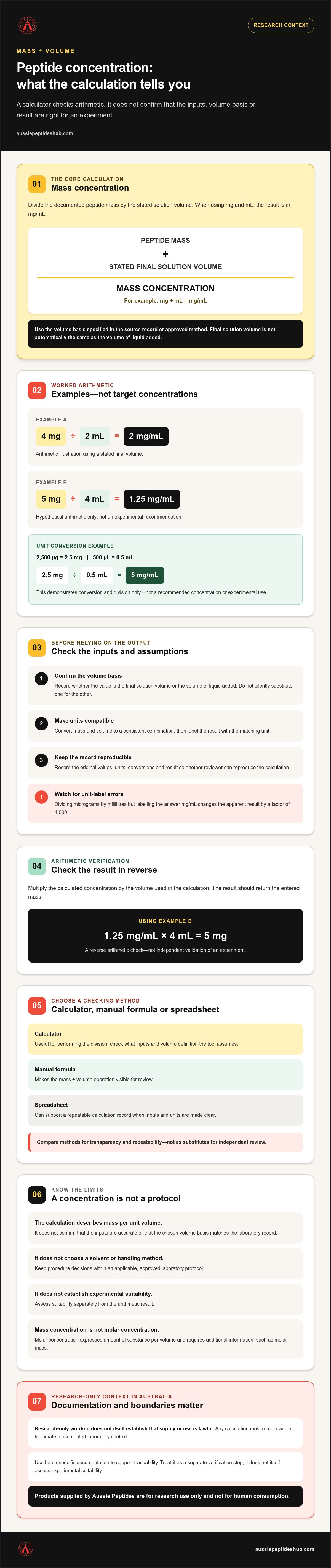
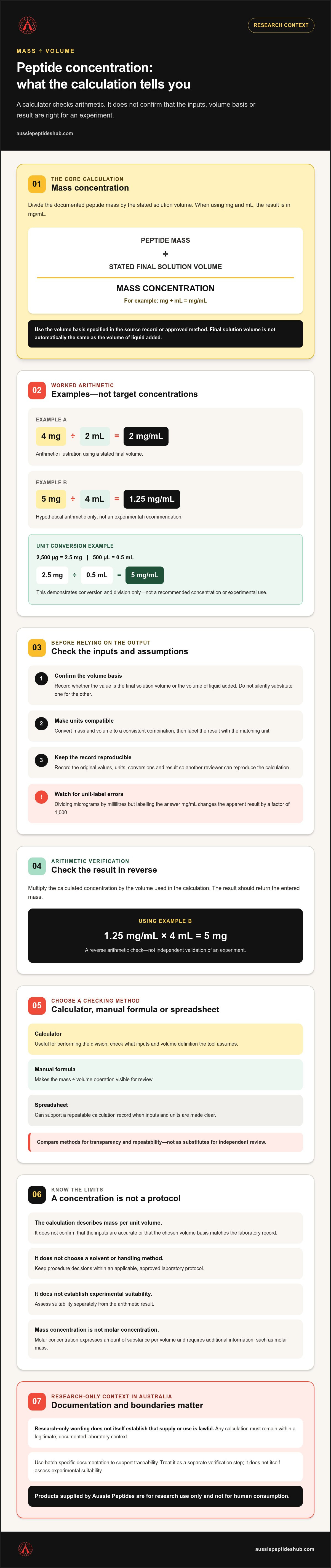
Mass concentration is the mass of peptide divided by the stated final solution volume, commonly expressed in mg/mL or µg/mL. For example, a record containing 4 mg of material in a stated final volume of 2 mL gives an arithmetic result of 2 mg/mL. This illustrates the formula only. It is not a target concentration or experimental recommendation.
The peptide reconstitution calculator australia search term can refer to different tools, so check what each calculator asks for and how it defines volume. A result based on final solution volume isn’t interchangeable with one calculated from the volume of liquid added. The calculator’s role is to support arithmetic for research documentation, not to select a solvent, provide handling instructions or validate an experiment.
What does a peptide concentration calculator calculate?
Enter a mass and a volume, then divide mass by volume. The output depends on those entries: an incorrect value or unstated assumption will produce a misleading result, even if the arithmetic is correct. Concentration is one recorded property, not a complete reconstitution protocol. Procedure and experimental suitability must come from applicable, approved laboratory documentation.
Which units should be entered?
Make the units explicit before calculating. Convert mass and volume to a consistent, convenient combination, then label the answer with the resulting unit. For instance, convert micrograms to milligrams or microlitres to millilitres before reporting in mg/mL. A mismatch, such as dividing a mass in micrograms by a volume in millilitres but labelling the answer mg/mL, changes the apparent result by a factor of 1,000.
Use the volume basis specified in the source record or approved method. Don’t assume that “volume” means the amount of liquid added; the defined final solution volume may be different. Record the original values, units, conversions and result so another reviewer can reproduce the calculation.
This calculation gives mass concentration, not molar concentration. Molar concentration expresses the amount of substance per volume and requires additional information, such as molar mass. See Molar concentration for the distinction. Keep the two measures separate in records. Products supplied by Aussie Peptides are for research use only and not for human consumption.
How to calculate peptide concentration from mass and volume
Use the documented peptide mass and the stated final solution volume. Divide the mass by the volume, then label the result with a concentration unit that matches those inputs.
Mass concentration equals peptide mass in milligrams divided by final solution volume in millilitres, assuming the recorded volume is the final solution volume; the result is in mg/mL.
For example, 5 mg ÷ 4 mL = 1.25 mg/mL. This is a hypothetical arithmetic example only. It does not set a target concentration or describe an experimental procedure. A peptide reconstitution calculator australia can perform this division, but the result is only as reliable as the entries and volume basis supplied.
A repeatable calculation sequence
Use a consistent record for each calculation. First, transcribe the mass and unit as documented. Next, record whether the volume means final solution volume or volume added, along with its unit. Convert values to compatible units, calculate mass divided by volume, and label the output. Don’t silently substitute one volume basis for another.
For instance, 2,500 µg is 2.5 mg, while 500 µL is 0.5 mL. To calculate in mg/mL, convert both values before dividing: 2.5 mg ÷ 0.5 mL = 5 mg/mL. This demonstrates unit conversion, not a recommended concentration or experimental use. The American Chemical Society’s guidance on proper solution preparation discusses accurate solution work. Follow the applicable, approved laboratory protocol for procedure decisions.
How to check the result
Check the arithmetic in reverse: multiply the calculated concentration by the volume used in the calculation. The result should return the entered mass. For the example above, 1.25 mg/mL × 4 mL = 5 mg. Then review unit conversions and decimal placement before recording the value.
Retain the unrounded result during calculation. Round only when reporting, and choose precision that the input measurements and laboratory records can support. Extra decimal places don’t make an uncertain input more precise. Keep the original values, conversions, formula and reported result together so another reviewer can reproduce the calculation.
For supplied research materials, consult the relevant product and batch documentation as a separate traceability check. Documentation doesn’t validate the volume assumption or establish experimental suitability. Products supplied by Aussie Peptides are for research use only and not for human consumption.
Calculator, manual formula, or spreadsheet: which method fits?
The peptide reconstitution calculator australia search may lead to web tools, but a calculator is only one way to do the arithmetic. Choose a method based on how often you need the calculation and how you will document the result. Convenience isn’t verification, and none of these tools approves a laboratory method.
| Method | Convenience | Transparency and record-keeping | Verification and protocol approval |
|---|---|---|---|
| Web calculator | Fast for a one-off calculation. | Depends on whether inputs, units and assumptions are retained in the record. | Check the output independently. It doesn’t approve a protocol. |
| Manual formula | Direct for a simple calculation. | Transparent if the formula, inputs, units and result are recorded. | A second calculation can identify arithmetic errors, but can’t approve a protocol. |
| Spreadsheet | Useful for repeated calculations. | Can preserve inputs and calculation history when cells, formulas and units are clearly labelled. | Requires controlled formulas and review. It doesn’t approve a protocol. |
Independent checks validate arithmetic, not experimental suitability. The entered mass and volume still need to match the source record, and the selected method must come from applicable, approved laboratory documentation. No calculator, manual calculation or spreadsheet can establish that the values or method suit a particular experiment.
When a web calculator is useful
A web calculator can quickly divide a documented mass by a stated volume. Before relying on its result, check the displayed units, how it rounds, and whether it uses final volume or volume added. Don’t assume features or outputs without checking the live tool. If the calculation forms part of a research record, retain the inputs and assumptions with the result.
When a spreadsheet or manual check helps
A manual calculation makes the operation visible. A documented spreadsheet can retain inputs, units, formulas and calculation history for repeat use. For consequential records, compare the result with a second method, such as recalculating manually. In a spreadsheet, label input and result cells, protect formulas from accidental edits, and arrange independent review. Repeated calculations don’t make an unchecked formula reliable.
Keep arithmetic separate from procedure decisions. Follow the approved laboratory protocol for experimental requirements; don’t use a calculation tool to select a solvent, specify handling conditions or validate a method. Products supplied by Aussie Peptides are for research use only and not for human consumption.
Before relying on a peptide reconstitution calculation
A correct calculation confirms only the arithmetic performed on the entered values. It doesn’t confirm that the material or inputs are correct, or that a procedure is suitable. Keep calculation checks separate from laboratory decisions. Solvent selection, sterility conditions, storage and handling steps must come from the applicable, approved laboratory protocol and relevant product documentation, not from a calculator output.
What a calculator cannot confirm
A calculator can’t establish material identity, purity, solubility, stability or suitability for an assay. It can’t determine whether an experimental concentration is scientifically appropriate, either. Those questions require relevant evidence and laboratory review. The peptide reconstitution calculator australia search may help locate arithmetic tools, but no tool can replace a protocol or validate an experimental method.
Don’t treat a calculated result as a handling instruction. This information is for legitimate research documentation only. It isn’t guidance for human consumption, dosing or administration. Products supplied by Aussie Peptides are for research use only and not for human consumption.
What to record in a research calculation
Make the calculation traceable. Record the source values and units, the volume basis, the formula, the calculation date and the result. Before relying on it, check the accompanying documentation for:
- Material identity and the applicable batch record.
- Stated mass and its unit, transcribed as documented.
- Whether the volume is final solution volume or volume added, plus its unit.
- The approved protocol reference and version.
- Any authorised deviations, with the appropriate record of review.
Keep lot-specific documents linked to the relevant research record. A batch-specific Certificate of Analysis can support traceability, but it doesn’t verify your volume assumption or establish experimental suitability. To understand what a COA reports and how to interpret it, consult the relevant COA documentation alongside the batch record and protocol.
For Aussie Peptides materials, use the vial lot number to check available batch details separately from the calculation. Check the batch documentation and retain the relevant record with your research documentation.
Research-only documentation and next steps in Australia
Use a defined sequence before accepting a concentration result: verify the material and source values, check that the units are compatible, confirm whether the volume means final solution volume or volume added, calculate, then arrange an independent arithmetic review. After that, follow the applicable, approved laboratory protocol for experimental decisions. A peptide reconstitution calculator australia can support the calculation step, but it can’t replace this documented review.
- Confirm the recorded material identity and batch details.
- Check the stated mass, unit and volume basis against source documentation.
- Calculate only when the required inputs and assumptions are explicit.
- Record the formula, result and independent review.
- Use the approved protocol for method and handling decisions.
How batch records support traceability
A batch-specific Certificate of Analysis (COA) helps connect analytical documentation to the material being recorded. For Aussie Peptides research supplies, the vial lot number can be used to check corresponding batch details online. Its peptides are independently HPLC-tested and supplied with matching COAs. An HPLC result is analytical documentation; it doesn’t establish clinical suitability, validate an experimental method or confirm that a calculated concentration is appropriate for an assay.
Keep the COA and lot information with the relevant research record, and assess them separately from the calculation and protocol review. The published BPC-157 research sourcing and verification guide is another documentation reference for considering sourcing and verification information. A COA supports traceability, not a substitute for authorised laboratory review.
What to do when inputs or assumptions are unclear
Pause. Don’t infer missing mass, volume, units or protocol requirements, and don’t treat an ambiguous calculator field as confirmation of its meaning. Check the source record and relevant laboratory documentation. If uncertainty remains, consult the authorised technical contact responsible for the work. Proceed with a calculation only when the required inputs and volume basis are explicit.
Research-only supplies are not for human consumption. This guide provides no dosing or administration guidance, and a research-use statement doesn’t determine whether a particular supply or activity is lawful. Keep decisions within a legitimate, documented research setting and follow applicable requirements.
For legitimate laboratory research, review the available Aussie Peptides research-supply and batch documentation as part of your verification process. Treat that material as a traceability resource, then rely on the approved protocol and laboratory review for experimental decisions.
Keep calculations documented and decisions protocol-led
A peptide reconstitution calculator australia can check mass divided by stated final volume, provided the units and volume basis are clear. Record the inputs, verify the arithmetic independently, and keep the result separate from experimental decisions. A calculated concentration doesn’t select a solvent or validate a method. Follow the applicable, approved laboratory protocol whenever handling or experimental requirements are involved.
Batch documentation supports a separate check: matching Certificates of Analysis and online batch-detail lookup by vial lot number help maintain traceability. Aussie Peptides reports independent HPLC testing of its peptides, Australian packaging and domestic cold-chain shipping. These details document the supplied material; they don’t confirm that a calculated result is suitable for an experiment.
To review the available documentation for laboratory supplies, review research-only peptide and laboratory supply information. Products are for research use only and not for human consumption. Keep each calculation transparent, traceable and tied to an approved protocol.
Frequently Asked Questions
How do you calculate peptide concentration from mass and volume?
Divide the documented peptide mass by the stated final solution volume. For example, 4 mg divided by 2 mL equals 2 mg/mL. This is an arithmetic illustration, not a recommended target. A peptide reconstitution calculator australia can perform the division, but its output depends on accurate inputs, consistent units and a clearly defined volume basis. Record those assumptions, then check the result independently.
What units should I use in a peptide reconstitution calculator?
Use compatible, clearly labelled units for both mass and volume. Common mass-concentration units include mg/mL and µg/mL. Convert values before calculating if needed: 1,000 µg equals 1 mg, and 1,000 µL equals 1 mL. Avoid mixing units without conversion. Check the calculator’s displayed units and report the result with the correct concentration unit so another reviewer can reproduce it.
Does peptide concentration use the volume added or the final volume?
Use the volume basis specified by the applicable laboratory record or approved protocol. Concentration is calculated using the stated solution volume, commonly the final volume, but a tool or record may define its input differently. Added volume and final volume aren’t automatically interchangeable. Check the calculator’s wording and document which value you used. If the basis is unclear, pause and consult the relevant laboratory documentation.
Can a peptide reconstitution calculator tell me which solvent to use?
No. A calculator performs arithmetic from entered values; it doesn’t select a solvent or provide a validated method. Solvent choice, handling, sterility conditions and storage requirements must come from relevant product documentation and an applicable, approved laboratory protocol. Don’t infer procedure from a calculator result. If the documentation doesn’t resolve a method question, consult the authorised technical contact responsible for the research.
How can I check whether a peptide calculator result is correct?
Recalculate the result manually or with a separate method, then reverse-check it by multiplying concentration by the volume used. The product should equal the entered mass, allowing for the precision of the recorded values. Also check unit conversions, decimal placement and whether the tool used final volume or volume added. Independent checks verify the arithmetic only, not the validity of experimental assumptions.
Is a peptide concentration calculator suitable for human dosing?
No. A concentration calculator is not a dosing, administration or medical decision tool. It can’t establish that a substance is suitable for human use or determine a safe amount. Aussie Peptides products are supplied for research use only and not for human consumption. Keep calculations within legitimate, documented laboratory research, and refer human health questions to a qualified health professional rather than relying on online calculations.
What should I record when calculating concentration for research?
Record the material identity, batch or lot reference, source mass and unit, volume value and unit, and whether the volume means final solution volume or volume added. Include the formula, calculation date, result and applicable protocol reference and version. Keep batch-specific documentation, such as a matching Certificate of Analysis, with the research record for traceability. Such documentation doesn’t validate the calculation or experimental method.