Preventing Peptide Degradation in Storage: A Practical Lab Guide
October 2, 2026 · 15 min read
A stable storage temperature cannot make up for poor handling during each transition. Preventing peptide degradation in storage means controlling moisture exposure, vial access and temperature changes, while following the requirements for the specific batch.
Lyophilised and dissolved peptides can have different handling requirements, and a change in appearance does not by itself show whether a sample has degraded. An HPLC purity result records a sample profile at the time of testing; it cannot establish how the peptide will hold up during later storage.
This guide provides a repeatable workflow for receiving, storing and handling research peptides. It covers ways to reduce unnecessary temperature excursions and moisture exposure, limit repeated vial access, and document storage conditions against the batch record. It also explains how to assess visible changes cautiously and when analytical testing may be needed. Use batch-specific documentation for storage requirements and stability periods. A consistent process supports traceability, but it does not replace evidence.
Key Takeaways
- Preventing peptide degradation in storage starts with following batch-specific requirements, not assuming every peptide has the same stability profile.
- Lyophilised and dissolved peptides have different exposure risks. Consult the relevant documentation before deciding how to store or handle either form.
- Reduce avoidable exposure to moisture, light, oxygen and temperature changes. Keep vials closed while they adjust to the required handling condition.
- Use a repeatable receive, inspect, record and store process. Log vial lot details and any storage excursions to support traceability.
- HPLC results and a matching Certificate of Analysis document batch testing at a point in time. They do not establish the outcome of later storage.
Why preventing peptide degradation in storage matters
Peptide degradation is a chemical or physical change that can affect the material being studied. A sample may undergo molecular change or form aggregates, altering its properties and potentially affecting experimental results. Storage history matters for reproducibility: two samples that began with comparable characteristics may no longer be equivalent after different handling or storage, even if their vials look the same.
Controlled storage means maintaining documented conditions that reduce a peptide’s exposure to factors that can drive chemical or physical change. Preventing peptide degradation in storage is not simply a matter of selecting a temperature. It also requires attention to vial access, moisture and the transitions involved in handling.
What changes can occur during peptide storage?
Several degradation pathways are possible, but none should be assumed without evidence. Moisture can contribute to hydrolysis, a reaction that cleaves peptide bonds. Oxidation can alter susceptible residues, while deamidation can change asparagine or glutamine residues. This overview of degradation via deamidation describes the process. The extent and rate of these changes depend on the peptide and its conditions, so one storage rule cannot establish stability for every sequence.
Physical changes matter too. Aggregation occurs when peptide molecules associate into larger groupings. This may affect sample uniformity, even when the chemical composition has not been fully assessed. A changed sample can introduce uncertainty when comparing experiments or replicate measurements.
Why appearance alone cannot confirm peptide integrity
Discolouration, cloudiness or visible particulates are warning signs. Record them and investigate, but do not treat them as definitive evidence of the cause or extent of change. A clear solution or unchanged-looking vial does not establish that the peptide remains chemically intact. Some alterations are not visible to the eye.
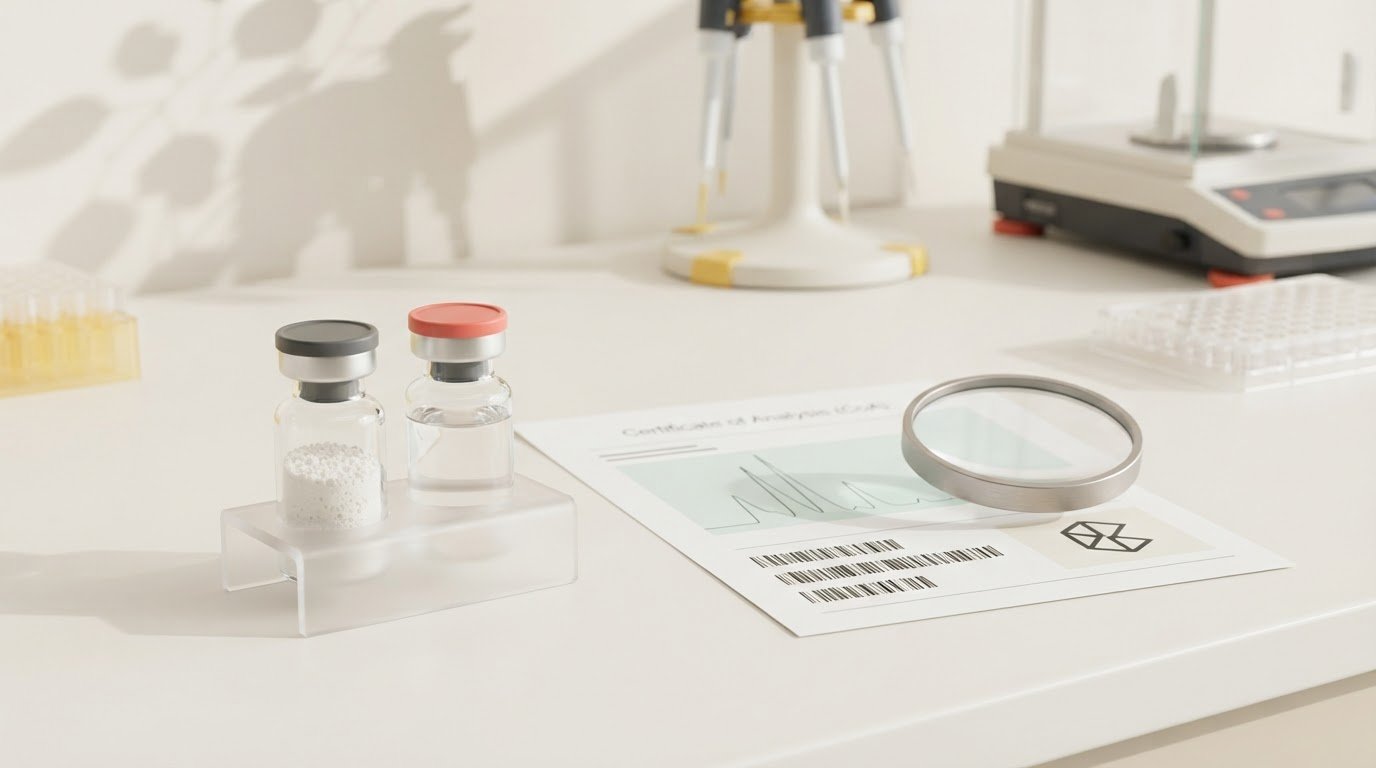
Analytical purity results also have a defined context. An HPLC result documents the sample’s measured profile at the time of testing; it does not establish what happens during subsequent handling and storage. For research-grade peptides, a matching Certificate of Analysis and lot details provide useful batch-level records, but they cannot substitute for assessing a specific sample after storage.
If sample integrity is in question, use an appropriate analytical assessment for the question being investigated. Record the sample identity, storage history and observed changes alongside the results. This helps separate documented evidence from visual assumptions and assess whether material condition may have affected experimental differences.
How heat, moisture, light and oxygen contribute to peptide degradation
Storage risks arise through different routes, and temperature is only one part of the control strategy. Higher temperatures can increase the rate of some chemical reactions, but there is no single degradation threshold for every peptide. Relevant conditions depend on the specific batch and its documentation. The International Council for Harmonisation (ICH) guidelines provide a framework for assessing stability under defined conditions; they do not establish one universal storage rule for all research peptides.
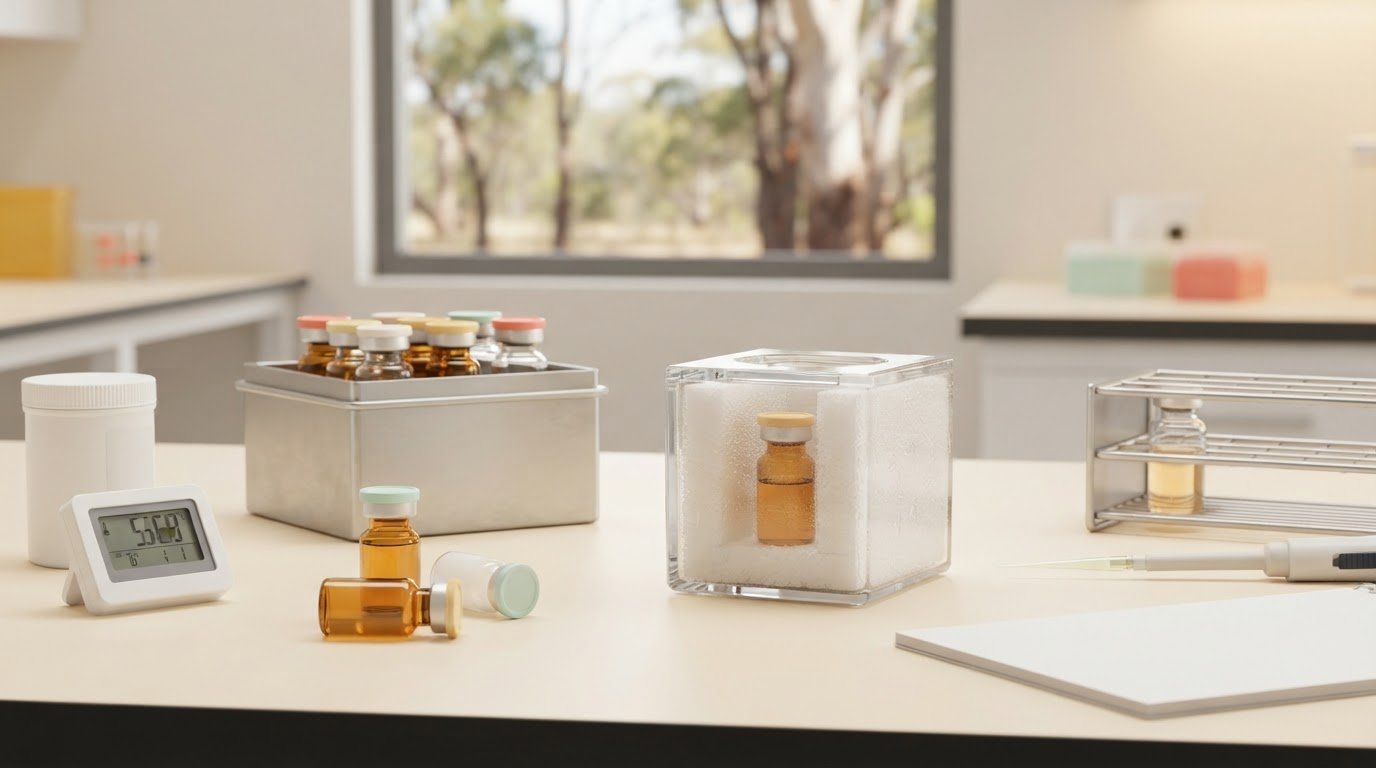
Moisture is a practical concern for dry, lyophilised material. Opening a vial can expose it to ambient humidity, increasing the opportunity for moisture-associated reactions such as hydrolysis. Light and oxygen can also contribute to oxidation in susceptible residues, including methionine, tryptophan and cysteine. A sealed, dry vial protected from light reduces exposure to moisture, oxygen and light, but batch-specific storage instructions still apply.
Why temperature changes and repeated access matter
Repeated warming and cooling add variability to a sample’s handling history. Each transition can create different conditions around the vial, while opening it provides another opportunity for exposure to ambient moisture and air. Keep access purposeful, close the vial promptly and return it to the documented storage condition.
Record excursions with the details available, such as when they occurred, how long they lasted and the conditions involved. Do not assume that one event caused degradation, or that a brief event had no effect. A record preserves context for later interpretation and supports consistent handling across experiments.
Chemical change versus physical change
Oxidation is a chemical change to susceptible residues. Aggregation is a physical process in which peptide molecules associate, potentially affecting sample uniformity. Temperature, moisture, light and oxygen may contribute to different risks, but the response depends on the sequence, formulation, solvent and exposure conditions. A storage factor that matters for one peptide may not have the same effect on another.
Separate observation from conclusion. Log what happened and consult the batch-specific documentation before changing storage practice or interpreting results. Aussie Peptides supplies research-grade peptides with matching batch documentation. View batch documentation for research peptides for a traceable reference to the material and its specified storage requirements.
Lyophilised versus dissolved peptides: compare storage decisions
Peptide form changes the main storage concerns. Lyophilised means freeze-dried: much of the water has been removed, but the material is not immune to moisture or temperature exposure. Once dissolved, a peptide is in a different chemical environment, and its stability behaviour may change with the solvent, concentration and pH.
Storage conditions should follow the specific batch documentation, not a universal peptide rule. Use the matching Certificate of Analysis and product storage instructions to guide decisions. The National Institute for Biological Standards and Control’s Peptide Handling, dissolution & Storage guidance also discusses differences between dry and dissolved material.
| Form | Principal exposure concern | Handling priority | Documentation to consult |
|---|---|---|---|
| Lyophilised | Moisture and light during vial access, weighing or transfer | Keep the container closed and dry between steps; minimise open-vial exposure | Batch-specific storage instructions and matching Certificate of Analysis |
| Dissolved | Changes associated with the solvent, concentration, pH and storage conditions | Use the specified solution-handling procedure; avoid repeated freeze-thaw unless a validated protocol permits it | Batch-specific documentation and supporting data for the solution formulation |
Lyophilised peptide storage considerations
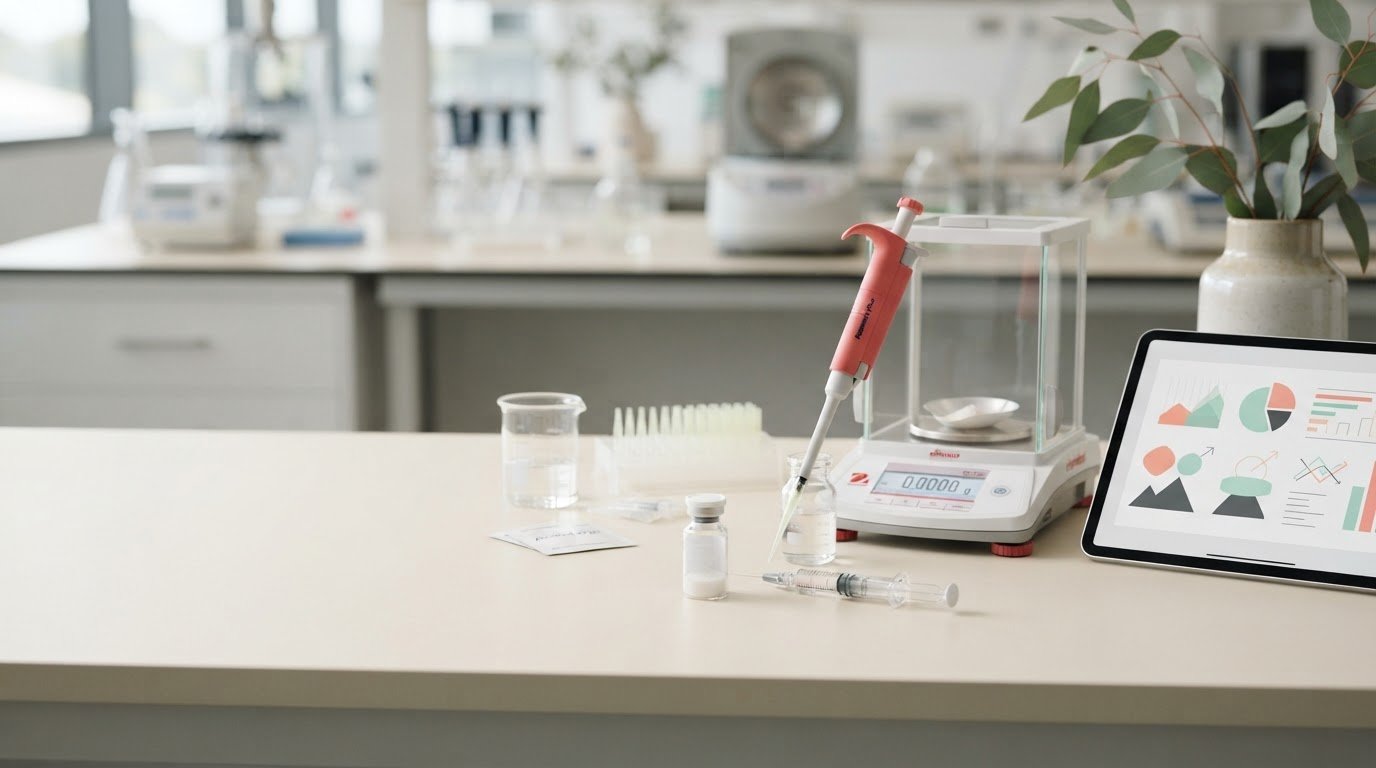
Protect dry material during routine handling. Before weighing or transferring, prepare the required equipment so the vial is open for the shortest practical time. Limit exposure to ambient humidity and light, then reseal the container promptly. Do not assume a default freezer setting applies. Follow the batch-specific instructions to select and maintain the required storage condition.
Dissolved peptide storage considerations
A dissolved sample cannot be treated as equivalent to the original dry material. Solvent choice, concentration and pH can affect solution stability, so do not assign a storage duration without peptide-specific supporting data. Repeated freeze-thaw cycles can add handling variability; avoid them unless a validated protocol permits that approach. Record preparation details and storage history so later results can be interpreted against the actual sample conditions.
For preventing peptide degradation in storage, use the peptide form and batch documentation as your starting point. A general chart may help identify questions, but it cannot replace the instructions and evidence relevant to the specific material.
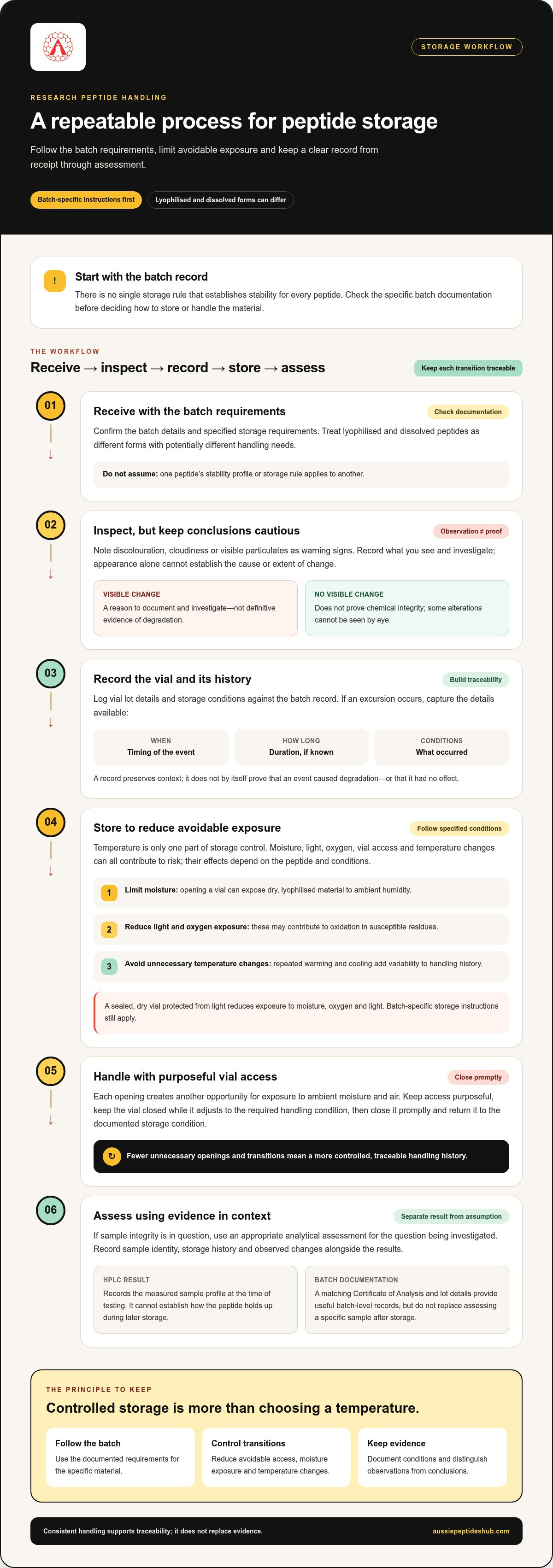
A practical workflow for preventing peptide degradation in storage
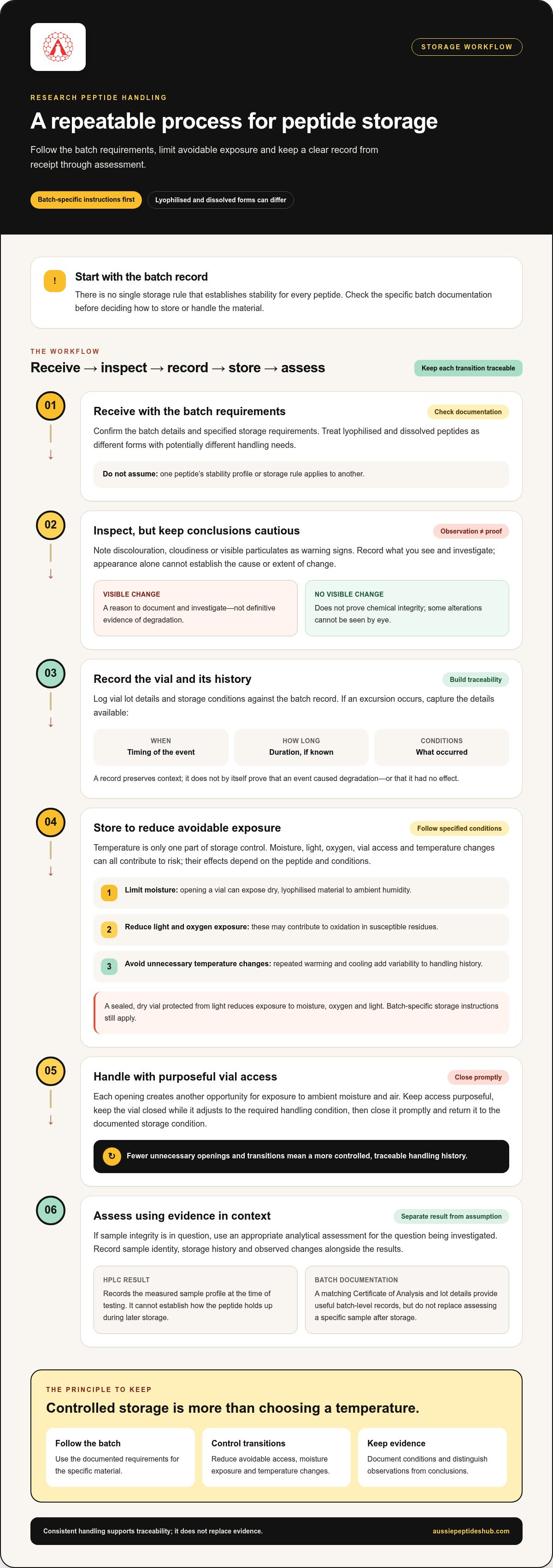
A repeatable process reduces avoidable handling differences and creates a traceable record for each vial. Follow the batch-specific storage instructions throughout. This workflow applies to research peptides for laboratory use only; it does not replace the product documentation or a validated laboratory procedure.
- Receive. Note the arrival date and check the delivery packaging before placing the vial into routine storage. If you observe damage or have a temperature concern, record it for review rather than assuming the sample is unaffected.
- Inspect. Check the vial and closure for visible damage, leakage or other changes. Record observations without treating appearance as proof of chemical integrity.
- Record. Log the vial lot number and compare it with the matching Certificate of Analysis. Include the receipt condition and any delivery concerns in the batch record.
- Store. Follow the storage instruction for that specific product and document the storage location. Record any temperature excursion with the details available, including when it occurred and its duration.
- Prepare. Plan the required amount and gather clean, dry equipment before opening the vial. If the documentation specifies a handling condition before opening, keep the vial closed while it reaches that condition.
- Reseal. Minimise open-vial time and avoid unnecessary transfers. Use appropriate dry laboratory equipment, then reseal the vial promptly to limit exposure to ambient moisture and air.
- Return to storage. Restore the vial to its documented storage location and record the handling event. Avoid unnecessary warming and cooling, and update the storage record if conditions change.
Receipt, inspection and storage records
Keep the lot number, Certificate of Analysis, receipt condition and storage location together in the batch record. This connects the sample’s identity to its documented history. If delivery packaging or the vial raises a concern, record it before routine storage so the observation is not lost or confused with later handling.
Opening, aliquoting and returning a vial to storage
Decide what the procedure requires before opening. Limiting repeated access reduces opportunities for moisture exposure and handling variation. If aliquoting is part of a validated laboratory procedure, document the transfer and resulting containers. Do not assume aliquoting or a particular storage condition suits every peptide.
Use the lot number and matching documentation as the starting point for your records. Review batch documentation and research-grade peptide options to connect product information with a controlled storage workflow.
Maintain peptide integrity with batch-specific evidence and controlled delivery
Supplier testing and laboratory storage records establish different parts of a peptide’s history. Supplier evidence documents the identified batch at the time of testing. After receipt, the laboratory is responsible for following the batch-specific storage instructions and recording handling conditions. Preventing peptide degradation in storage depends on maintaining that chain of evidence, not treating an initial test result as proof of future integrity.
Aussie Peptides packages research-grade peptides in Australia and ships them across Australia using cold-chain packaging. This supports controlled delivery, but does not establish a specific transit temperature or remove the need to inspect the delivery, record its condition and move the vial into the documented storage environment. Keep the delivery record with the vial’s lot information so later storage decisions have a traceable starting point.
What HPLC results and a Certificate of Analysis can establish
High-performance liquid chromatography (HPLC) separates components in a sample to produce a chromatographic profile. The reported result provides analytical evidence about the tested batch under the stated method and conditions. A matching Certificate of Analysis (COA) links those results to a specified batch; it does not predict how the sample will behave after later storage or handling.
Use the vial lot number to connect the physical sample, batch details and laboratory storage log. For an example of lot-level verification, see this BPC-157 Australia research-only sourcing guide. Record the lot number alongside the receipt date, storage location and any documented excursion. That creates a traceable record rather than relying on a COA alone.
When a storage concern needs analytical follow-up
An unexpected appearance or a recorded storage excursion is a reason to review the applicable protocol and sample history. Neither observation, by itself, establishes that degradation occurred. Do not infer purity or activity from colour, odour or one handling event. If the research question requires confirmation, use an appropriate analytical assessment and document the method and sample identity.
Batch-focused analytical evidence helps keep conclusions tied to the material actually under study. The retatrutide synthesis, purity and evidence guide offers a further example of considering batch evidence separately from later storage outcomes.
Aussie Peptides supplies research-grade peptides for laboratory use only. Each product is independently HPLC-tested, with a matching Certificate of Analysis and online lot-number verification. View research-grade peptides with batch documentation.
Make storage decisions traceable
Preventing peptide degradation in storage depends on more than choosing a temperature. Follow the batch-specific instructions, distinguish lyophilised material from dissolved samples, and limit avoidable exposure to moisture, light, oxygen and repeated handling. Keep a clear record of receipt conditions, vial lot number, storage location and any excursion.
Supplier testing and later storage records serve different purposes. Independent HPLC testing and a matching Certificate of Analysis document batch-level results at testing; they do not predict the outcome of subsequent handling. Use the vial lot number to connect batch details with your laboratory storage log, and use an appropriate analytical assessment if sample integrity needs to be evaluated.
Aussie Peptides supplies research-grade peptides for laboratory use only, packaged in Australia and shipped across Australia using cold-chain packaging. Lot-number lookup supports batch-detail verification. Browse research-grade peptides and batch documentation.
A consistent, documented workflow gives your research a stronger basis for reproducibility. Keep records current and let the evidence guide each storage decision.
Frequently Asked Questions
How should research peptides be stored to prevent degradation?
Follow the storage instructions supplied for the specific peptide batch and form. Lyophilised material and dissolved samples can have different storage requirements, so do not apply one temperature or handling rule to every peptide. Keep vials appropriately sealed, limit exposure to moisture and light, and record the lot number, storage location and any temperature excursion. Preventing peptide degradation in storage depends on following documented conditions and keeping a traceable handling record.
Do lyophilised peptides need to be refrigerated?
Not necessarily. The required storage condition depends on the peptide and its batch-specific documentation. Lyophilised means freeze-dried, but the material can still be affected by moisture or temperature changes. Check the supplied storage instructions before choosing a refrigerator, freezer or other location. Keep the vial closed and dry during handling, then return it promptly to the documented condition. Do not assume refrigeration is suitable for every lyophilised peptide.
Can I freeze a dissolved research peptide?
Only if the batch documentation or a validated laboratory protocol supports freezing that particular solution. Solvent, concentration and pH can affect solution stability, and freezing may add freeze-thaw handling if the sample is repeatedly removed and returned. Do not assume freezing will preserve every dissolved peptide. Follow the specified conditions, avoid unnecessary temperature cycling, and document preparation and storage details so the sample’s history is available when interpreting research results.
How long do peptides last in storage?
There is no single storage life that applies to all peptides, forms and conditions. Use the stability period, retest date or other guidance in the relevant batch documentation, where provided. A Certificate of Analysis reports results for an identified batch at the time of testing; it does not establish how long a sample will remain unchanged after storage begins. Record the lot number and storage history, and do not extend a stated period without supporting data.
What happens if a peptide is left at room temperature?
The effect depends on the peptide, whether it is lyophilised or dissolved, the duration and the conditions of exposure. Room-temperature exposure may affect some samples, but one event alone does not prove degradation. Record the time and circumstances, then review the batch-specific instructions or applicable laboratory protocol before deciding how to proceed. Do not infer that a sample is intact simply because it looks unchanged; analytical assessment may be needed.
How can I tell whether a stored peptide has degraded?
Appearance can flag a concern, but it cannot confirm or rule out degradation. Record discolouration, cloudiness or particulates and assess them against the relevant protocol. A clear sample is not proof of chemical integrity, and smell is not a reliable measure of purity or activity. If the research requires confirmation, use an appropriate analytical method for the question being investigated. Keep the sample’s lot number and storage history with the assessment.
Should a peptide vial warm up before it is opened?
Follow the batch-specific handling instructions. If they require the vial to reach a particular handling condition, allow it to do so while it remains sealed. Opening a cold vial can expose the contents to ambient moisture, so prepare equipment first and minimise the time the vial is open. Do not use a universal warming period or temperature; record any relevant handling step in the sample’s storage history.