Buying Retatrutide in 2026: A Research-Supply Verification Checklist
October 3, 2026 · 14 min read
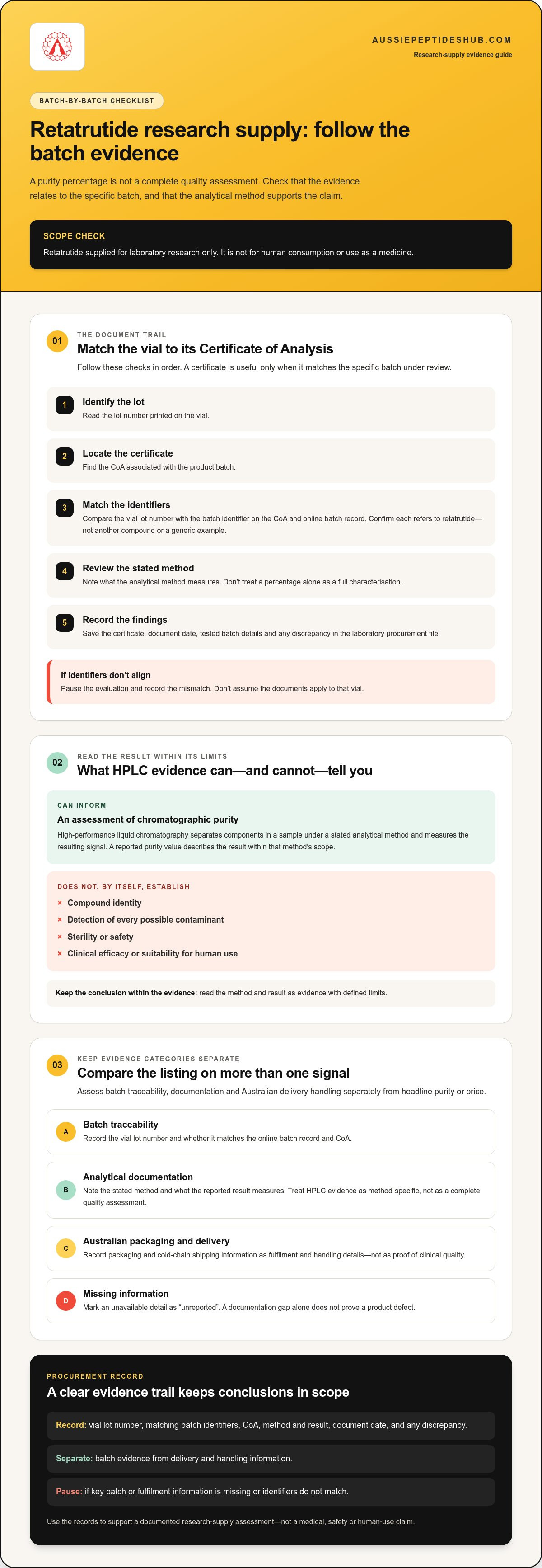
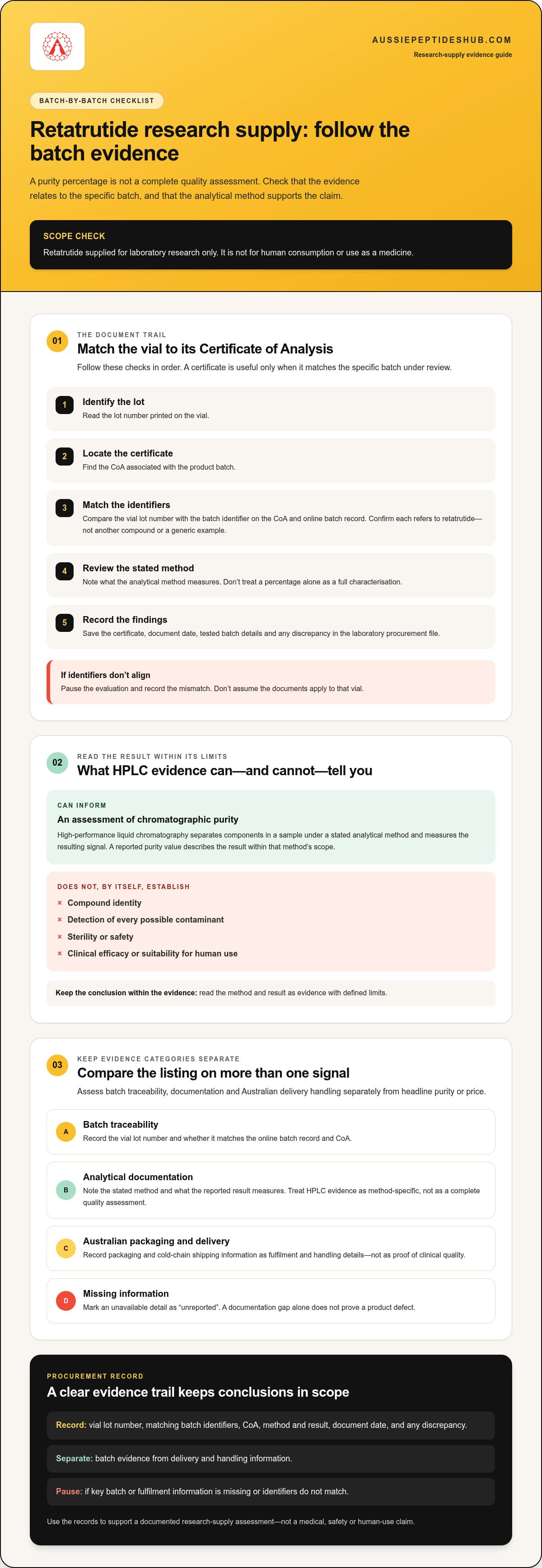
A purity percentage is not a complete quality assessment. When buying retatrutide for laboratory research, focus on the evidence trail: the result should relate to the specific batch, and the analytical method should support the claim being made.
It’s reasonable to expect clear information about batch identity, analytical testing and delivery. This checklist explains how to assess research-only listings, match a Certificate of Analysis to a batch and interpret independent HPLC results. HPLC can provide evidence about chromatographic purity, but it does not, by itself, prove a compound’s identity, sterility, safety or suitability for human use.
You’ll also learn how to use vial lot numbers for traceability, what Australian packaging and cold-chain shipping information can tell you, and what those fulfilment details cannot establish. Retatrutide supplied for research is for laboratory use only, not human consumption. The aim is to support a documented, evidence-based research-supply decision, not to make unsupported medical or quality claims.
Key Takeaways
- Define the intended laboratory research use before comparing listings. Retatrutide supplied by Aussie Peptides is not for human consumption or use as a medicine.
- When buying retatrutide, match the vial lot number to its Certificate of Analysis and online batch record.
- Assess what the stated analytical method supports. HPLC evidence can inform a purity assessment, but it does not establish sterility or suitability for human use.
- Compare batch traceability, documentation and Australian delivery handling separately from headline purity or price.
- Record procurement details and pause the evaluation if key batch or fulfilment information is missing. A documentation gap alone does not prove a product defect.
Buying retatrutide: define the research-only purchase before comparing listings
Buying retatrutide in this context means sourcing a compound for controlled laboratory research, not obtaining a treatment. That distinction sets the scope for comparison: assess the listing as research supply, not as a promise of clinical effect, safety or suitability for a person.
Research compounds are not prescription medicines, and a research listing is not evidence of suitability for human use. Aussie Peptides supplies products for laboratory research only. They are not for human consumption or use as medicines.
What does buying retatrutide for research mean?
For a laboratory buyer, procurement starts with a defined research purpose and documented supply requirements. Experimental rationale belongs in the study plan; it does not validate a seller’s claims. Assess the purchase separately by reviewing the batch record, available analytical documentation and fulfilment details against your laboratory’s requirements.
For background on the compound’s development and research context, see this overview of Retatrutide. For more on synthesis, purity and evidence considerations, consult the retatrutide research peptide synthesis and evidence guide.
What this checklist can and cannot establish
This checklist focuses on evidence a buyer can inspect: whether the vial’s lot number matches the Certificate of Analysis (CoA), whether batch details can be checked online, what the stated analytical method measures, and how Australian packaging and delivery are described. Aussie Peptides provides matching CoAs and independent HPLC testing. Use the lot number printed on the vial to check batch details online.
These records support traceability and analytical review. An HPLC result can inform an assessment of chromatographic purity, but it does not, on its own, establish identity, sterility, safety, clinical efficacy or suitability for human use. Keep each conclusion within the evidence and the method reported.
Delivery information has a separate purpose. Australian packaging and cold-chain shipping describe fulfilment and handling, not clinical quality. Record them as procurement details, not as substitutes for batch evidence.
Australian regulatory status and applicable restrictions can change and require current verification. This checklist does not make a legal determination. Its focus is narrower: distinguish research-only supply from treatment claims, then assess the available records and handling information.
Retatrutide buying checklist: verify the batch and its Certificate of Analysis
Before buying retatrutide for laboratory research, follow the document trail from the physical vial to its batch record. A certificate is useful only if it can be matched to the specific batch under review. A generic sample document or an unmatched purity figure cannot establish that link.
How to match a retatrutide lot number to its COA
Use this sequence to make the check repeatable:
- Identify the lot. Read the lot number printed on the vial.
- Locate the COA. Find the certificate associated with the product batch.
- Match identifiers. Compare the vial lot number with the batch identifier on the COA and online batch record. Confirm that each refers to retatrutide, not another compound or a generic example.
- Review the method. Note the stated analytical method and what the reported result measures. Don’t treat a percentage alone as a full characterisation.
- Record findings. Save the certificate, document date, tested batch details and any discrepancy in the laboratory procurement file.
Aussie Peptides provides matching Certificates of Analysis, and the vial lot number can be used to check batch details online. If identifiers do not align, pause the evaluation and record the mismatch. Don’t assume the documents apply to that vial.
What an HPLC result can and cannot tell you
High-performance liquid chromatography (HPLC) separates components in a sample under a stated analytical method and measures the resulting signal. A reported purity value describes the result within that method’s scope. It does not automatically confirm compound identity, detect every possible contaminant, or establish sterility, safety or suitability for human use. Read the method and result as evidence with defined limits.
For broader Australian sourcing considerations, see the retatrutide Australia research-supply buying guide. Drugs.com describes retatrutide as an investigational drug in the United States. That reference does not determine Australian regulatory status, which should be assessed separately using current Australian information.
For a direct comparison, review the batch documentation accompanying Aussie Peptides retatrutide research supply, then retain the matching records with your laboratory procurement documentation.
Compare retatrutide listings by evidence, not by a single purity figure
Compare what each listing documents for the specific batch, and keep evidence separate from promotional claims. If a detail is not available, mark it as “unreported”. That gap alone does not prove a defect.
| Comparison point | What to record | What it helps assess |
|---|---|---|
| Lot traceability | Vial lot number and whether it matches an online batch record | Whether the supplied vial can be linked to batch-level information |
| COA access | Whether a Certificate of Analysis is accessible and identifies the tested material and batch | Whether the document relates to the listing’s specific batch |
| Analytical method | Method stated, tested material and reported result | What the analytical evidence measures, and its stated scope |
| Australian packing | Whether the listing states that products are packaged in Australia | A fulfilment detail, not a measure of analytical quality |
| Delivery handling | Stated domestic shipping and cold-chain handling information | How the order is handled in transit, not proof of product quality |
| Price and headline purity | Record separately from batch documents | Comparison fields only; neither replaces traceability or analytical evidence |
Aussie Peptides products are packaged in Australia, independently HPLC-tested and supplied with matching Certificates of Analysis. Use the vial lot number to check batch details online. Orders are shipped across Australia in cold-chain packaging. Treat these details according to what they establish: the batch record supports traceability, HPLC describes analysis, and cold-chain packaging describes delivery handling.
Why purity alone is not a complete buying criterion
A purity percentage is a result produced under a particular analytical method. It does not, by itself, establish identity, sterility or the absence of every contaminant. Before comparing figures, check whether the tested material, batch context and methods are sufficiently comparable. If those details differ or are not reported, don’t rank suppliers by the numbers alone.
Keep price in a separate field. It can inform procurement planning, but it does not validate a batch or expand what a test result demonstrates. When buying retatrutide for laboratory research, prioritise records that connect the specific vial to its analytical evidence. Treat unreported information as unknown, not as proof of failure.
Before buying retatrutide in Australia: complete the practical procurement checks
A laboratory procurement check should connect the research purpose, batch evidence and fulfilment record. Review these details before ordering, then verify the received vial against its documents. Keep observations factual: Australian packaging and cold-chain shipping describe fulfilment, but do not establish analytical quality or suitability for human use.
Pre-purchase checks for an Australian research order
- Confirm the stated purpose. Check that the listing and accompanying documents describe laboratory research use, not treatment or human use.
- Check batch-record access. Confirm that the batch information and analytical record can be associated with the vial lot number.
- Review the analytical record. Note the tested material and stated method. Record what the result reports without treating it as proof of attributes the method does not establish.
- Review domestic fulfilment details. Note the stated Australian packaging and shipping handling, including cold-chain packaging. Treat these as delivery information, not proof of product quality.
- Retain order records. Save the listing details and order documentation with the batch information for the laboratory file.
If a key detail is unreported, record it as unknown rather than assuming the listing has failed a test. Pause the procurement assessment if the available information does not let your laboratory make a documented decision.
Receipt checks and laboratory recordkeeping
At receipt, link the parcel, order and vial in your records. Log the delivery date, parcel condition, product identifier and lot number printed on the vial. Compare the lot number with the order record and matching Certificate of Analysis (COA), then save the COA and online batch record with the receipt entry.
- Record any visible parcel or packaging condition relevant to the delivery file.
- Check that the vial identifier and batch details correspond with the documentation.
- Note any discrepancy and keep the records together for review under laboratory procedures.
- Follow the product documentation and the laboratory’s approved handling procedures. Don’t infer storage temperatures or handling requirements from cold-chain packaging alone.
This receipt check supports traceability. It does not independently establish sterility, safety or suitability for human use. Aussie Peptides supplies research-grade products for laboratory use only, not human consumption.
For a supply option with batch details that can be checked using the vial lot number, review Aussie Peptides research-grade retatrutide.
A research-only retatrutide purchase: make the decision from verifiable records
A sound procurement decision rests on a linked evidence trail, not one prominent claim. For laboratories buying retatrutide, use a simple threshold: can you connect the vial to a traceable batch, review analytical records for that batch, and understand the stated fulfilment arrangements? If a key detail is missing, pause the evaluation. Missing information warrants a hold or further review, but it is not proof of a specific product defect.
When does a listing meet a basic documentation threshold?
Use these checks before proceeding:
- Batch match: A lot identifier is available, and the vial, batch record and Certificate of Analysis (COA) refer to the same material and batch.
- Relevant analytical evidence: The record identifies the tested material and describes the method and result. Prefer batch-specific documentation over a general purity statement without batch context.
- Separate handling information: Australian packaging and stated shipping arrangements are recorded as fulfilment details. They do not replace analytical evidence or demonstrate product quality.
If the batch identifier does not match, or the available document is only a generic example, the evidence trail is incomplete. Don’t fill the gap with assumptions. Record what is available, note what remains unreported and pause until the laboratory can assess the documentation against its procurement requirements.
Keep conclusions within the evidence. An HPLC result describes an analytical output under a stated method. It does not automatically establish identity, sterility, safety, clinical efficacy or suitability for human use. Retatrutide supplied as research-grade material is for laboratory research only. It is not a prescription medicine and is not for human consumption or use as a medicine.
What is the next step for research buyers?
File the listing details, batch record, COA and receipt notes together in the laboratory procurement documentation. This preserves the basis for the decision and supports later review. For scientific context on synthesis, purity and evidence, read the retatrutide research peptide synthesis and evidence guide.
Proceed only when the records provide enough relevant information for your laboratory’s research-supply assessment. If they do not, pause rather than treating a headline figure or fulfilment claim as a substitute. To review the research-only retatrutide listing, visit Aussie Peptides.
Make your research-supply decision from the evidence
Buying retatrutide for laboratory research calls for a traceable batch record, relevant analytical documentation and clear fulfilment information. Match the vial lot number to its Certificate of Analysis and online batch record. Read HPLC results within the scope of the stated method: a purity figure alone does not establish every quality attribute.
Aussie Peptides provides independent HPLC testing with matching Certificates of Analysis. Check batch details online using the vial lot number. Products are packaged in Australia and shipped across Australia in cold-chain packaging. These records and handling details support procurement review, but they do not make research-grade material a prescription medicine or a product for human consumption.
Keep the evidence with your laboratory records and pause if key details are missing. To review the research-grade listing, review Aussie Peptides research-grade retatrutide.
Frequently Asked Questions
Is retatrutide available to buy in Australia for research?
Aussie Peptides supplies research-grade retatrutide for laboratory research, not human consumption. That description is not a determination that every purchase or use is permitted under Australian rules. Before buying retatrutide, verify current Therapeutic Goods Administration information and any requirements that apply to your institution, research activity and intended use. Don’t treat an online listing as evidence of therapeutic approval or pharmacy availability.
Can I use research-grade retatrutide as a medicine?
No. Aussie Peptides’ research-grade retatrutide is for laboratory research only, not human consumption or use as a medicine. A Certificate of Analysis or HPLC result does not convert research material into a prescription medicine or establish suitability for people. Don’t use a research listing to make treatment decisions. This material is not supplied for self-treatment, dosing or administration.
How do I check a retatrutide COA before buying?
Compare the lot number printed on the vial with the batch identifier on the Certificate of Analysis (COA) and online batch record. Confirm that the certificate identifies the same compound and tested batch, rather than showing a generic example. Review its date, stated analytical method and reported result, then retain it with procurement records. HPLC data describes a method-specific result, so interpret it within that scope.
Does an HPLC purity result prove a retatrutide product is safe?
No. HPLC separates and measures components under a stated analytical method. A reported purity result does not, by itself, confirm identity, sterility, safety, clinical efficacy or suitability for human use, nor does it establish that every possible contaminant is absent. Read the result as evidence about the analysis performed, not as a general safety certification. Research-grade retatrutide remains for laboratory research only.
What should I do if the vial lot number does not match the COA?
Pause the procurement assessment and don’t proceed with research use until the discrepancy is reviewed. Record the vial lot number, the batch identifier shown on the COA, the order details and the date you identified the mismatch. Review the online batch record and retain the documents together. A mismatch means the records do not currently establish a clear batch link; it does not, on its own, prove a specific defect.
How much does research retatrutide cost in Australia?
Use the current listed Australian-dollar price when preparing a procurement budget. Record price separately from the evidence for batch identity and analytical quality. Compare it alongside, not in place of, the lot-specific COA, stated test method and traceability information.
What happens if cold-chain packaging arrives damaged?
Document the parcel condition and delivery date, and retain the packaging and order records for your laboratory’s review. Don’t infer the product’s condition or exposure solely from visible damage, and don’t assume a particular temperature or handling requirement unless the product documentation specifies it. Follow the documentation and your laboratory’s approved process for reviewing damaged deliveries before deciding how to proceed.