Peptide Stability After Reconstitution in 2026: A Research Reference
October 2, 2026 · 15 min read
A single shelf-life number can look precise and still be wrong for a specific peptide. Peptide stability after reconstitution 2026 is best treated as an evidence question, not a universal countdown. The sequence, solvent, temperature and handling conditions all matter.
Conflicting storage claims can make laboratory decisions difficult. A solution’s colour or clarity can’t confirm its chemical integrity, and a batch Certificate of Analysis or HPLC result doesn’t establish how the material behaves after reconstitution. Those records help verify the supplied batch. Post-reconstitution stability requires relevant, peptide-specific evidence.
This research reference explains what changes when a lyophilised peptide enters solution, which conditions can influence degradation, and how to assess stability claims without treating broad estimates as validated data. It also outlines how handling records, analytical methods and traceable batch documentation support research decisions. Products discussed are for research use only, not for human consumption.
Key Takeaways
- Assess stability against defined conditions and a documented period, rather than treating a single day count as universal.
- Consider peptide identity, formulation, solvent, concentration, temperature, light exposure and handling when interpreting different results.
- Distinguish chemical integrity, assay performance and biological activity. Evidence for one outcome doesn’t automatically establish the others.
- For peptide stability after reconstitution 2026, compare claims with peptide-specific evidence and record the conditions behind each result.
- Build a traceable research record using the vial lot number, solvent identity, preparation date and relevant batch documentation.
Peptide Stability After Reconstitution: What Changes in Solution?
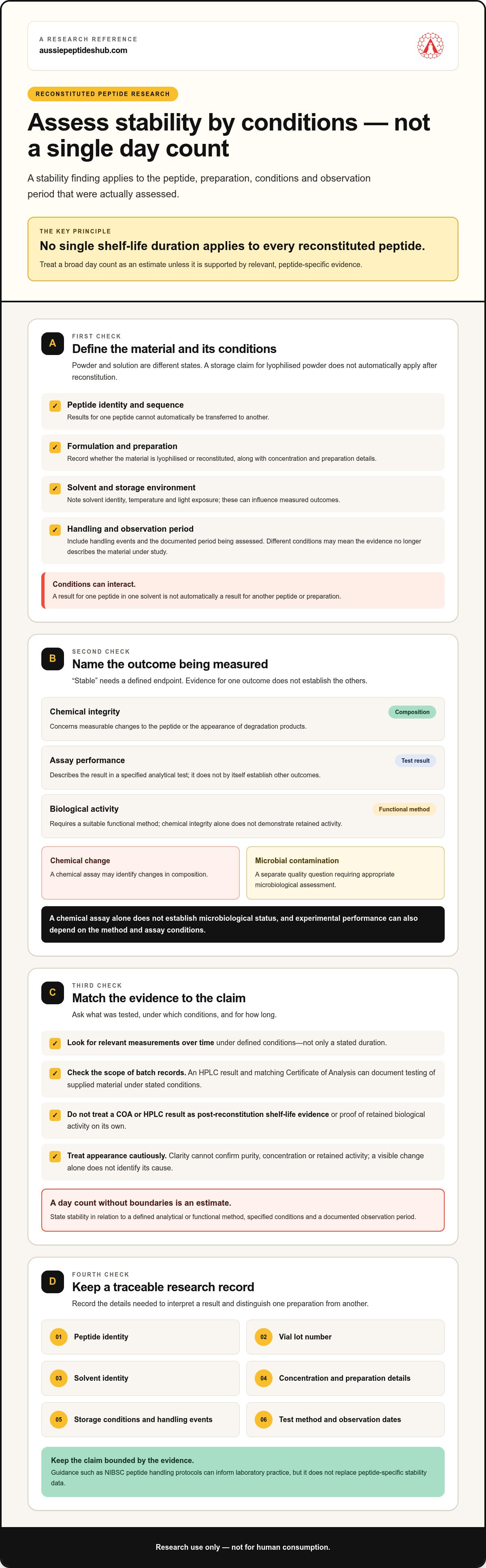
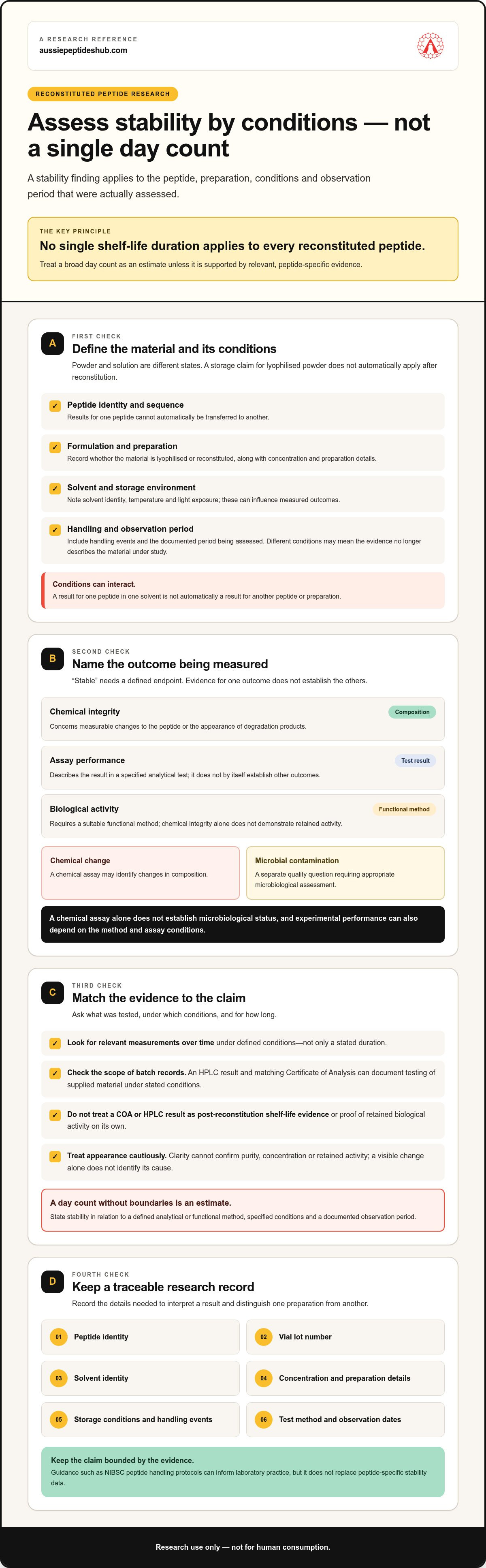
Post-reconstitution stability describes whether a peptide retains its defined properties under specified conditions over a documented period. It isn’t a universal property that can be expressed as one number. No single shelf-life duration applies to every reconstituted peptide. For peptide stability after reconstitution 2026, ask whether the evidence applies to the particular peptide, prepared form, storage conditions and observation period being considered.
Lyophilised powder and reconstituted solution are different states
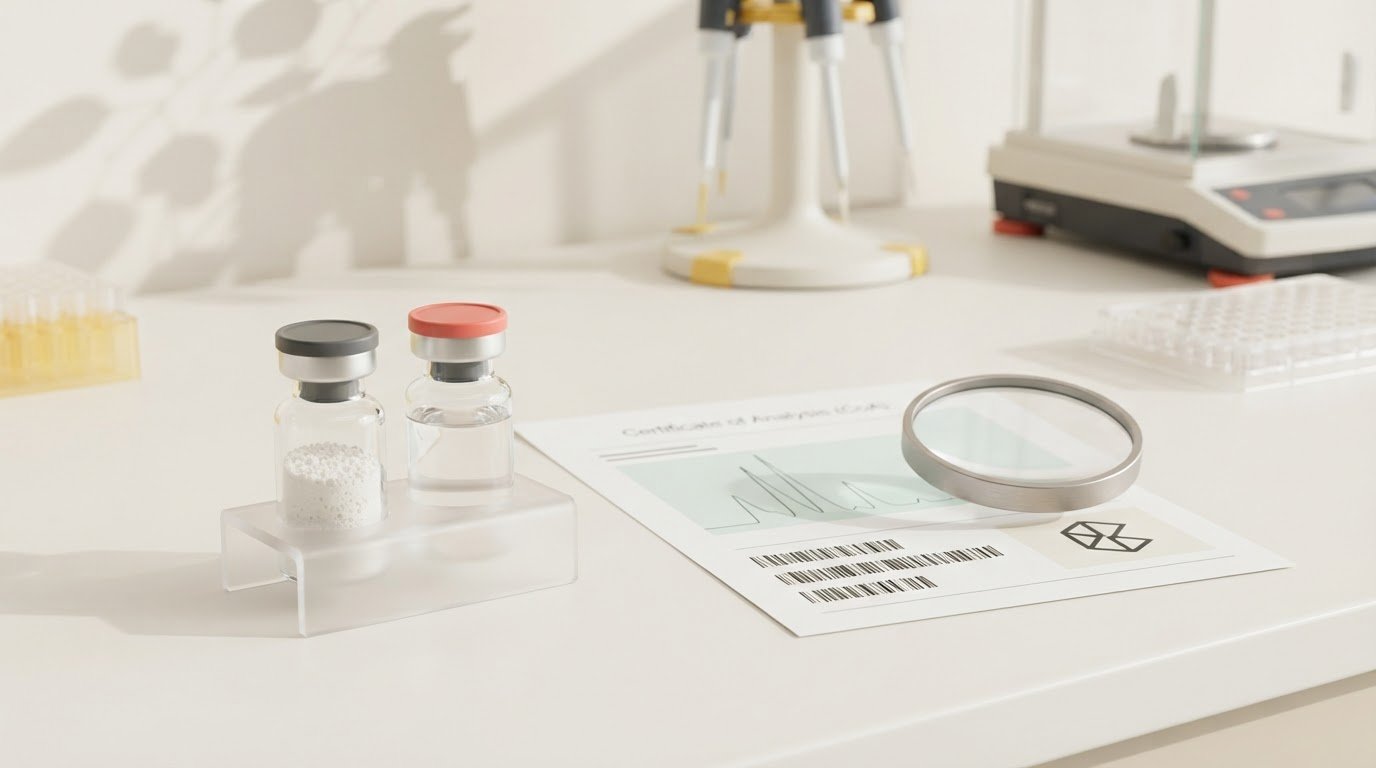
Lyophilisation removes water to produce a dry material and can support storage stability, but it doesn’t make the powder immune to degradation. Light, temperature, moisture exposure and packaging conditions can still affect it. A storage claim for lyophilised powder therefore can’t automatically be applied to a solution.
Adding solvent changes the material’s environment and introduces other variables, including solvent identity, concentration and exposure during handling. The peptide structure, formed from amino acids linked by peptide bonds, also helps identify which chemical changes may be relevant. Check whether product documentation and the research method refer to lyophilised material or a reconstituted preparation.
What does stability mean in a research context?
A stability claim needs a defined endpoint. Chemical integrity concerns measurable changes to the peptide or the appearance of degradation products. Assay performance describes the result in a specified analytical test. Biological activity is a separate outcome assessed through a suitable functional method. Evidence for one endpoint doesn’t establish the others.
These distinctions matter when interpreting batch records. An HPLC result and matching Certificate of Analysis can document testing of supplied material under stated conditions. On their own, they don’t establish post-reconstitution shelf life or retained biological activity. A stability assessment needs relevant measurements taken over time under defined conditions.
Chemical change is also distinct from microbial contamination and experimental performance. A chemical assay may identify changes in composition, while contamination requires appropriate microbiological assessment. Experimental performance can be affected by factors beyond the peptide’s chemical integrity, including the method and assay conditions. Don’t treat these outcomes as interchangeable.
Appearance is not a reliable substitute for measurement. A clear solution can’t establish purity, concentration or retained activity, and a visible change alone doesn’t identify its cause. State stability only in relation to a defined analytical or functional method, specified conditions and a documented observation period. Without those boundaries, a day count is an estimate, not a peptide-specific finding.
Why Reconstituted Peptides Change: Temperature, Chemistry and Handling
Reconstitution changes the conditions around a peptide; it doesn’t establish how long that peptide remains stable. Results can vary with sequence and formulation, solvent identity, concentration, temperature, light exposure and handling. These factors can interact, so a finding for one peptide in one solvent cannot automatically be transferred to another peptide or preparation.
Documented conditions determine how stability results can be interpreted. If the solvent, storage conditions or observation period differ, the evidence may not describe the material under study. Guidance such as the NIBSC peptide handling protocols can inform laboratory practice, but it doesn’t replace peptide-specific stability data.
Chemical degradation is not one process
Hydrolysis is a possible chemical change in aqueous conditions. Oxidation can affect susceptible parts of a molecule, while aggregation involves peptide molecules associating into larger assemblies. Whether these pathways occur, and to what extent, depends on the peptide and its environment. Without suitable data, avoid assigning a degradation rate or pathway to a specific sequence.
Temperature, light and concentration may influence a measured outcome, but listing possible factors doesn’t establish a particular shelf life. Research assessing peptide stability after reconstitution 2026 should connect each claim to the material tested, the preparation conditions and the analytical method used. That makes a general mechanism a testable, bounded finding.
Handling and contamination affect different quality questions
Repeated access to a container adds handling steps that may create a microbial contamination risk. This is separate from chemical degradation: a peptide may undergo chemical change without microbial contamination, and contamination can occur without demonstrating chemical degradation. A chemical assay alone doesn’t establish microbiological status.
Solvent and preservative presence also need careful interpretation. A preservative may be intended to limit microbial growth under specified conditions, but its presence doesn’t prove chemical stability or guarantee contamination-free material. It doesn’t replace appropriate handling or relevant testing. Reconstitution, solvent preservation and chemical stability are related considerations, not interchangeable terms.
For research records, log the peptide identity, solvent, concentration, preparation details, storage conditions and handling events alongside the test method and observation dates. This helps distinguish a change in chemical integrity from a contamination concern or an assay outcome. Research-grade peptides supplied by Aussie Peptides are for laboratory research use only, not for human consumption. Review research peptide batch documentation as one part of material verification.
Storage Conditions and Solvents: Compare Evidence, Not Blanket Timelines
A shelf-life figure is meaningful only when the evidence describes the same peptide, material form and conditions. Online day counts often omit those details. Treat context-free figures as non-transferable claims, not storage instructions. For peptide stability after reconstitution 2026, compare the evidence behind a duration before applying it to a research record.
Compare the material state and the evidence
| Material state | Condition to identify | Evidence required | Key limitation |
|---|---|---|---|
| Lyophilised powder | Documented packaging and storage conditions for the dry material | Product-specific data for that form, with the assessment method and observation period stated | Dry-state evidence does not establish stability after solvent is added |
| Reconstituted solution | Peptide, formulation, solvent, concentration, storage and handling conditions | Measurements over a documented period using a method suited to the stated stability endpoint | Results apply only to the tested preparation and conditions |
Why published shelf-life ranges can disagree
Studies may assess different peptide identities, formulations, solvents or concentrations. They may also use different analytical endpoints, sampling intervals and acceptance criteria. One assessment might track chemical change while another measures a different property. A reported duration without these details can’t show whether the results apply to another preparation.
Check what was tested, how it was stored, when samples were assessed and what counted as acceptable. If those details aren’t available, the duration isn’t a validated instruction for a different peptide or research setting. Don’t resolve conflicting ranges by choosing the longest or shortest number. First establish whether either source is relevant to the material in question.
What bacteriostatic water can and cannot establish
Bacteriostatic water contains a preservative intended to limit microbial growth under specified conditions. That role addresses a different question from chemical stability. The presence of a preservative doesn’t prove compatibility with a particular peptide, establish how long it remains chemically intact, prevent all contamination or replace appropriate handling.
Solvent compatibility means the solvent is suitable for the intended preparation; it isn’t evidence of a validated stability period. Refer to applicable product-specific documentation and research protocols for conditions relevant to the material and method. Don’t infer a universal temperature, freezing practice or discard period from a general online timeline.
For pre-experiment material verification, review research-grade peptides and batch documentation. Batch records support traceability, but they don’t substitute for a stability study of the reconstituted preparation.
A Research Record for Peptide Reconstitution and Storage
A traceable record makes stability observations easier to interpret and repeat. It should connect the material to its preparation, storage history and experimental endpoint. This is a documentation framework, not a universal reconstitution recipe or a protocol for human use. Follow the applicable laboratory procedure for preparation and handling.
Record the material and preparation context
Start with the peptide identity and vial lot number. Compare the lot number with the matching Certificate of Analysis (COA), and retain the relevant batch record with the experiment. Batch verification helps identify the starting material. It doesn’t establish the stability of a solution prepared from it.
Record the preparation details required by the approved research method, including solvent identity and any relevant formulation or concentration information. Note the preparation date and the relevant research record or experiment identifier. Link the record to the analytical or functional endpoint being assessed so results can be interpreted against the right question.
Track conditions and deviations consistently
Log the storage conditions specified by the laboratory procedure, along with access events and any deviations. Record when each observation or sample assessment was made. Entries made at the time of an event are more useful than a later reconstruction from memory.
- Material: peptide identity, vial lot number and linked COA.
- Preparation: solvent identity, preparation date and method-specific details.
- Storage and access: applicable conditions, access events and handling deviations.
- Assessment: observation date, analytical method and predefined acceptance criteria.
- Accountability: experiment identifier and responsible research record.
Record unexpected colour, clarity or other visible changes, but treat them as observations, not a stability test. A clear solution cannot certify chemical integrity, purity, concentration or retained activity. To evaluate change over time, use a suitable method and criteria defined before interpreting the results.
For peptide stability after reconstitution 2026, the record should show which material form was assessed and under what conditions. A reference on lyophilised peptide handling can provide additional context when published. Don’t infer a URL or substitute dry-state guidance for evidence about a prepared solution.
Review research-grade peptides and batch documentation to support pre-experiment material verification. Research-grade products are for laboratory use only, not for human consumption.
Use Batch Evidence Carefully: What a COA Says About Stability
A Certificate of Analysis (COA) is part of the evidence record for a supplied batch. It identifies the material and reports analytical results for testing performed under stated conditions. That information can support pre-experiment verification. It doesn’t automatically show how the peptide behaves after reconstitution or establish a shelf-life period for a prepared solution.
Purity at one time point does not establish future stability after reconstitution. A starting-material quality record and a stability study answer different questions. The first reports findings about a batch at a defined point in its testing. The second evaluates material over time under documented conditions, using specified time points and analytical endpoints.
What a batch COA can support
Use the vial lot number to identify the batch and compare it with the matching online batch details and COA. Check which analytical result is reported and what the documentation says was tested. Keep the COA linked to the relevant research record so the source material can be traced to the experiment.
An HPLC result provides information from that analysis. It doesn’t answer every question about identity, purity, chemical change or biological activity, and it shouldn’t be treated as evidence of post-reconstitution stability. Keep conclusions within the scope of the reported method and result.
When a stability conclusion needs more evidence
A stability claim needs peptide-specific data that identifies the tested material and preparation, states the conditions and time points, and describes the analytical endpoint. Determine whether the study measures chemical integrity, biological activity or another defined outcome. These are distinct results, not interchangeable measures.
For peptide stability after reconstitution 2026, a matching COA helps establish which supplied batch entered the research process. To support a conclusion about the reconstituted material, the evidence must also cover the relevant solution and documented conditions over time. A batch test can’t fill that gap by implication.
Aussie Peptides supplies research-grade peptides for laboratory use only, not for human consumption. Use the vial lot number to check matching batch details, and treat that documentation as one component of the broader research quality record. View research peptides and batch verification information.
Make Stability Decisions From Traceable Evidence
Peptide stability after reconstitution 2026 is not a universal day count. A defensible assessment links the peptide and prepared form to specified conditions, a documented observation period and a relevant analytical endpoint. Solvent choice, temperature and handling shape the context, while a batch COA records starting-material testing rather than proving how a reconstituted solution will perform over time.
Build a research record that connects the vial lot number, matching batch documentation, preparation details and storage history to the experiment. Visual appearance can flag a change, but it can’t establish chemical integrity, concentration or activity. Keep those conclusions tied to suitable measurements.
Aussie Peptides supplies research-grade peptides for laboratory use only, not for human consumption. Products are independently HPLC-tested and supplied with matching Certificates of Analysis. Batch details can be checked using the lot number printed on each vial. Australian packaging and domestic cold-chain shipping support handling before laboratory receipt, but don’t establish a post-reconstitution stability period.
Review research peptides and batch documentation to support pre-experiment material verification. With traceable records and peptide-specific evidence, research decisions can be more consistent and clearly qualified.
Frequently Asked Questions
How long does a reconstituted research peptide remain stable?
There’s no universal duration. Stability depends on the peptide, solvent, concentration, handling and storage conditions. For peptide stability after reconstitution 2026, use applicable product documentation or peptide-specific stability data. Check whether the evidence states the conditions, observation period and endpoint. If these details are missing, treat a day count as an estimate, not a validated shelf-life claim for the material being studied.
Does bacteriostatic water make a reconstituted peptide last longer?
Not necessarily. Its preservative may help address microbial growth under relevant conditions, but it doesn’t establish chemical stability or prevent every contamination event. Its effect can’t be assumed to be identical across different peptides and research conditions. Treat solvent selection and stability evidence as separate questions. Follow the documented research method applicable to the material rather than applying a general storage duration.
Can reconstituted peptides be frozen for storage?
Freezing isn’t a universal solution for preserving a reconstituted peptide. The outcome may depend on peptide identity, formulation, solvent, concentration and freeze-thaw history. Evidence for one preparation may not apply to another. Don’t assume freezing preserves chemical integrity or that thawing leaves a sample unchanged. Use only conditions supported by applicable documentation or a validated research method, and record any deviation.
How can you tell if a reconstituted peptide has degraded?
Appearance alone can’t confirm degradation or show that a sample remains suitable for a research assay. A change in colour or clarity may prompt investigation, but a clear solution doesn’t prove chemical integrity, purity, concentration or activity. A defensible conclusion requires an appropriate analytical method, defined acceptance criteria and documented conditions. Follow laboratory procedures when a sample shows an unexpected change.
Does an HPLC Certificate of Analysis confirm stability after reconstitution?
No. A batch-specific HPLC result reports an analytical finding for the tested sample under stated conditions at the time of analysis. It doesn’t automatically establish how the material behaves after solvent is added or during later storage. A post-reconstitution stability conclusion requires suitable data over time, with the peptide, preparation conditions, time points and analytical endpoint clearly identified.
Does peptide stability depend on the specific peptide?
Yes. Sequence and formulation can influence susceptibility to chemical change, while solvent, concentration, temperature, light and handling also affect the conditions being assessed. Evidence for one peptide shouldn’t be transferred automatically to another. Look for data tied to the specific research material and stated conditions. If suitable data aren’t available, record the uncertainty rather than assigning a fixed shelf-life period.
What should a laboratory record after reconstituting a research peptide?
Record the peptide identity, vial lot number, solvent and preparation details required by the research method, plus the preparation date, storage conditions and relevant handling events. Link these details to the experiment and its analytical endpoint. A consistent log helps interpret results and deviations, but doesn’t independently prove stability. Peptides supplied for research are for laboratory use only, not for human consumption.