Buy Research Peptides in Australia: A Supplier Evaluation Guide
September 28, 2026 · 16 min read
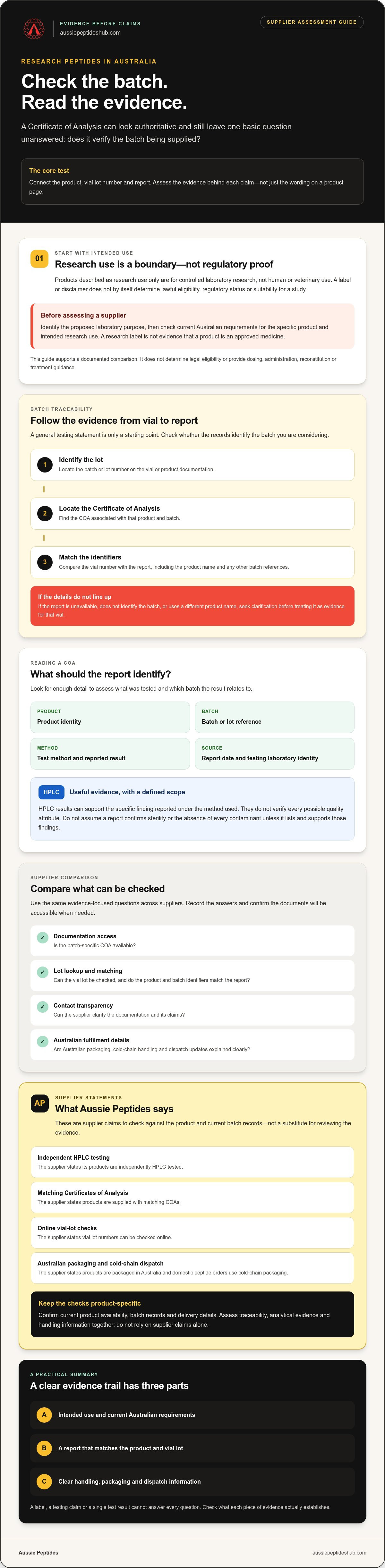
A Certificate of Analysis can look authoritative and still leave a basic question unanswered: does it verify the batch being supplied? If you’re searching “buy research peptides australia”, assess the evidence behind each claim, not just the wording on a product page.
Comparing suppliers can be difficult when test reports, lot numbers and handling details aren’t clearly connected. This guide explains what to check before ordering: whether analytical records identify the relevant batch, what a Certificate of Analysis does and doesn’t establish, and how Australian packaging and cold-chain dispatch are described.
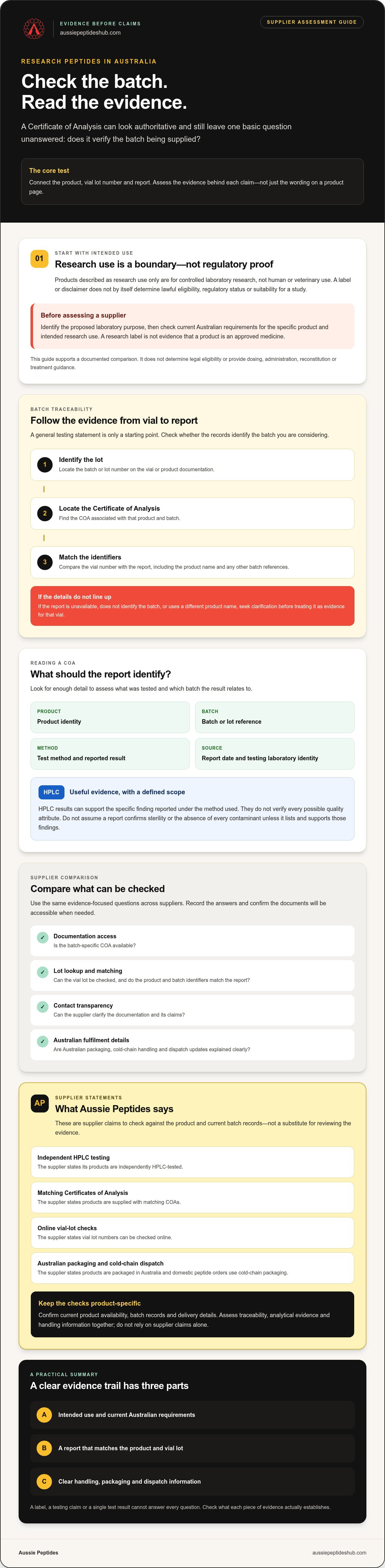
Aussie Peptides states that its products are independently HPLC-tested, supplied with matching Certificates of Analysis, and traceable through vial lot numbers that can be checked online. Check these details against the product and batch you’re considering. Products are for laboratory research only, not for human consumption. A research-use label doesn’t determine regulatory status on its own, so check current Australian requirements for the specific product and intended research use before proceeding. The aim is to assess traceability, analytical evidence and handling information, rather than relying on supplier claims alone.
Key Takeaways
- Before you buy research peptides australia, confirm the material is intended solely for controlled laboratory research, not human consumption.
- Check the vial lot number against its Certificate of Analysis, and confirm the identifiers match the batch being supplied.
- Use HPLC results as one part of the evidence. They don’t verify every possible quality attribute.
- Compare suppliers on documentation access, lot lookup, contact transparency, Australian packaging, and clear cold-chain and dispatch information.
- Aussie Peptides states that products are independently HPLC-tested, supplied with matching COAs and traceable through online lot verification. Check current batch records and delivery details before ordering.
Buying research peptides in Australia starts with intended use
Start by defining the work the material is intended to support. A supplier’s label, product description or disclaimer doesn’t determine whether a particular purchase is suitable or lawful. Before you buy research peptides australia, identify the proposed laboratory purpose and check the applicable Australian requirements for that material and intended use.
Peptides are short chains of amino acids, but that scientific description doesn’t establish a product’s regulatory status or suitability for a given study. Research-use materials are distinct from approved medicines. A research label isn’t evidence that a product is an approved medicine, nor does it replace an assessment of the relevant rules.
What does research use only mean?
It sets a clear boundary: products described as research use only are supplied for controlled laboratory research, not for human or veterinary use. They aren’t presented here as medicines, and this section doesn’t provide dosing, administration, reconstitution or treatment guidance. A label alone doesn’t establish lawful eligibility. Check current requirements with relevant Australian authorities or a qualified adviser before ordering.
Keep the evaluation focused on evidence and process. Confirm that the product is clearly identified, the batch documentation refers to the vial lot being supplied, and the supplier explains its Australian packaging, handling and dispatch arrangements. These checks help assess traceability and fulfilment. They don’t establish regulatory approval or suitability for human use.
Which supplier questions should come first?
Ask direct, verifiable questions before placing an order. Can you identify the product and its batch? Is the Certificate of Analysis available, and do its identifiers match the vial lot? Can you check the lot details after purchase? What does the supplier state about Australian packaging, cold-chain handling and dispatch updates? Record the answers and confirm the documentation will be accessible when you need it.
Aussie Peptides states that its products are for laboratory research only, not human consumption. It also states that products are independently HPLC-tested, supplied with matching Certificates of Analysis, packaged in Australia, and traceable through online vial-lot checks. Domestic peptide orders use cold-chain packaging. Confirm current product availability, batch records and delivery details before ordering.
This guide focuses on supplier assessment, product documentation and Australian fulfilment information. It supports a documented comparison, not a determination of legal eligibility. Verify current requirements for the specific product and intended research use before proceeding.
Check batch evidence before you buy research peptides
A supplier’s testing statement is only a starting point. The key question is whether the records identify the specific batch under consideration and explain what was tested. For anyone searching “buy research peptides australia”, batch traceability provides a practical way to assess documentation instead of relying on a general quality claim.
Use this sequence before ordering:
- Identify the lot: Locate the batch or lot number on the vial or product documentation.
- Locate the COA: Find the Certificate of Analysis associated with that product and batch.
- Match the identifiers: Compare the vial number with the report, including the product name and any other batch references.
If a report is unavailable, doesn’t identify the batch, or uses a different product name, ask the supplier to clarify before treating it as evidence for that vial.
What should a peptide Certificate of Analysis show?
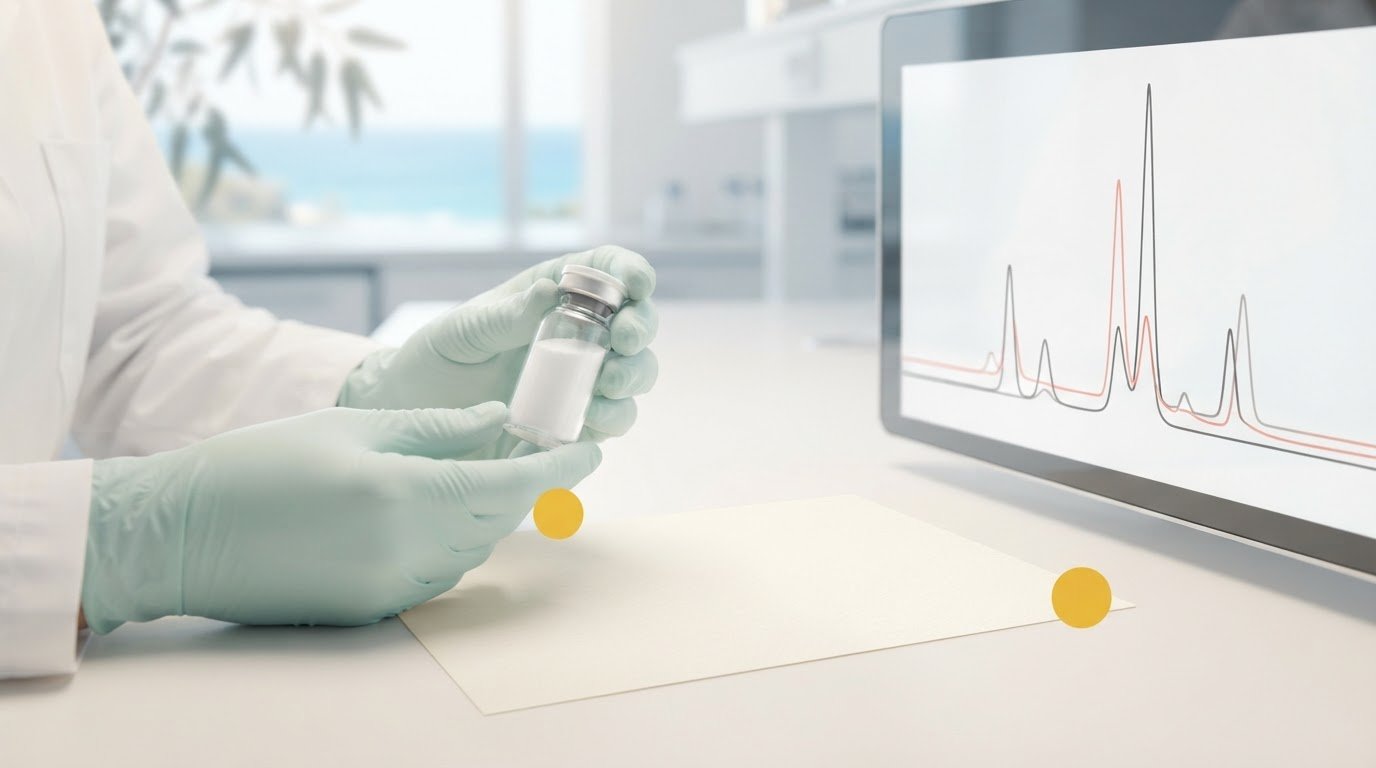
Check for the product identity, batch or lot reference, test method, reported result, report date and testing laboratory’s identity. A document that says “independently tested” but names no laboratory or method offers less detail to assess than a report that records those particulars. The claim and the underlying report are not the same evidence.
Interpret the result within its stated scope. HPLC results can support the specific finding reported under the method used, but they don’t establish every possible quality attribute. Unless a report lists and supports them, don’t assume it confirms attributes such as sterility or the absence of every contaminant. Check what the result measures, and what it doesn’t.
How do you match a COA to a vial?
Match the vial’s lot number directly to the report’s batch identifier. Then check that the product naming and batch details are consistent across the vial, COA and any supplier lot lookup. A near-match isn’t a confirmed match. Missing, mismatched or unverifiable details warrant clarification before you rely on the report.
Aussie Peptides states that its products are independently HPLC-tested, supplied with matching COAs, and traceable through online vial-lot checks. Verify the current report and lot details for the specific product. For a closer look at how testing claims should be assessed, read this guide to third-party tested peptides in Australia.
Testing records don’t change the research-use boundary. Products are for research use only, not for human consumption. Harvard Health Publishing discusses the benefits and risks of supplementing; that health information is not a substitute for checking Australian requirements or evidence for a research product.
To apply these checks, review the supplier’s available product and batch information at Aussie Peptides online.
Compare research-peptide suppliers using evidence, not promises
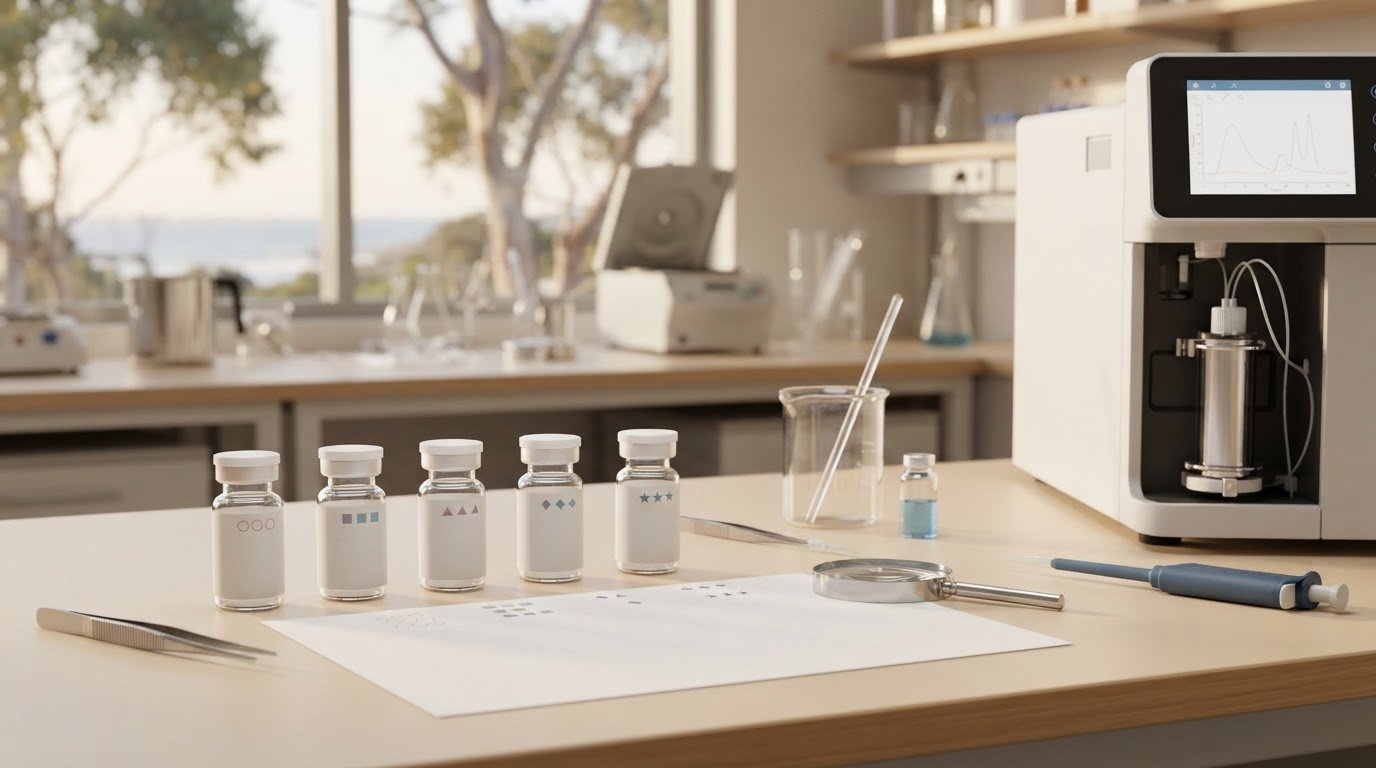
Use the same criteria for each supplier. A comparison is useful when it separates information you can inspect from claims that remain unsupported. A broad statement such as “high purity” isn’t a substitute for a batch-linked report, a stated test method or a clear explanation of what the result measures.
| Criterion | What to check |
|---|---|
| Batch evidence | Does the supplier provide a report that identifies the product and relevant batch or lot? |
| COA access | Can you review the Certificate of Analysis before ordering, and does it include a method, result, report date and testing-laboratory details? |
| Lot lookup | Can the vial identifier be used to retrieve or confirm matching batch information? |
| Contact transparency | Is the business identity clear, and can you ask specific questions about records or fulfilment? |
| Australian packaging | Does the supplier explain where products are packaged? |
| Cold-chain information | Are cold-chain arrangements described separately from general packaging claims? |
| Dispatch communication | Does the supplier explain what dispatch updates are provided and how delivery details can be checked? |
Which supplier details can you verify?
Look for records tied to identifiers printed on the vial, not just a generic product page. Note what’s available, what can be checked, and what remains unclear. If a lot lookup returns no matching record or a supplier doesn’t answer a specific question, record that gap. Missing information isn’t evidence of quality.
Aussie Peptides states that products are independently HPLC-tested, supplied with matching COAs, and traceable through online vial-lot checks. The business also states that products are packaged in Australia and domestic peptide orders use cold-chain packaging. Check the current batch records and delivery details for the product you’re assessing.
How should testing claims be compared?
Compare like with like: the stated analytical method, report identifiers, result and testing-laboratory information. An HPLC result can support the finding reported under that method, but it isn’t a complete safety assessment or proof of every quality attribute. Treat unqualified purity or quality language as a claim until its supporting evidence is available.
For a worked example of reading product documentation, see BPC-157 purity test results and COA interpretation. For additional context on evaluating a specific research-only product, review the BPC-157 Australia sourcing and verification guide.
Keep the intended-use boundary clear during comparison: products are for research use only, not for human consumption. If you’re assessing where to buy research peptides australia, rank suppliers by the records and handling details you can verify, not by the strength of their marketing language.
Review Australian fulfilment and research-use requirements before ordering
Fulfilment details affect how a research order is handled and documented. Before you buy research peptides australia, confirm what the supplier means by Australian packaging, how domestic dispatch is described, and what updates are provided. These details help you assess the process. They don’t establish a delivery time, guarantee a particular transit temperature or determine whether a product is lawful for a specific purpose.
What should you confirm about cold-chain delivery?
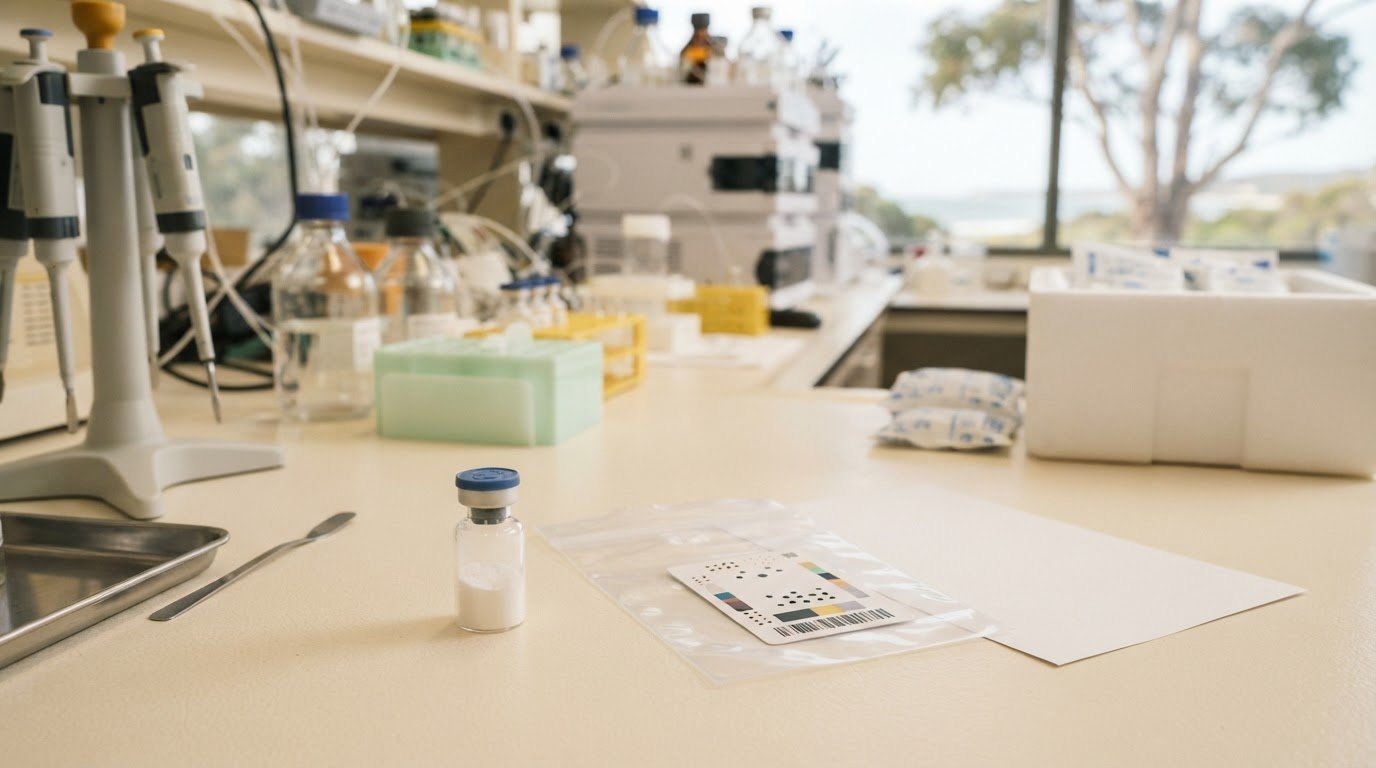
Ask how cold-chain packaging is used for domestic peptide orders and what dispatch information you’ll receive. Clarify what steps are available if a parcel arrives damaged or appears inconsistent with the supplier’s stated handling process. The phrase “cold-chain” alone doesn’t verify temperature performance throughout transit. Don’t infer validated conditions unless the supplier provides supporting information.
Aussie Peptides states that products are packaged in Australia and domestic peptide orders use cold-chain packaging. Check the current fulfilment details for the specific order. Also confirm whether you can access product documentation and batch records after purchase, not only while reviewing the product page. Retained records support later reference to the supplied lot.
What should you verify before checkout?
Confirm that the material is appropriate for the stated laboratory purpose, and check current Australian requirements for that product and intended use. If classification or legal eligibility is unclear, pause and seek advice from a qualified adviser or relevant authority. A supplier’s research-use description doesn’t resolve those questions.
- Check the product identity and the intended research purpose.
- Confirm the available lot information and that its COA matches the identified batch.
- Review the order details, Australian packaging information and stated dispatch process.
- Ask how product and batch documents can be accessed after the order is placed.
- Record any unanswered handling or documentation questions before proceeding.
Keep the boundary explicit: products described as research use only are not intended for human or veterinary use. Documentation and fulfilment checks can help assess a supplier’s process, but they don’t establish human-use suitability, regulatory approval or a particular legal outcome. Verify the applicable requirements for the material and research purpose independently.
Aussie Peptides describes its catalogue as research-use-only and states that domestic peptide orders use cold-chain packaging. Review the available product, batch and fulfilment information before deciding whether it meets your laboratory procurement requirements. For that assessment, review the research-peptide product information.
Aussie Peptides: assess the documented process, then decide
Aussie Peptides describes a supplier process that can be assessed through specific records rather than general assurances. The business states that its products are independently HPLC-tested, supplied with matching Certificates of Analysis, and traceable through online batch-detail checks using the lot number printed on each vial. These are stated business details, not a substitute for reviewing the report and matching it to the batch under consideration.
What documentation does Aussie Peptides describe?
The business states that products are supplied with matching COAs and that vial lot numbers can be checked online. For a specific product, review the available report and compare its product name and batch identifier with the vial details. Check what the stated HPLC result measures, and keep its limits in view. A reported analytical result doesn’t establish every possible quality attribute.
Before ordering, confirm that the records you need are available for the current batch and can be accessed after purchase. If an identifier is missing or doesn’t match, ask for clarification rather than assuming the documents apply. Keep a copy of the relevant product and batch records with your laboratory procurement documentation.
What is the next step for a laboratory buyer?
Apply the same criteria to the supplier’s current information: product identification, batch traceability, COA access, Australian packaging and stated fulfilment arrangements. Confirm current availability, lot-specific documentation and delivery details before making a decision. If the available records don’t meet your laboratory’s procurement requirements, pause and resolve the gap before ordering.
That boundary is separate from any regulatory assessment. Verify current Australian requirements for the specific material and intended research purpose. Direct unresolved questions about classification or legal eligibility to relevant authorities or qualified advisers. Experimental design questions should also go to appropriately qualified professionals.
If your assessment indicates that the available documentation and fulfilment information meet your laboratory’s requirements, you can review the current research products and laboratory supplies. If you’re looking to buy research peptides australia, make the decision using the current product and batch records, not a general claim or the research-only label alone.
Make the decision from records, not claims
A sound supplier assessment starts with intended use, then checks whether batch records identify the product being supplied. Match the vial lot to its Certificate of Analysis, and interpret HPLC results within the limits of the stated method. These checks help you compare documented evidence without treating a test result as proof of every quality attribute.
Before you buy research peptides australia, confirm current Australian requirements for the specific material and research purpose. Review the supplier’s packaging, cold-chain and dispatch information as well.
Aussie Peptides states that products are independently HPLC-tested and supplied with matching Certificates of Analysis. Vial lot numbers can be checked online, products are packaged in Australia, and domestic peptide orders use cold-chain packaging. Verify the current batch documents and fulfilment details for the product you’re assessing.
Review the research-use-only product range and available batch information, then decide whether the records meet your laboratory procurement requirements. An evidence-led review helps you make a decision based on the information available.
Frequently Asked Questions
How can I buy research peptides in Australia for laboratory use?
For laboratory procurement, first define the research purpose and verify current Australian requirements for the specific material and intended use. Then compare suppliers using identifiable product and batch information, a matching Certificate of Analysis (COA), and clear Australian packaging and dispatch details. Searches for “buy research peptides australia” can return different supplier claims, so assess the records available for the specific batch rather than relying on general statements.
Are research peptides for human consumption?
No. Products described as research use only are for controlled laboratory research and are not intended for human or veterinary use. They aren’t instructions or recommendations for personal use. A research-only label also doesn’t establish a product’s regulatory status or make it suitable for another purpose. If you’re considering a product for a non-laboratory use, don’t rely on supplier wording; consult a qualified health professional and check relevant Australian requirements.
How can I verify a peptide batch number and Certificate of Analysis?
Compare the lot number printed on the vial with the batch identifier on the COA. Check that the product name and other batch details are consistent, then review the stated test method, result, report date and testing-laboratory information. Aussie Peptides states that vial lot numbers can be checked online and products are supplied with matching COAs. Confirm the current record applies to the specific vial or batch you’re assessing.
Does HPLC testing prove a research peptide is safe for human use?
No. HPLC testing reports findings associated with the method and result stated in the analytical record. It doesn’t, by itself, establish every quality attribute or prove that a research product is safe or suitable for human use. Read the report within its stated scope, and don’t interpret a purity-related result as a complete safety assessment. Research-use-only products are not for human consumption; seek qualified medical advice for health questions.
What should I check before ordering research peptides online in Australia?
Confirm that the product is intended for your controlled laboratory research, then check current Australian requirements for that material and purpose. Review product identity, batch documentation and whether the COA matches the relevant lot. Also verify the supplier’s Australian packaging, cold-chain and dispatch information, and whether documents remain accessible after purchase. If regulatory classification or legal eligibility is uncertain, consult relevant authorities or a qualified adviser before proceeding.
Can research peptides be shipped across Australia using cold-chain packaging?
Aussie Peptides states that domestic peptide orders are shipped using cold-chain packaging across Australia. Check current fulfilment and delivery details for the order you’re considering, including the supplier’s description of packaging and dispatch updates. The term “cold-chain” alone doesn’t confirm temperature conditions throughout transit or guarantee a particular delivery outcome. Ask what information is available if a shipment arrives damaged or appears inconsistent with the stated handling process.
What should I do if a vial lot number does not match its Certificate of Analysis?
Don’t treat the COA as evidence for that vial until the discrepancy is resolved. Recheck the vial and report identifiers, then contact the supplier with the product name and mismatched lot details. Ask for clarification or documentation that clearly corresponds to the batch. Keep a record of the discrepancy and response. If the batch still can’t be verified, don’t rely on the unmatched report when assessing the product for laboratory procurement.