Semaglutide Peptide for Research: Mechanism, Evidence and In Vitro Scope
October 4, 2026 · 14 min read
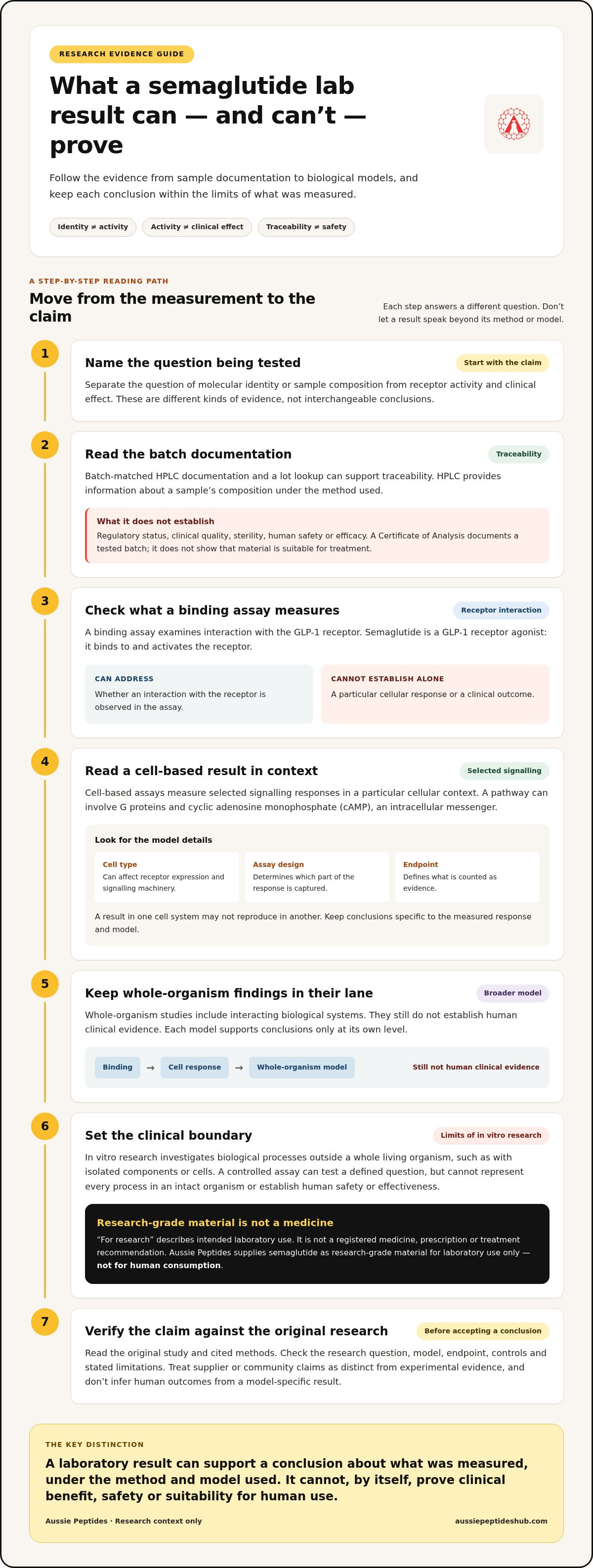
What can a laboratory result actually prove about a peptide? The distinction matters when assessing semaglutide peptide for research. Semaglutide is a synthetic peptide that acts as a glucagon-like peptide-1 (GLP-1) receptor agonist, but research-grade material is not the same as an approved medicine. Understanding that boundary helps when interpreting what in vitro findings can establish.
This article explains semaglutide’s molecular identity and receptor activity, then outlines what laboratory research can investigate and where its conclusions stop. An assay can measure a defined response under controlled conditions. It cannot, by itself, establish clinical benefit, safety or suitability for human use.
The discussion separates experimental evidence from supplier or community claims, and explains why batch documentation supports traceability without proving clinical efficacy. It also distinguishes research-only material from medicines supplied through approved channels in Australia. Use this framework to interpret mechanisms, assess in vitro evidence and recognise the limits of what a research-grade sample can show.
Key Takeaways
- Distinguish semaglutide’s GLP-1 receptor activity from the regulatory and clinical status of a medicine. Research material isn’t a treatment recommendation.
- Check what a receptor assay measures, then keep conclusions specific to that model and endpoint.
- Separate molecular identity, purity, biological activity and clinical evidence when assessing a claim.
- Read original studies and cited methods. Check the research question, controls and limitations before accepting a conclusion.
- For semaglutide peptide for research, batch-matched HPLC documentation and lot lookup support traceability, not proof of efficacy, sterility or human safety.
What semaglutide is, and what “for research” means
Semaglutide is a peptide medicine and an agonist of the glucagon-like peptide-1 (GLP-1) receptor. In plain terms, it binds to and activates that receptor, which is involved in glucose regulation and appetite signalling. Receptor activation describes a biological mechanism, not a guaranteed clinical outcome. The Semaglutide overview summarises its identity and pharmacology; research claims still need to be checked against the original studies they cite.
The phrase semaglutide peptide for research describes material intended for laboratory investigation. It doesn’t make that material a registered medicine, a prescription or a treatment recommendation. The label defines its intended use, not its suitability for people.
Semaglutide’s molecular identity in brief
Semaglutide is based on glucagon-like peptide-1, a naturally occurring signalling molecule, and acts at the GLP-1 receptor. An agonist activates a receptor, like a key engaging a lock and triggering a cellular response. What happens next depends on the biological system being studied. A response in a cell model does not, by itself, predict a clinical effect in a person.
Research material is not a medicine
In vitro research means investigating biological processes outside a whole living organism, such as through work with isolated components or cells. It can test a defined question in a controlled model, but it cannot represent every process in an intact organism or establish that a substance is safe or effective for human use.
Analytical results also have defined limits. For example, high-performance liquid chromatography (HPLC) can provide information about a sample’s composition under the method used. That result does not establish regulatory status, clinical quality, sterility or human safety. A Certificate of Analysis is documentation about a tested batch, not evidence that the material is suitable for treatment.
Aussie Peptides supplies semaglutide as research-grade material for laboratory use only. It is not for human consumption. Research-grade testing and documentation cannot establish safe human use. The material must not be treated as a medicine or used as a basis for self-experimentation or treatment decisions.
How semaglutide interacts with the GLP-1 receptor
GLP-1 receptor agonism means a molecule binds to the receptor and activates it, initiating cellular signalling. It does not promise a particular outcome. Semaglutide’s receptor activity is established pharmacology. The size and meaning of a response in a specific experiment depend on the model and endpoint being measured.
What GLP-1 receptor agonism describes
The GLP-1 receptor is a cell-surface receptor in the G protein-coupled receptor family. In broad terms, semaglutide binds the receptor, receptor activation engages intracellular signalling proteins, and the cell produces a measurable response. One pathway involves G proteins and cyclic adenosine monophosphate (cAMP), an intracellular messenger. The review of semaglutide’s mechanism provides further pharmacological context. The pathway explains how a signal can begin; it does not, by itself, establish an effect in a whole organism.
That distinction matters in studies of the semaglutide peptide for research. A receptor-binding result, a change in a signalling marker and a response in an animal model are different observations. Each supports conclusions at its own level, not automatic claims about human outcomes.
Why findings depend on the research model
Experimental conditions shape what researchers observe. Cell type can affect receptor expression and the surrounding signalling machinery. Assay design determines which part of the response is captured, and the chosen endpoint determines what is counted as evidence. A result from one cell system may not reproduce in another. Check these details in the original paper and methods rather than inferring them from a headline or summary.
- Binding assays examine interaction with the receptor.
- Cell-based assays measure selected signalling responses in a particular cellular context.
- Whole-organism studies include interacting biological systems but still don’t establish human clinical evidence.
When interpreting a model-specific claim, note the system, controls and endpoint, then check whether the authors identify limitations. An established mechanism can guide a research question, but it cannot remove the boundaries of the model.
Evidence also remains molecule-specific. Similar target pathways don’t make different peptides interchangeable, and findings about semaglutide shouldn’t be transferred to retatrutide without supporting data. The retatrutide research peptide overview discusses a separate molecule and its evidence. For laboratory context, review research-grade semaglutide with the same distinction between material documentation and biological conclusions.
What semaglutide studies can show, and what they cannot
Different evidence answers different questions. A result about a sample’s composition is not the same as a result about receptor activity, and neither alone establishes a clinical effect. For semaglutide peptide for research, interpret each finding against the method used, the controls reported and the limits of the study design.
| Evidence type | What it can address | What it cannot establish on its own |
|---|---|---|
| Identity | Whether analytical data support the expected molecule, depending on the tests used. | Purity, biological activity or clinical suitability. |
| Purity | The proportion of detected material attributed to a component under a specified analytical method. | Confirmed identity, sterility, functional activity or safety. |
| Biological activity | Whether a defined model shows a measured response under stated assay conditions. | Effects in other models or in people. |
| Clinical evidence | Outcomes measured in human studies with a defined design and population. | Automatic relevance to every use, population or research material. |
Analytical quality is not biological validation
An HPLC chromatogram separates detected components under the conditions of the method. A reported purity value reflects the analysis and calculation used; interpretation depends on the method, documentation and sample tested. It is not, by itself, proof of molecular identity or receptor function. Purity data alone cannot establish biological activity or clinical benefit. An HPLC result also does not establish sterility or human safety.
Documentation is useful when it is batch-matched and traceable. Aussie Peptides supplies semaglutide with independent HPLC testing and a batch-matched Certificate of Analysis; lot details can be checked online. These records support analytical review and batch traceability. They don’t convert research material into a medicine or demonstrate efficacy.
The same evidence discipline applies across molecules, but conclusions don’t transfer between them. The BPC-157 research-only verification guide concerns a separate peptide. Its evidence cannot validate semaglutide, and semaglutide findings cannot validate BPC-157.
Read research claims at the right evidence level
Classify the evidence before interpreting a claim. Cell-based findings concern a specific laboratory model and endpoint. Animal studies add whole-organism biology but remain distinct from human research. Human clinical evidence requires human studies; it cannot be inferred from a cell response, an animal result or a vendor description.
For any claimed outcome, locate the original paper and check the research question, model, controls, endpoint and limitations. Ask whether the result was reproducible and whether the cited study directly tested semaglutide. A summary without a supporting citation is not a substitute for primary evidence.
How to assess semaglutide research literature without overclaiming
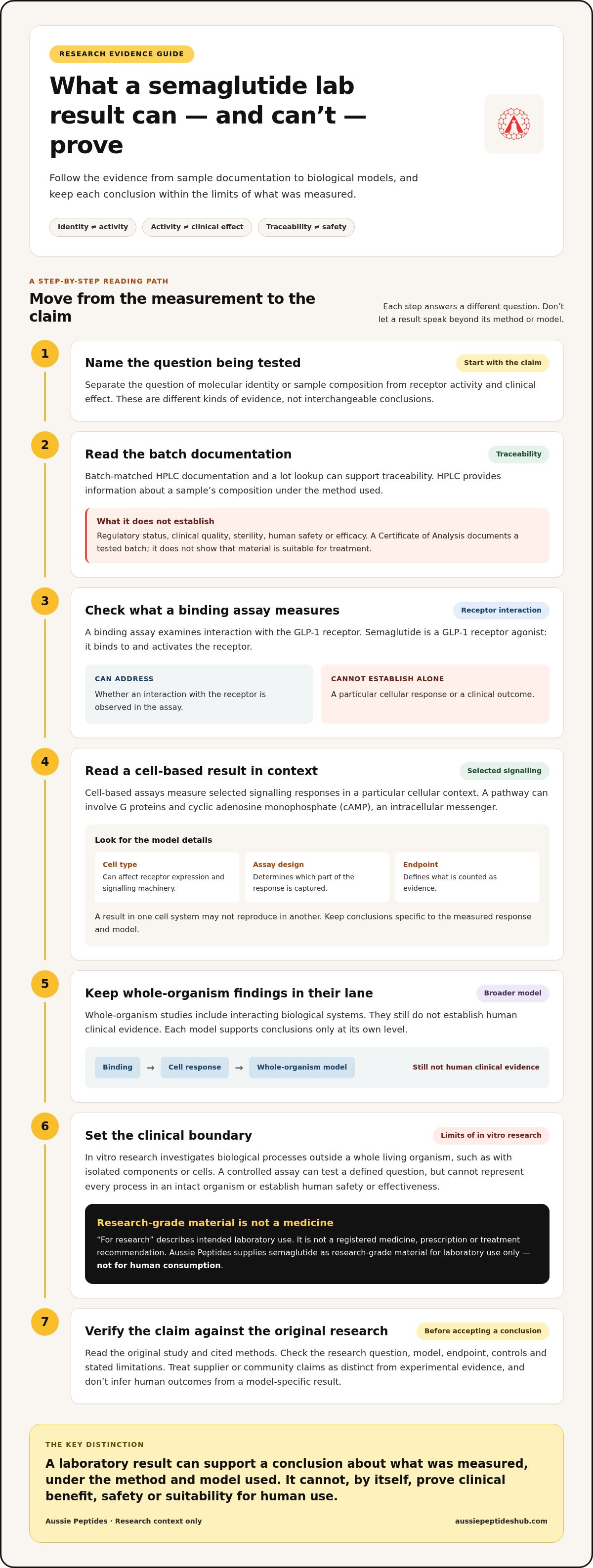
A study’s conclusion is only as broad as its design allows. Before accepting a claim about semaglutide, trace it to the original paper and identify what researchers actually tested. Summaries can omit model details, controls or caveats that change how a finding should be interpreted.
A concise framework for reading a study
Read the methods and results alongside the abstract. Record the study question, model, endpoint, comparison groups and the authors’ stated limitations. This helps distinguish a measured result from a wider interpretation.
- Question: Does the paper investigate receptor binding, a cellular response or another defined outcome?
- Model: What cells or other research system were used, and what can that model represent?
- Endpoint: What was measured? A change in one marker isn’t automatically evidence of a broader biological effect.
- Controls: What comparisons were included, and do they support the stated interpretation?
- Limitations: What qualifications do the authors report, and do the conclusions stay within those boundaries?
Study design determines what an experiment can support. A receptor-binding assay can address binding under its test conditions, but cannot by itself establish downstream effects in every cell type or whole-organism outcomes. A cell-based result also doesn’t settle clinical relevance.
Separate evidence from interpretation
Follow each claim back to its cited source. Confirm that the paper studied semaglutide, not another peptide or a related compound, then check whether the summary accurately reflects the research question and endpoint. If a claim rests on a review, follow its references to the primary study before treating the claim as established.
Keep three categories distinct: what the experiment directly measured, what the authors infer from that result, and what remains a hypothesis. A proposed mechanism may be plausible without being demonstrated by that particular experiment. One result also cannot establish reproducibility. Replication, independent evidence and testing across relevant models help assess whether a finding holds beyond a single set of conditions.
Apply the same discipline to claims about semaglutide peptide for research. Vendor descriptions and community summaries aren’t substitutes for cited methods and results. Record the evidence level, then limit your conclusion to it.
For laboratory research use only, review research-grade semaglutide with its batch documentation, while keeping product traceability separate from claims about biological or clinical evidence.
Australian research-only boundaries and traceable semaglutide material
In Australia, research-use labelling defines the intended scope of a material. It doesn’t make it a registered medicine or authorise human use. Aussie Peptides supplies semaglutide for laboratory research only. It is never for human consumption, and its analytical documentation cannot establish safety or suitability for people.
Research teams should check current Therapeutic Goods Administration (TGA) guidance and applicable institutional requirements before using research material. Requirements can depend on the research context. Supplier records support sample traceability; they don’t replace institutional oversight, approvals or other applicable requirements.
What batch documentation can establish
A lot number links a vial to its corresponding batch documentation. Aussie Peptides provides independent HPLC testing, a batch-matched Certificate of Analysis (COA) and online lot-number lookup. These records help researchers identify the batch and review the analytical results reported for it.
A COA has a defined scope. It reports specified results for the tested material using stated analytical methods. It doesn’t necessarily cover every quality attribute, and it cannot, by itself, prove efficacy, regulatory approval, sterility or suitability for human use. Read the document as a batch record, not as clinical evidence.
Keep Australian research use within its proper scope
Australian packaging and domestic cold-chain dispatch describe handling and fulfilment. They don’t establish clinical suitability or change the research-only status of the material. Keep the intended use clear in records, and apply relevant institutional requirements alongside supplier documentation.
For work involving the semaglutide peptide for research, separate three questions: what the batch records document, what the research model measures and what current Australian requirements apply. Each needs its own evidence. Don’t treat a COA as a substitute for regulatory guidance or institutional review.
To review the material’s research-only scope and batch traceability information, view semaglutide research material.
Keep research evidence within its limits
Semaglutide activates the GLP-1 receptor, but a response in a defined laboratory model isn’t proof of a clinical outcome. Interpret each study according to its model, controls and measured endpoint, and trace broad claims back to the original research. That discipline helps distinguish evidence from interpretation.
For semaglutide peptide for research, analytical records answer questions about the documented batch, not its clinical efficacy or suitability for people. Aussie Peptides supplies semaglutide for laboratory research only, never human consumption. Independent HPLC testing, batch-matched Certificates of Analysis and online lot-number lookup support review and traceability. Australian packaging and domestic cold-chain shipping describe handling, not clinical suitability.
Keep research use within the relevant institutional requirements and consult current TGA guidance where applicable. For material details and batch documentation, view semaglutide research material. A clear separation between sample records, experimental findings and clinical evidence makes research interpretation more precise and responsible.
Frequently Asked Questions
What is semaglutide as a research peptide?
Semaglutide is a peptide that acts as an agonist of the glucagon-like peptide-1 (GLP-1) receptor. As a research peptide, it refers to material intended for laboratory investigation, not a prescription or treatment recommendation. Research-grade semaglutide is for laboratory use only and is not for human consumption. Findings from research material must be interpreted within the limits of the particular sample, method and model studied.
How does semaglutide interact with the GLP-1 receptor?
Semaglutide binds to and activates the GLP-1 receptor, initiating cellular signalling. An agonist is a molecule that activates a receptor; the term describes a mechanism, not a guaranteed outcome. A laboratory assay may examine receptor binding or a selected downstream response, but results depend on the model and endpoint. Receptor activity alone doesn’t establish an effect in a whole organism or a clinical outcome.
Can in vitro semaglutide research predict effects in humans?
No. In vitro research investigates biological processes outside a whole living organism, often using cells or isolated components. It can provide evidence about a defined response in that system, but it doesn’t reproduce all the interacting processes of a living organism. A result may inform a research question, but it can’t by itself predict human effects or establish safety, efficacy or suitability for human use.
Does an HPLC purity result prove semaglutide is biologically active?
No. High-performance liquid chromatography (HPLC) separates detected components under the conditions of a particular analytical method. A reported purity result addresses the sample’s composition as assessed by that method. It doesn’t, by itself, confirm receptor activity, sterility, human safety or clinical benefit. Biological activity requires relevant functional evidence, and conclusions must remain limited to the assay and conditions reported.
Is research-grade semaglutide the same as prescription semaglutide?
No. Research-grade semaglutide is supplied for laboratory investigation and isn’t interchangeable with a registered prescription medicine. A research-use label doesn’t establish therapeutic suitability, regulatory status or clinical quality. Aussie Peptides supplies semaglutide for laboratory use only, never human consumption. Analytical testing and batch records don’t turn research material into a medicine or support its use as a treatment.
How should researchers assess claims about semaglutide studies?
Trace each claim to the original paper and confirm that the study investigated semaglutide. Identify the research question, model, measured endpoint, comparison groups and limitations. Then check whether the authors’ conclusions match their results and study design. Treat hypotheses as hypotheses, and don’t infer human effects from cell-based findings, vendor descriptions or summaries without directly relevant evidence.
What does a semaglutide Certificate of Analysis tell you?
A Certificate of Analysis (COA) reports specified analytical results for a tested batch. A batch-matched COA, considered alongside the vial’s lot number, helps connect the material to its documentation. Aussie Peptides provides independent HPLC testing, batch-matched COAs and online lot-number lookup. A COA’s scope is limited to the tests and results it reports; it doesn’t establish efficacy, regulatory approval, sterility or suitability for human use.