Tirzepatide Laboratory Research Vial: A Buyer’s Guide
October 6, 2026 · 15 min read
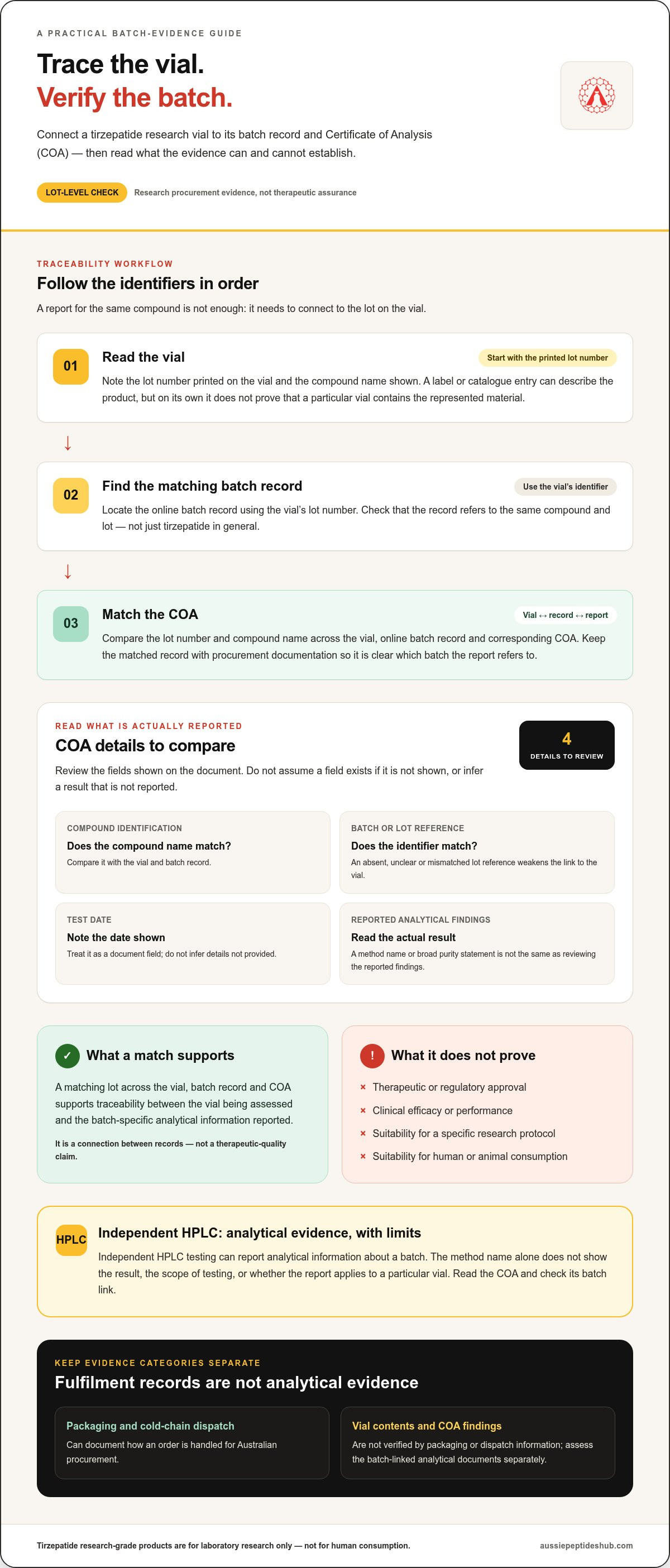
What evidence shows that a tirzepatide laboratory research vial is linked to the batch information presented for it? A catalogue description or broad purity claim is not enough. Start with a practical traceability check: match the lot number printed on the vial to its online batch record and the corresponding Certificate of Analysis (COA).
Before selecting research material, review the batch-specific documents rather than relying on marketing language. This guide explains how to compare identifiers and read the information reported on a COA, what independent HPLC testing can tell you, and what it cannot prove. A purity result is analytical information, not proof of therapeutic approval or clinical efficacy.
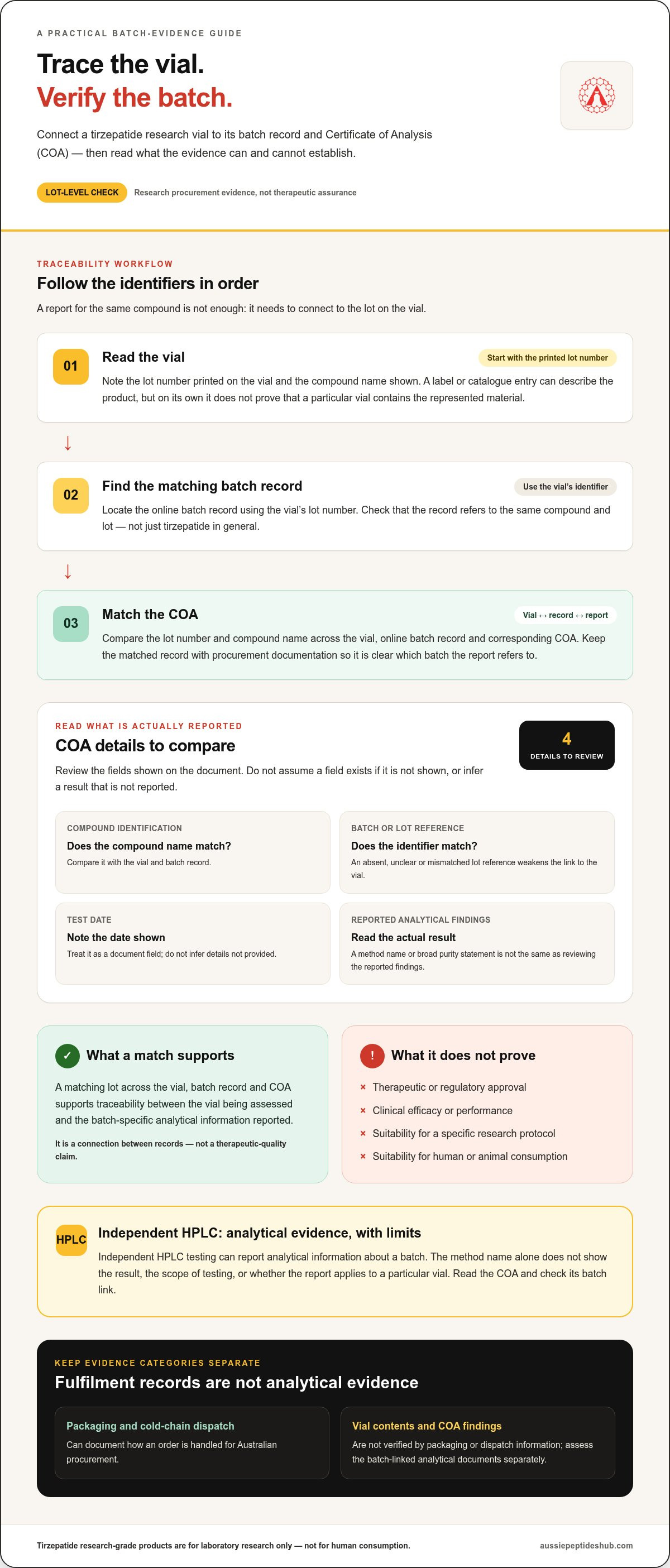
For Australian procurement, keep fulfilment records separate from analytical evidence. Packaging and cold-chain dispatch information can help document how an order is handled, but they do not verify vial contents or COA findings. Tirzepatide research-grade products are for laboratory research only and are not for human consumption. This is a procurement guide, not advice about treatment or therapeutic use.
Key Takeaways
- Assess a tirzepatide laboratory research vial by checking its stated research scope, product identity and batch records separately.
- Match the vial’s printed lot number to its online batch record and corresponding Certificate of Analysis.
- Use independent HPLC testing as analytical evidence, not as proof of therapeutic approval or clinical efficacy.
- When comparing suppliers, distinguish details linked to a specific batch from general supplier statements.
- Record Australian packaging and cold-chain dispatch information as fulfilment details. These products are for laboratory research only, not human consumption.
Tirzepatide research vials: what they are and are not
A tirzepatide laboratory research vial is supplied for use in a controlled laboratory research context. The research-use designation describes the stated scope of supply. It is not a treatment recommendation and does not establish suitability for human or animal consumption. Keep procurement decisions within the research purpose and protocols of the laboratory.
Keep three questions separate: what the material is represented to be, what the batch records document, and whether it fits the laboratory’s intended research scope. A product name provides a general description, but it does not connect a particular vial to batch-specific evidence or establish its suitability for a given research protocol.
What does “laboratory research use” mean for tirzepatide?
The label sets an intended-use boundary; it is not a claim about therapeutic use. A laboratory may consider a research vial for a defined analytical or experimental workflow, but the label itself does not validate the material for that work or authorise another use. Research-grade products are for laboratory research only and are not for human consumption.
For general background on the molecule and its medical context, see the Tirzepatide overview. General information about the compound is separate from procurement evidence: it cannot verify the contents or analytical characteristics of an individual vial.
What a vial label and catalogue entry cannot prove
A vial label or catalogue entry can name the compound and state the supplier’s intended use. On its own, it cannot show that a particular vial contains the represented material or that its batch corresponds to a specific analytical report. To assess traceability, compare the lot number printed on the vial with the lot identifier on the corresponding batch record and Certificate of Analysis (COA).
Separate supplier descriptions from evidence tied to the lot. A record that names a testing method or reports an analytical result can help you assess the documented batch, but it does not establish every aspect of product identity or suitability for a particular research protocol. Check that the document clearly relates to the vial’s batch. A general certificate or unlinked purity statement does not provide the same batch-specific connection.
A COA records reported analytical information for a batch; it does not establish regulatory approval, clinical efficacy or suitability for human or animal consumption. Treat it as one part of the procurement record, not as a therapeutic assurance. The vial’s stated identity, the evidence associated with its lot and the boundaries of its intended research use answer different questions.
How to assess tirzepatide vial identity, HPLC testing and its batch COA
For a tirzepatide laboratory research vial, start by establishing a traceable link to its batch record. Read the vial’s printed lot number, locate the corresponding online batch record and COA, then compare the identifiers. A report for tirzepatide that refers to a different lot does not document the vial in hand.
Independent HPLC testing is an analytical method used to report information about a batch. The method name alone does not show the result, the scope of testing or whether a report applies to a particular vial. Read the actual COA, note what it reports and keep those findings distinct from broader catalogue claims.
Which details should a tirzepatide COA contain?
Review the fields shown on the document, such as the compound identification, batch or lot reference, test date and reported analytical findings. Compare the compound name and batch identifier with the vial and online record. Do not assume a field exists if it is not shown, or infer a result that is not reported. If the lot reference is absent, unclear or mismatched, the document provides a weaker link to the vial being assessed.
How to connect the vial lot number to its report
Use a short, repeatable check:
- Locate the lot number printed on the vial.
- Find the online batch record using that identifier.
- Compare the lot number and compound name across the vial, record and COA.
A generic report, or one linked to another lot, does not establish a connection to the vial you are assessing. Retain the matched record with your procurement documentation so it is clear which batch the report refers to. For a more detailed explanation of COA fields, consult the article’s guide to reading peptide COAs.
A COA documents reported analytical information; it does not establish clinical performance, therapeutic approval or suitability for human or animal consumption. For Australian regulatory information, consult current guidance from the Therapeutic Goods Administration (TGA). An analytical report is not a substitute for that guidance. Research-grade tirzepatide is for laboratory research only, not human consumption.
For procurement review, use the batch-linked tirzepatide research material and its lot record as connected but distinct documentation points. A matching lot supports traceability; it is not a therapeutic-quality claim.
Compare tirzepatide research vial suppliers using evidence, not slogans
Use the same evidence categories for each supplier. Separate statements about general operations from information that can be connected to a specific lot. This makes a comparison of a tirzepatide laboratory research vial more useful than a comparison based on catalogue language alone.
| Criterion | Supplier statement | Evidence to review |
|---|---|---|
| Batch documentation | A COA or batch verification is provided. | Check that the vial lot number matches the COA and any online batch record. |
| Analytical testing | The material is independently HPLC-tested. | Review the batch-specific report and the analytical findings it actually records. |
| Vialling and packaging | Vialling or packaging occurs in Australia. | Record this as a supplier-provided fulfilment detail, distinct from analytical evidence. |
| Cold-chain dispatch | Orders are sent in cold-chain packaging. | Review the stated packaging and dispatch information. It describes fulfilment, not a test result. |
Batch matching connects an analytical record to the specific material being procured. A general statement may describe a supplier’s process, but it does not show that a report relates to the lot in hand.
Which supplier statements are verifiable?
Prioritise details you can compare with the vial identifier and its matching records. “High purity” is incomplete without batch-specific context, a corresponding report and clearly presented findings. Do not treat a catalogue figure as an independent result for every lot, or assume that a reported analytical result establishes therapeutic approval or efficacy.
Apply identical criteria across suppliers. Aussie Peptides’ products are independently HPLC-tested and supplied with matching COAs. The lot number printed on each vial can be used to verify batch details online. Vialling and packaging take place in Australia, and domestic orders are shipped nationally in cold-chain packaging. These details support traceability and describe fulfilment; they are not claims of therapeutic quality.
Why Australian handling and cold-chain records matter
Knowing where vialling and packaging occur adds context to the fulfilment record. Cold-chain packaging documents how domestic orders are dispatched; it does not verify compound identity or analytical findings. Assess those separately against the relevant batch documentation.
The same comparison framework can inform a separate review of semaglutide research material, but assess each compound and its own batch records independently. Tirzepatide products discussed here are for laboratory research only and are not for human consumption.
A procurement checklist for tirzepatide laboratory research vials
A consistent document review helps separate procurement evidence from assumptions. Before selecting a tirzepatide laboratory research vial, work through these five checks and retain the relevant records for your laboratory’s procurement process.
A five-point document review before procurement
- Define the intended scope. Confirm the material is being considered solely for laboratory research. Research-use labelling is not a treatment recommendation or evidence of suitability for human consumption.
- Check the compound identity. Compare the compound name on the vial with the name shown in its batch record and Certificate of Analysis (COA). Note any wording that differs or is unclear.
- Match the lot. Locate the vial’s printed lot number, then compare it with the batch identifier on the online record and COA. Record any mismatch or missing identifier as a limitation in the documentation.
- Review analytical documentation. Note the testing method and findings actually reported on the batch-specific COA. Do not infer results that are not shown or treat a general supplier statement as a result for the lot in hand.
- Log fulfilment details. Record the stated vialling and packaging location, packaging information and cold-chain dispatch details. These are procurement and delivery records, not instructions for handling the vial or proof of analytical quality.
Apply the same checks to each batch. A clear record trail helps identify which evidence relates to the material being procured and which statements describe broader supplier processes.
Research documentation is not therapeutic approval
A COA is useful evidence of reported analytical information for a batch, but it is not a regulatory or therapeutic endorsement. HPLC testing does not, by itself, establish inclusion on the Australian Register of Therapeutic Goods (ARTG), prescription status, clinical efficacy or suitability for treatment. Research-grade tirzepatide is for laboratory research only and is not for human consumption.
Australian requirements can change and may depend on the product and circumstances. Check current information from authoritative Australian sources, including the Therapeutic Goods Administration (TGA), before procurement. Do not rely on a supplier’s research-use label or an analytical report as a substitute for checking applicable requirements. This section is a documentation checklist, not legal advice.
For a procurement review grounded in lot-linked records, review tirzepatide research documentation alongside the vial details. Keep the evidence trail with your laboratory records and assess each batch against its own documentation.
Aussie Peptides tirzepatide: traceable batch records and Australian fulfilment
Aussie Peptides’ tirzepatide is synthesised by contract manufacturers, independently HPLC-tested, then vialled and packaged in Australia. Each vial is supplied with a Certificate of Analysis (COA) matching its batch. For procurement, the product description identifies the material being supplied, while the lot record links the vial to its batch documentation.
What documentation accompanies the Aussie Peptides vial?
Use the lot number printed on the vial to look up its batch details online. Compare that identifier with the one on the matching COA, confirm the document names tirzepatide, then review the analytical information it reports. This connects the evidence to the batch being assessed, rather than relying on a general catalogue statement or an unrelated report.
Independent HPLC testing provides analytical information about the products. The COA records batch-related findings; neither the method nor the document establishes therapeutic approval, clinical efficacy or suitability for treatment. A matching lot record supports procurement traceability, not a therapeutic-quality claim. Do not infer assay values or other specifications beyond what the batch documentation states.
Australian fulfilment is documented separately from analytical testing. Vialling and packaging take place in Australia, and domestic orders are shipped nationally in cold-chain packaging. This describes packaging and dispatch, not a guaranteed transit time or proof of the vial’s analytical characteristics. Keep fulfilment records distinct from the batch COA in your procurement files.
Review the product and its batch documentation
The tirzepatide laboratory research vial is supplied for laboratory research use only and is not for human consumption. Its intended-use boundary is separate from identity and batch evidence. Review those records for research procurement only; a COA or HPLC result is not a basis for human use or therapeutic decisions.
For a direct review, open the tirzepatide research vial page and examine its batch documentation. Match the vial’s printed lot number to the corresponding online record and COA before recording the material in your laboratory procurement process.
Make batch evidence part of your procurement process
Selecting a tirzepatide laboratory research vial means assessing more than the compound name or a general purity statement. Match the vial’s printed lot number to its online batch details and corresponding Certificate of Analysis. Treat independent HPLC findings as analytical evidence, not proof of therapeutic approval or clinical efficacy.
Aussie Peptides supplies research-grade tirzepatide with independent HPLC testing and a matching COA. The printed lot number supports online batch-detail verification. Vialling and packaging take place in Australia, and domestic orders use cold-chain packaging for national delivery. These records can inform laboratory procurement, but they do not change the intended-use boundary: the product is for laboratory research only and is not for human consumption.
Review the product information and batch documentation together before making a research procurement decision. Review the tirzepatide research vial and compare its lot-linked records with your laboratory requirements.
Frequently Asked Questions
What should a tirzepatide laboratory research vial include?
Assess the vial alongside its batch documentation, rather than relying on the product name alone. Check the vial’s printed lot number and compare it with the compound name and batch reference on its matching Certificate of Analysis (COA). Review the analytical findings actually reported, as well as the stated research-use boundary. These checks support procurement traceability; they do not establish suitability for human or animal consumption.
How can I verify a tirzepatide vial’s batch?
Locate the lot number printed on the vial, use it to find the supplier’s online batch details, then compare the identifier and compound name with the corresponding COA. The identifiers should refer to the same batch. A generic report, a report without a clear lot reference or one showing a different identifier does not establish a link to the vial being assessed. Retain matched records with your procurement documentation.
What does an HPLC-tested tirzepatide COA tell you?
An HPLC-tested COA records analytical information reported for the identified batch. Review the document for the compound name, batch reference, test date and findings that are actually shown. HPLC testing is not, by itself, proof of every aspect of product identity, clinical performance or therapeutic quality. The report’s value depends on its scope and its traceable connection to the vial’s lot number.
Does a tirzepatide COA prove that a research vial is approved for human use?
No. A COA is a batch analytical document, not a regulatory approval or therapeutic endorsement. An HPLC result does not establish approval for human use, inclusion on the Australian Register of Therapeutic Goods, clinical efficacy or suitability for treatment. Research-grade tirzepatide is for laboratory research only and is not for human consumption. Check current Australian regulatory information with authoritative sources such as the TGA.
Is tirzepatide laboratory research material the same as a prescription medicine?
No. Laboratory research material and a prescription medicine are distinct categories. A research-use label describes the stated purpose of the supplied material; it does not make the material a prescription medicine or establish suitability for treatment. Likewise, a COA or analytical test result does not confer therapeutic status. Research-grade products are for laboratory use only, not human consumption. Consult current TGA information for Australian regulatory details.
How should Australian laboratories compare tirzepatide research vial suppliers?
Apply the same evidence checks to each supplier. See whether the vial’s lot number links to an online batch record and matching COA, what independent testing is documented, and whether packaging location and cold-chain dispatch information are stated. Separate supplier descriptions from details tied to a specific batch. Treat broad purity claims as incomplete without supporting batch context, and check current Australian requirements through authoritative sources.
Does cold-chain delivery prove that a tirzepatide vial is analytically verified?
No. Cold-chain packaging is a fulfilment detail; it does not demonstrate compound identity, HPLC testing or a match between a vial and its COA. Assess analytical evidence separately by checking the lot number against the corresponding batch record and report. Packaging and delivery records can inform procurement documentation, but they are not substitutes for batch-specific analytical information. Neither type of record establishes therapeutic approval or clinical efficacy.