Lab Grade Semaglutide Australia: A Research-Use Buying Guide
October 5, 2026 · 15 min read
What does “lab grade” establish if the supporting evidence can’t be tied to the vial in hand? When assessing lab grade semaglutide australia, the label alone isn’t a quality measure. Start with the vial’s lot number, its matching analytical records and the stated handling information.
Before selecting research material, check whether the batch documentation identifies the vial you’re reviewing and explains what the reported results measure. This guide covers how to match a lot number to its Certificate of Analysis, what independent HPLC testing can and can’t establish, and which handling details to review. HPLC results are one analytical data point; they don’t demonstrate suitability for human use.
Aussie Peptides supplies semaglutide for laboratory research only, not for human consumption. Products are independently HPLC-tested, with matching Certificates of Analysis and online batch verification using the lot number printed on each vial. Products are vialled and packaged in Australia, with cold-chain domestic shipping. The sections ahead explain how these records support traceability while keeping research material distinct from therapeutic medicines.
Key Takeaways
- “Lab grade” is a supplier description, not proof of therapeutic approval or suitability for human use. Keep research material distinct from medicines intended for treatment.
- When assessing lab grade semaglutide australia, match the vial’s lot number to its Certificate of Analysis and check that the document identifies the batch.
- Use HPLC results as one piece of analytical evidence. A chromatogram alone doesn’t establish complete product characterisation or human suitability.
- Review the stated research-only status and handling information, including vialling, packaging and cold-chain shipping, before ordering.
- Online lot verification links a vial identifier to batch details. That traceability helps identify the batch, but doesn’t establish every quality attribute.
What “lab grade semaglutide” means in Australian research supply
“Lab grade” is a supplier description, not a universal standard. On its own, the phrase doesn’t identify a testing method, link a result to a particular batch or establish TGA approval or suitability for human use. For lab grade semaglutide australia, assess the stated research purpose alongside the vial’s batch identity and supporting analytical records.
Semaglutide is the compound being assessed; a general overview of its properties doesn’t establish the quality or regulatory status of a specific research product. Those questions require product-specific evidence and clear intended-use information.
Research material: Supplied for laboratory research, with batch and analytical documentation to assess against the stated research purpose. It is not a therapeutic medicine and is not for human consumption.
Therapeutic medicine: A medicine intended for treatment and regulated for therapeutic use. A research-use label doesn’t make a product an approved medicine or an alternative to one.
Research-use material is not the same as a therapeutic medicine
Aussie Peptides semaglutide products are intended for laboratory research only and are not for human consumption. A “research use only” statement defines the product’s intended boundary; it does not establish approval, safety or suitability for people. For current regulatory information, consult the Therapeutic Goods Administration (TGA) and the Australian Register of Therapeutic Goods (ARTG). Refer to their current information rather than relying on a supplier label to describe regulatory status.
Research material must not be presented as a prescription medicine or therapeutic alternative. Analytical records can inform evaluation for laboratory purposes, but they don’t establish approval for treatment.
Why “lab grade” needs supporting evidence
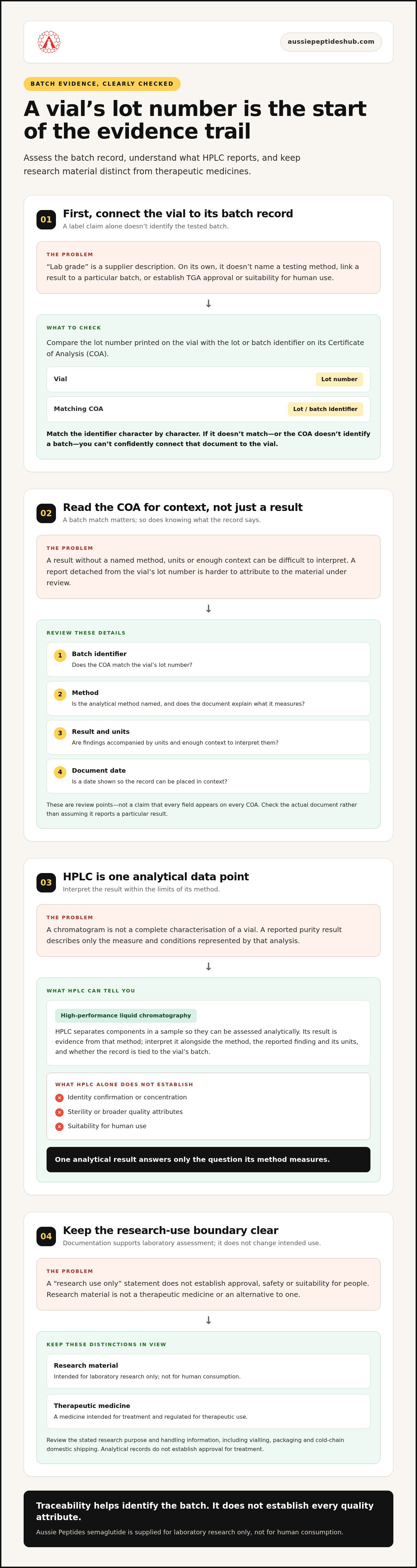
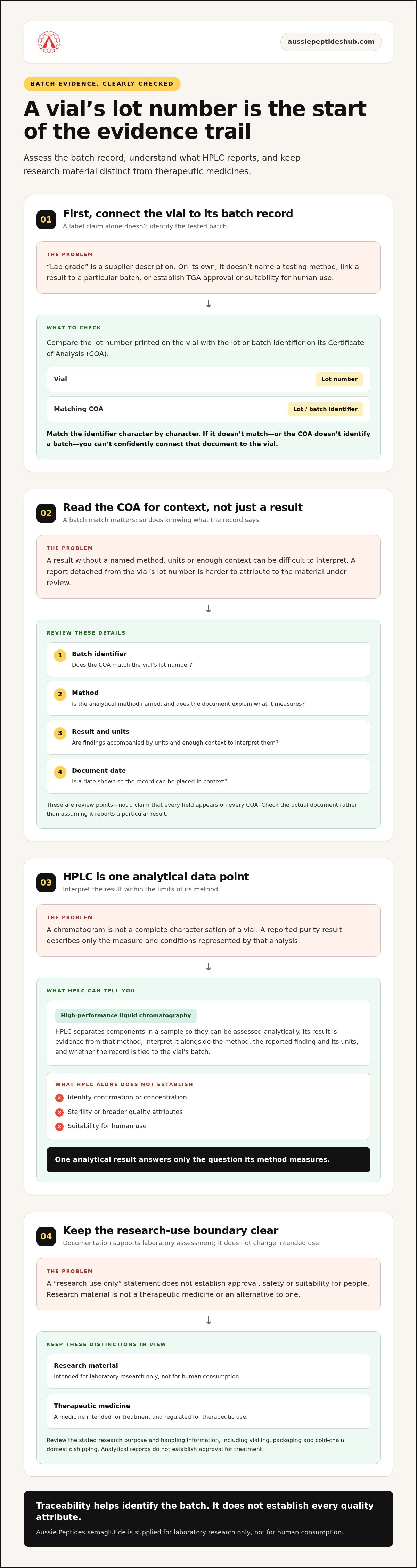
The phrase alone doesn’t name the test method, identify the tested batch or state what result was recorded. Start with documentation that connects the vial’s lot number to its matching Certificate of Analysis (COA). The match helps establish which batch the document refers to. Then review the method and reported findings to understand what the analysis covers.
Supplier terminology describes a product; batch-linked analytical records provide evidence that can be checked. Consider intended use, batch identity and analytical documentation together. A test report detached from the vial’s lot number is harder to attribute to the material under review. Even a matching COA must be interpreted within the limits of the method used.
Aussie Peptides provides matching COAs, and the lot number printed on the vial can be used to verify batch details online. Products are independently HPLC-tested, then vialled and packaged in Australia. These records support traceability and laboratory assessment; they don’t change the research-only boundary or establish human suitability.
How to assess semaglutide identity, purity and batch evidence
Start by checking the link between the vial and the document for its batch. For lab grade semaglutide australia, look for evidence that identifies the material being assessed, names the analytical method and makes clear what each reported result means. Aussie Peptides semaglutide is for laboratory research only and is not for human consumption.
What to look for on a batch-matched Certificate of Analysis
Find the lot number printed on the vial, then compare it character by character with the lot or batch identifier on the Certificate of Analysis (COA). A matching identifier connects the document to the batch in question. If the identifiers don’t match, or the COA doesn’t identify a batch, you can’t confidently make that connection.
- Batch identifier: Does the COA match the vial’s lot number?
- Method: Is the analytical method named, and does the document explain what it measures?
- Result and units: Are reported findings accompanied by units and enough context to interpret them?
- Document date: Is a date shown so the record can be placed in context?
These are review points, not a claim that every field appears on every COA. Aussie Peptides provides matching COAs and online batch verification using the vial’s lot number. Review the actual document rather than assuming it reports a particular result or test output.
What an HPLC result can and cannot establish
High-performance liquid chromatography (HPLC) separates components in a sample so they can be assessed analytically. A chromatogram is evidence from that method, not a complete characterisation of the vial. A reported purity result describes only the measure and conditions represented by the analysis.
Purity is not interchangeable with identity confirmation or concentration. An HPLC result by itself also doesn’t establish sterility, broader quality attributes or suitability for human use. Interpret it in the context of the method, the reported result and its units, and whether the test record is tied to the vial’s batch.
One analytical result answers only the question its method measures. Keep that limit in view when assessing a purity claim. Independent HPLC testing and a matching COA provide analytical and traceability information; they don’t change the product’s research-only status.
For further context on mechanism and in-vitro scope, read the semaglutide peptide research overview. For batch-level review, begin with the vial identifier and its matching record in the research semaglutide documentation.
Compare research-grade semaglutide on evidence, not label claims
A product claim is useful only when its scope is clear. For lab grade semaglutide australia, compare the records behind each claim: does the vial connect to a defined batch, and does the analytical document explain what was measured? Documentation supports a more disciplined assessment, but it doesn’t establish therapeutic approval or predict a research outcome.
| Evidence item | What it can show | What it cannot prove |
|---|---|---|
| Batch traceability | A vial lot number can connect the physical product to batch details. | Traceability alone doesn’t verify every quality attribute or experimental result. |
| Matching Certificate of Analysis (COA) | A matching lot or batch identifier links the document to the batch under review. | A document match doesn’t establish that every relevant property was tested. |
| HPLC method disclosure | The named method gives context for interpreting the analytical result it reports. | HPLC evidence alone doesn’t establish full product characterisation, sterility or human-use suitability. |
| Research-only statement | It identifies the stated intended-use boundary. | It doesn’t confer therapeutic approval or make the material suitable for people. |
Batch traceability versus general product claims
A general purity statement doesn’t identify which vial or batch it describes. A lot identifier linked to product documentation gives you a specific record to compare with the vial in hand. Aussie Peptides prints a lot number on each vial, provides matching COAs and enables online verification of batch details using that number.
This is a traceability step, not a complete quality assessment. A verified batch record doesn’t confirm every characteristic of the material or determine how it will perform in a particular experiment.
Purity percentage versus a complete evidence picture
A purity figure needs context. Review the method used, the sample or batch to which the result applies, and the units or basis stated in the record. Without those details, a percentage can be difficult to assess. Don’t assume that a purity result confirms identity, concentration, biological activity or clinical effects.
Aussie Peptides semaglutide is independently HPLC-tested and supplied with matching COAs. The product is for laboratory research only and is not for human consumption. Treat its records as evidence for assessment within their stated scope, not as proof of therapeutic approval, human suitability or a particular research outcome.
Check handling, packaging and research-use boundaries before ordering
Before ordering lab grade semaglutide australia, review the intended use, product description, batch records and delivery handling in sequence. Together, these checks help establish whether the material and its documentation are presented consistently for laboratory research. They don’t convert research material into a therapeutic medicine or establish suitability for human use.
A practical documentation and handling review
- Confirm the intended use. The product description should state that semaglutide is for laboratory research only and not for human consumption. Keep this boundary clear when reviewing the accompanying information.
- Read the product description. Check that it identifies the material as research-use semaglutide and doesn’t present it as a prescription medicine or therapeutic alternative.
- Match the batch records. Compare the vial’s lot number with its corresponding batch documentation. Aussie Peptides provides online lot verification so you can check the vial identifier against batch details.
- Review handling information. Follow the product-specific handling instructions supplied with the material. Don’t infer storage temperatures or time limits from general statements about packaging or delivery.
Keep the purpose narrow. This is a research-material assessment, not guidance for personal use, dosing, reconstitution or administration. A clearly stated research-only boundary is part of the documentation review, not a substitute for it.
Australian packaging and domestic cold-chain dispatch
Aussie Peptides products are vialled and packaged in Australia. Domestic peptide shipping across Australia uses cold-chain packaging. These details describe handling and fulfilment, but don’t establish a specific temperature range, transit time or storage period. Use the product label and supplied documentation for product-specific handling information rather than making assumptions.
For a complete pre-order review, keep the product description, vial identifier, matching batch documentation and supplied handling information together. This gives you a traceable reference for laboratory assessment. It doesn’t verify every quality attribute, determine an experimental outcome or establish therapeutic approval.
Review the research semaglutide details with these checks in mind. The material is intended for laboratory research only and is not for human consumption.
Aussie Peptides semaglutide: documented for laboratory research
Aussie Peptides supplies semaglutide for laboratory research only. It is not for human consumption and is not presented as a prescription medicine or therapeutic alternative. For Australian laboratory buyers assessing lab grade semaglutide australia, focus on the stated research-use boundary, batch-linked records and handling information, not the label alone.
What the documented process provides
The semaglutide is synthesised by contract manufacturers, independently HPLC-tested, then vialled and packaged in Australia. A matching Certificate of Analysis (COA) accompanies the batch. Use the lot number printed on the vial to verify batch details online and connect the physical identifier to its corresponding documentation.
These records support batch-level review. HPLC provides an analytical data point within the scope of its method; a COA and lot lookup help identify which batch the record concerns. Neither establishes therapeutic approval, suitability for human use, clinical performance or the outcome of a laboratory experiment. Interpret each document according to what it actually reports.
Domestic peptide shipping across Australia uses cold-chain packaging. This describes the stated dispatch approach, not a specific temperature range, transit period or storage instruction. For handling, use the product label and supplied documentation rather than assuming parameters that aren’t stated.
Next step for Australian laboratory buyers
Review the product description alongside its corresponding batch documentation. Confirm that the vial identifier matches the batch record, read the analytical information within its stated scope, and keep the research-only boundary clear. The semaglutide research overview provides scientific context on mechanism and in-vitro scope; it is not personal-use guidance.
Assess the documentation as evidence for laboratory research, not as a claim about therapeutic use or experimental results. Review research-use semaglutide information and its associated batch documentation.
Use batch evidence to guide your next review
Assess lab grade semaglutide australia through records linked to the vial, not the wording on a product label. A matching Certificate of Analysis and lot-number verification help connect batch documentation to the material under review. Independent HPLC testing adds analytical evidence, but doesn’t establish every quality attribute, therapeutic approval or suitability for human use.
Aussie Peptides semaglutide is for laboratory research only and is not for human consumption. Products are vialled and packaged in Australia, with cold-chain domestic shipping. Review the supplied handling information and keep the research-only boundary clear throughout your assessment.
For the product description and associated documentation, review research-use semaglutide information. Apply the same checks to intended use, batch identity and analytical evidence before making a research-supply decision. A methodical review gives your laboratory a clearer basis for evaluating the records.
Frequently Asked Questions
What does lab grade semaglutide mean?
“Lab grade” is a supplier description, not a universal certification or guarantee. On its own, it doesn’t identify the testing performed, the batch tested or the scope of a result. For lab grade semaglutide australia, assess the intended research use alongside batch-linked documentation, such as a vial lot number and its matching Certificate of Analysis. The label doesn’t establish therapeutic approval or suitability for human use.
Is research-grade semaglutide approved for human use in Australia?
No. Research-grade semaglutide supplied for laboratory research is not thereby approved for human use in Australia. Aussie Peptides products are intended for laboratory research only and are not for human consumption. A research-use label or analytical document doesn’t establish therapeutic approval, safety or suitability for people. For current information about medicines and their regulatory status, consult the Therapeutic Goods Administration and the Australian Register of Therapeutic Goods.
How can I verify a semaglutide COA matches the vial?
Compare the lot number printed on the vial with the batch or lot identifier on the Certificate of Analysis (COA). Check that they match, then review the document date, named analytical method, and the meaning and units of any reported result. Aussie Peptides provides matching COAs, and the vial lot number can be used to verify batch details online. A matching identifier links the record to that batch, not to every quality attribute.
Does an HPLC purity result prove semaglutide identity or safety?
No. High-performance liquid chromatography (HPLC) separates components for analytical assessment, and a reported purity result relates to what that method measures. It doesn’t, on its own, prove identity, concentration, sterility or human-use safety. Interpret the result alongside its method, units and batch context. Independent HPLC testing is one analytical data point; it doesn’t establish therapeutic approval or make research material suitable for human consumption.
Can research-grade semaglutide be used for weight loss?
No. Research-grade semaglutide is intended for laboratory research only and is not for human consumption, including use for weight loss. It isn’t a therapeutic medicine or an alternative to one. A research label, COA or HPLC result doesn’t establish approval or suitability for treatment. If you’re seeking weight-management care, speak with a qualified health professional about appropriate options rather than using research material.
How is research-use semaglutide packaged and shipped in Australia?
Aussie Peptides products are vialled and packaged in Australia, then shipped domestically across Australia using cold-chain packaging. These details describe the packaging and dispatch approach; they don’t specify a temperature range or delivery timeframe. For product-specific handling or storage, follow the label and supplied documentation. Don’t infer storage parameters from the phrase “cold-chain” alone, and keep the material’s laboratory-only status clear.
What should I check before selecting a research semaglutide vial?
Check that the product description clearly states laboratory research only and not for human consumption. Match the vial’s lot number to its COA and online batch details, then review the named method and what each result measures. Read the product-specific handling information supplied with the material as well. Treat these records as evidence for research-material assessment, not proof of therapeutic approval, human suitability or a particular experimental outcome.