TB-500 research peptide Australia: structure, evidence and research scope
October 8, 2026 · 16 min read
What does “tb 500 research peptide australia” refer to when the name appears alongside claims about tissue repair and recovery? The terminology can be imprecise, and laboratory findings are often presented without their limitations. TB-500 is described in research as a synthetic fragment related to thymosin beta-4, but that relationship alone doesn’t establish effects in people.
It’s reasonable to want a clear distinction between what has been studied and what online claims suggest. The available evidence is largely preclinical, so it can’t establish human safety or therapeutic benefit. In Australia, TB-500 is not approved for human therapeutic use; the June 2026 Poisons Standard classifies it as Schedule 4.
This article explains the terminology, outlines the scope and limits of the research, and shows how to interpret documentation for research-only material. It also explains what independent HPLC testing and a batch Certificate of Analysis can show, and what they can’t prove. These records can support batch traceability and analytical review, but they don’t establish that a product is safe or effective for human use.
Key Takeaways
- Check how a source defines TB-500 before comparing findings. Naming conventions can affect what a study actually examined.
- Distinguish cell-based, animal and human research. Each design answers different questions and has different limits.
- When assessing claims about the tb 500 research peptide australia, check the original study, its model and publication status before drawing conclusions.
- Use batch records to trace research material: Aussie Peptides provides matching Certificates of Analysis and online lot-number lookup.
- Interpret HPLC results and cold-chain handling within their scope. Neither establishes human safety, efficacy or therapeutic suitability.
What is the TB-500 research peptide, and what does the name mean?
TB-500 is a name used for research peptide material, not a recognised treatment name that establishes a medicine’s composition or effects. In Australia, searches for tb 500 research peptide australia can lead to product labels and scientific discussions that use related terminology differently. Treat the label as a starting point for checking identity, not as proof of it.
TB-500 and thymosin beta-4: clarify the terminology
A cautious working definition is: “TB-500 is a research-market name commonly used for a synthetic peptide described as related to thymosin beta-4.” This wording reflects the general overview in TB-500 Wikipedia; it should not be treated as a verified sequence specification. Goldstein, Hannappel and Kleinman’s scientific review describes thymosin beta-4 as an actin-binding protein, but that does not establish that every material labelled TB-500 has the same sequence or activity (Goldstein et al., “Thymosin beta 4: actin-sequestering protein moonlights to repair injured tissues”, Trends in Molecular Medicine, 2005).
Descriptions of TB-500 as a particular thymosin beta-4 fragment or sequence should be checked against a primary source that identifies the material studied. A related name is not a chemical identity test, and a shared or similar sequence does not establish equivalent biological activity.
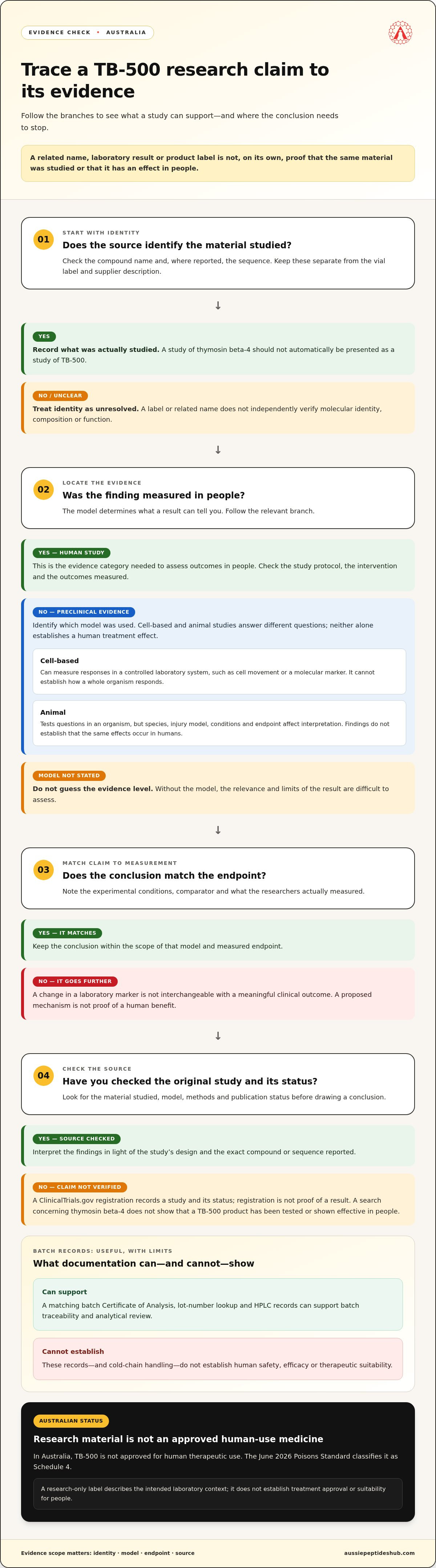
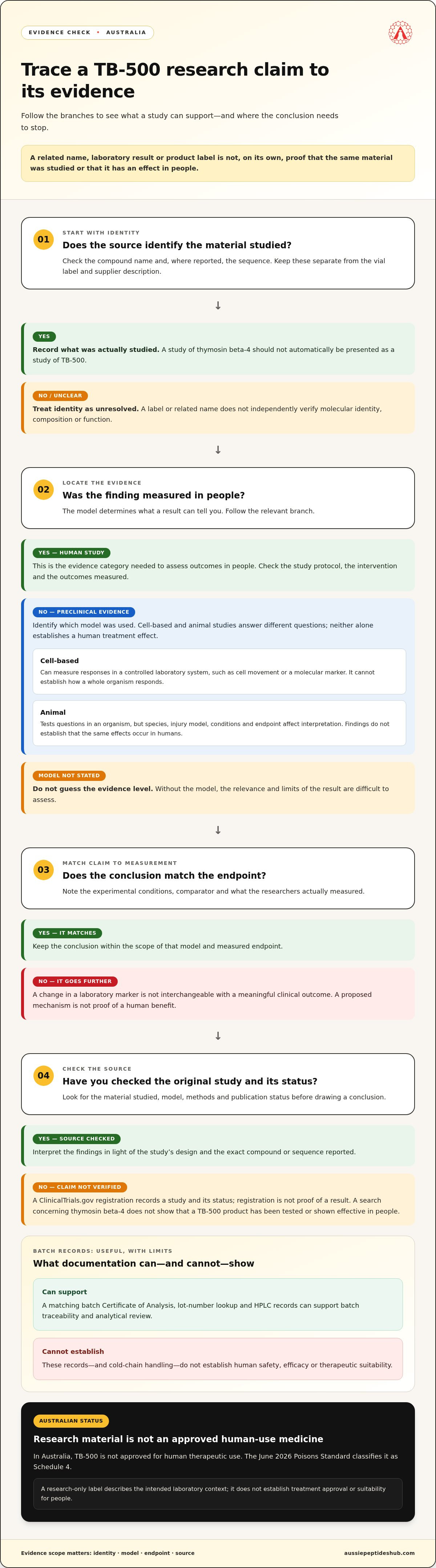
When reviewing a claim, keep four details separate: the compound name, the sequence reported in a study, the vial label and the supplier’s description. A vial label records how a product is presented; it doesn’t independently demonstrate molecular identity, composition or function. For the same reason, a study of thymosin beta-4 shouldn’t automatically be presented as a study of TB-500.
What research-only means in this context
Research-only material is supplied for laboratory research, not as a human-use medicine. Aussie Peptides identifies its TB-500 as for laboratory use only and not for human consumption. A research label or product description doesn’t establish approval for treatment or suitability for people.
Study design also sets limits. In-vitro research examines cells or biological processes under controlled laboratory conditions. Animal studies test questions in an organism, but their findings don’t establish that the same effects occur in humans. Clinical studies involving people are a different evidence category. Claims about human outcomes require relevant human data, not an extrapolation from cells or animals.
When assessing a TB-500 claim, note the exact name used by the researchers, the material’s stated sequence and the study model. Then check whether the source is a primary publication and whether its methods support the claim. If those details aren’t reported, treat the identity or interpretation as unresolved rather than relying on a product label or a related compound name.
How is TB-500 studied, and what biological questions does research examine?
Research into TB-500-related claims should be read as a set of questions under investigation, not as a catalogue of established effects. Researchers may ask whether a specified peptide interacts with cellular processes, whether an observed change occurs in an animal model, or whether a comparable outcome has been tested in people. Each question requires evidence from the relevant model and material.
Experimental models and endpoints
Study design defines what a result can support. Cell-based work can measure responses in a controlled laboratory system, such as a change in cell movement or a molecular marker. It cannot establish how a whole organism responds. Animal studies can assess outcomes in a more complex biological system, but the species, injury model, experimental conditions and measured endpoint all affect interpretation. Neither design alone demonstrates a human treatment effect.
Human research asks a different question: whether a defined intervention is associated with measured outcomes in participants under a stated protocol. ClinicalTrials.gov records study registrations and status, but registration is not proof of a result. Its Clinical trials for Thymosin Beta-4 search concerns the named molecule. It should not be read as evidence that a TB-500 product has been tested or shown effective in people.
For any paper, record the compound or sequence studied, model, experimental conditions, comparator and endpoint. A change in a laboratory marker is not interchangeable with a meaningful clinical outcome. If a supplier description uses a related name, that alone doesn’t show the study examined the same material.
Mechanism claims and their limits
Mechanistic language needs direct support. Thymosin beta-4 has been studied in relation to actin, a protein involved in cellular structure and movement. For example, Bock-Marquette and colleagues reported work on thymosin beta-4, integrin-linked kinase and cardiac repair in a study combining experimental models (Nature, 2004, “Thymosin beta4 activates integrin-linked kinase and promotes cardiac cell migration, survival and cardiac repair”). That paper concerns thymosin beta-4; it cannot automatically substantiate an equivalent mechanism for every material described as TB-500.
Where a pathway is proposed but not firmly established, describe it as a hypothesis. Check whether the cited experiment measured the pathway directly, which model it used and whether the result was replicated. A plausible biological explanation is not a demonstrated clinical benefit.
Preclinical findings can identify biological questions, but they don’t prove that the same outcomes occur in people. This distinction matters in searches for tb 500 research peptide australia, where mechanistic language can be mistaken for evidence of healing or performance effects. Keep the claim matched to the evidence: check the model, material and endpoint. For laboratory-only material, consider the documented research scope alongside the TB-500 research material information, without treating product descriptions as study results.
What does the TB-500 evidence establish, and what remains uncertain?
Match evidence to the exact material and question studied. Findings about thymosin beta-4 may provide biological context, but they don’t establish that a TB-500-labelled product has the same composition or produces the same result. The available TB-500 evidence is largely preclinical; completed human efficacy trials establishing therapeutic benefit have not been identified in the evidence reviewed here.
Preclinical findings versus human evidence
Preclinical studies can identify responses in cells or animal models under specified experimental conditions. For example, Bock-Marquette and colleagues examined thymosin beta-4 in experimental work on cardiac cell migration, survival and repair, including animal research (Nature, 2004). That is evidence about the molecule and models reported in that paper, not proof of a human outcome from TB-500. The study’s publication, model and material identity all matter.
The following distinctions help prevent overstatement:
| Evidence type | What it can show | What it cannot show by itself |
|---|---|---|
| Cell-based research | A measured cellular or molecular response under laboratory conditions. | Whole-body effects, clinical benefit or safety in people. |
| Animal research | Outcomes in a specified species and experimental model. | That the same outcome occurs in humans or with a differently identified peptide. |
| Human clinical evidence | Outcomes measured in participants under a defined study protocol. | Broad effectiveness beyond the studied population, intervention and conditions. |
| Analytical purity data | Information about measured sample characteristics using the stated method. | Biological efficacy, human safety or therapeutic suitability. |
Common claims that need stronger evidence
Claims about recovery, healing or performance require outcome evidence that directly tests those outcomes. A proposed pathway, such as an actin-related mechanism discussed in thymosin beta-4 research, can provide a reason for further investigation. It does not demonstrate that TB-500 improves tissue repair or athletic performance in people. Supplier descriptions, testimonials and anecdotal reports are not substitutes for controlled clinical studies.
Current preclinical findings can support further research, but they don’t establish that TB-500 is effective or safe for human use. This is the key limit when assessing tb 500 research peptide australia claims: check whether the cited paper studied TB-500 itself, which model it used, and whether the reported endpoint matches the claim. If a certificate reports analytical testing or purity, interpret it as sample documentation, not evidence of a biological effect. HPLC testing cannot establish clinical efficacy or safety.
How should Australian readers assess TB-500 research material and claims?
Use a consistent review sequence before drawing conclusions from a product description or research claim. Check identity, batch documentation, analytical method and intended scope separately. This helps prevent a test result from being mistaken for proof of biological performance or human suitability.
- Check identity. Compare the stated compound name and any sequence description with the source being cited. A label or related name alone doesn’t verify composition.
- Match the batch. Compare the lot number on the vial with the lot number on its Certificate of Analysis (COA). Confirm that the document relates to that batch.
- Read the method. Identify what the reported test measures and what the report actually states. Don’t assume an analytical method answers questions it wasn’t designed to assess.
- Check the claim’s scope. Identify whether the claim concerns laboratory analysis, a cell experiment, an animal model or human research. Keep conclusions within that evidence category.
Read batch documents without overstating their meaning
A COA is useful when its connection to the material is clear. Match the vial’s lot number to the certificate, then review the named test method, reported result and document date. If a report doesn’t identify the batch or explain what was measured, it provides less traceable information.
High-performance liquid chromatography (HPLC) is an analytical technique. An HPLC result describes measurements produced under the method used; it doesn’t, by itself, establish sterility, human safety, therapeutic efficacy or suitability for use in people. A reported purity figure is not a clinical outcome. Interpret it only in relation to the sample and test described.
Aussie Peptides states that its TB-500 is independently HPLC-tested and supplied with a matching COA. The lot number printed on the vial can be used to check batch details online. These records support batch traceability and analytical review, but they don’t establish a biological effect.
Keep Australian research-only boundaries explicit
Research material is for laboratory research only and not for human consumption. Don’t interpret a research-only label as evidence of approval for personal use. Australian regulatory requirements can change, so verify current information against official Therapeutic Goods Administration guidance before making a specific legal or regulatory statement. A supplier description cannot replace that check.
Compound-specific assessment also matters. A sourcing guide about BPC-157 may cover documentation principles, but it cannot verify TB-500 identity or evidence. Apply the same careful review to each compound, and avoid transferring findings or claims between them.
For laboratory research, consider TB-500 research material alongside its batch documentation and stated scope. Keep the conclusion precise: documents describe a material and its testing, while research studies address biological questions.
What does Australian TB-500 research supply documentation tell you?
Supply records answer operational questions: which batch a vial belongs to, what analytical documentation accompanies it, and how the material is handled for dispatch. They don’t answer whether TB-500 produces a biological effect. For readers assessing tb 500 research peptide australia information, keeping these questions separate makes product documentation easier to interpret without treating it as evidence of human-use suitability.
What batch traceability can verify
A printed lot number provides a reference for locating the corresponding batch record. Compare the vial identifier with the lot number on the Certificate of Analysis (COA). Then check that the document identifies the same material and review the analytical method and results it reports. A mismatch, missing identifier or unclear test description limits what the record can verify.
Aussie Peptides states that its TB-500 is independently HPLC-tested, supplied with a matching COA and traceable through an online lot-number lookup. This provides a practical documentation trail: use the vial’s lot number to check batch details, and refer to the certificate for the stated analytical information for that batch.
Traceability is useful, but it has limits. A matching identifier connects records; it doesn’t independently confirm every product attribute or establish sterility, human safety, efficacy or therapeutic benefit. HPLC findings describe measurements made using the stated analytical method. Interpret them within that scope, not as a general guarantee about how a material will perform in a biological system.
Research-only product context
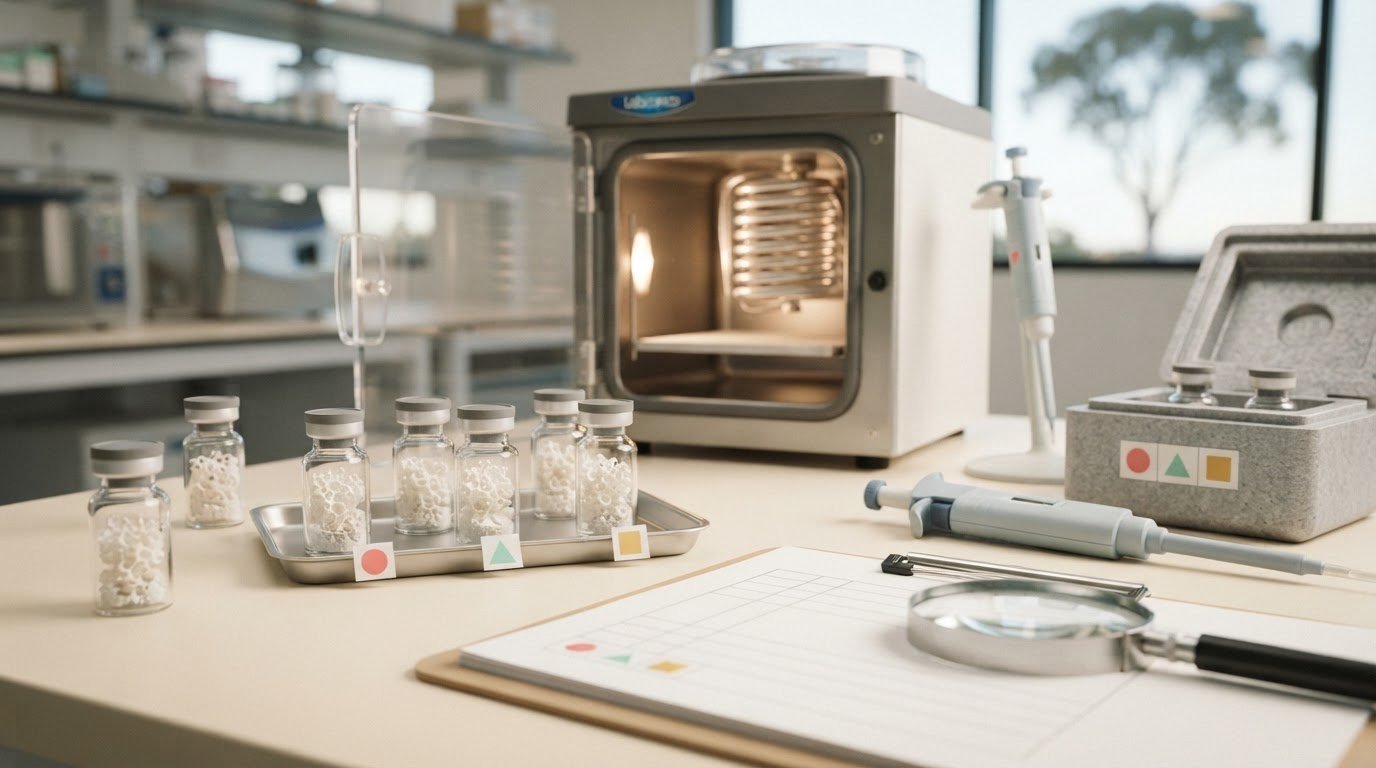
TB-500 supplied by Aussie Peptides is a research-grade peptide for laboratory use only, not for human consumption. Read its handling information as precisely as its test documentation. The material is packaged in Australia and shipped domestically using cold-chain packaging. These details describe packaging and dispatch arrangements; they don’t report experimental results or demonstrate that a compound is suitable for treatment.
For a laboratory record, keep the documentation together: retain the vial’s lot identifier, its matching COA and details of the intended research scope. If the analysis relies on a particular compound identity or published finding, record that source separately. Supply records and research literature serve different purposes, and neither should be substituted for the other.
Use these distinctions as a final check: batch traceability supports record linkage, HPLC documents analytical measurements, and packaging and cold-chain dispatch describe handling. None establishes human-use safety or a therapeutic effect. For laboratory research context and the associated documentation, view Aussie Peptides research information.
Set a clear standard for your next research step
Before evaluating another claim about tb 500 research peptide australia, write down the question your research is intended to address. Specify the material identity, model and measurable endpoint before reviewing results. This helps guard against changing the question after seeing a favourable result or treating a proposed mechanism as a confirmed outcome.
Keep source records with your study notes. Record the publication or protocol, the exact compound description used and any limits stated by the authors. If the source doesn’t clearly identify its material or methods, note that uncertainty rather than filling the gap with an assumption. A disciplined record makes later comparisons more useful and keeps conclusions tied to the evidence reviewed.
Aussie Peptides’ TB-500 is supplied for laboratory research only, not for human consumption. Its documentation supports material and batch review, not therapeutic decisions. View Aussie Peptides research information for the research-only supply context. A precise question and a careful record are a sound place to begin.
Frequently Asked Questions
What is TB-500?
TB-500 is a name used for a synthetic peptide research compound commonly described as related to thymosin beta-4. The name alone doesn’t identify the precise sequence or establish that two products contain identical material. For a specific study or vial, compare the stated identity with its source documentation. TB-500 supplied by Aussie Peptides is intended for laboratory research only, not for human consumption.
Is TB-500 the same as thymosin beta-4?
No. TB-500 is commonly described as a fragment related to thymosin beta-4, the naturally occurring protein, but the terms aren’t automatically interchangeable. Check whether a paper names thymosin beta-4 or a specific TB-500 sequence, and whether it reports the material tested. Similar terminology doesn’t prove identical composition or biological activity. This distinction matters when interpreting research cited to support claims about a product labelled TB-500.
What does TB-500 research show?
Research discussed in connection with TB-500 is predominantly preclinical, including laboratory and animal investigations. These studies can examine biological questions under defined conditions, but they don’t establish clinical outcomes. The available evidence does not establish human therapeutic efficacy, and completed human efficacy trials have not been identified in the material reviewed for this article. Treat recovery or performance claims as unproven unless supported by relevant human clinical evidence.
Is TB-500 approved for human use in Australia?
No. According to the June 2026 Poisons Standard and TGA status described in the current regulatory material, TB-500 is not approved for human therapeutic use in Australia and is classified as Schedule 4. A “research use only” label doesn’t make a product an approved medicine or establish that it may be used personally. Check current TGA and Poisons Standard information for official updates.
Does an HPLC Certificate of Analysis prove TB-500 is safe or effective?
No. An HPLC Certificate of Analysis reports analytical information about a sample using the stated method. It doesn’t establish that the material is sterile, safe for people or effective for a medical purpose. For example, an analytical result cannot show that a proposed healing effect occurs in humans. Read the certificate for what it measures, and assess safety and efficacy claims against appropriate clinical evidence.
How can I verify an Australian TB-500 research peptide batch?
Compare the lot number printed on the vial with the identifier on the matching Certificate of Analysis, then review the reported method and batch details. Aussie Peptides provides independent HPLC testing, matching COAs and online batch-detail lookup using the vial lot number. This supports traceability for tb 500 research peptide australia material, but it doesn’t independently validate every product attribute or establish human-use safety or efficacy.