Lyophilised Peptides Australia: Handling, Storage and Batch Verification
October 7, 2026 · 14 min read
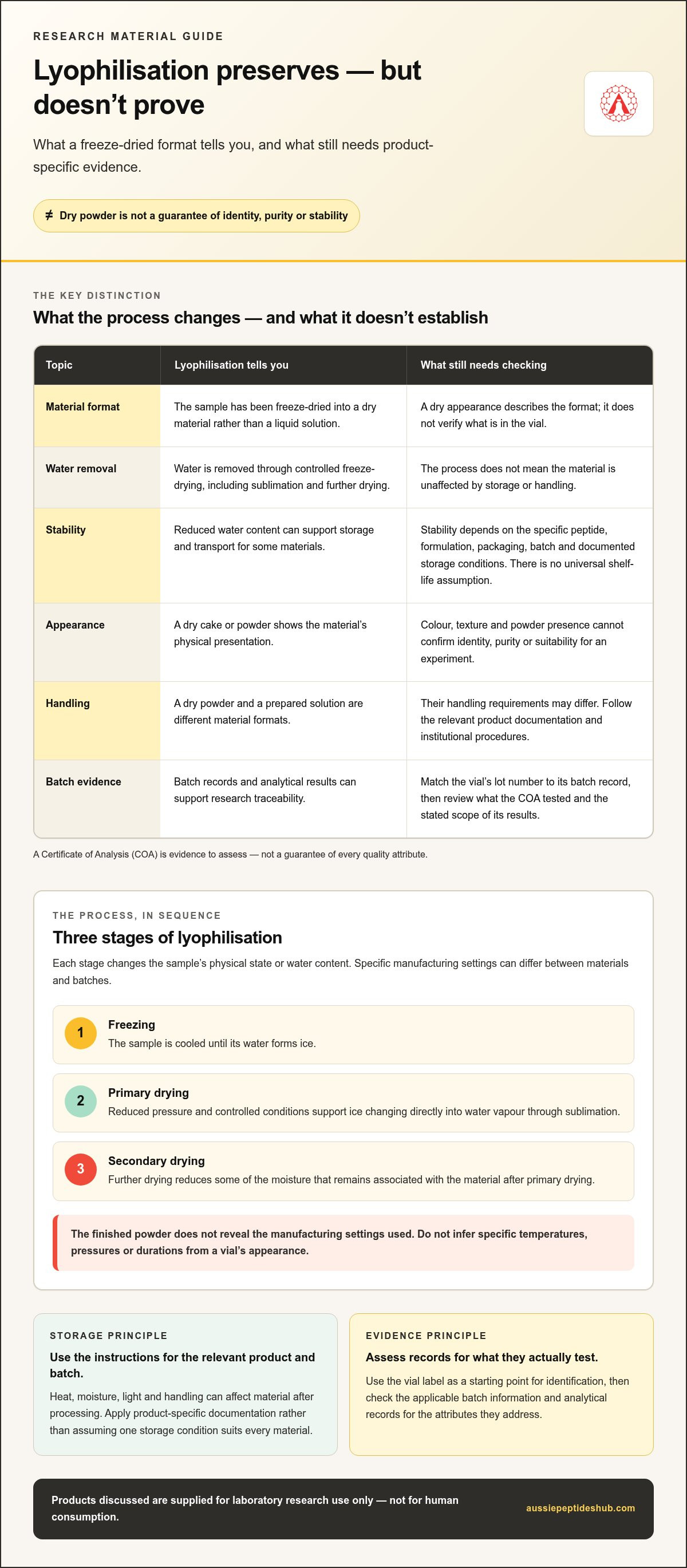
Does a freeze-dried vial stay stable simply because most of its water has been removed? It’s an understandable assumption, but lyophilisation supports preservation; it doesn’t remove the need for product-specific handling, storage or batch evidence. For anyone assessing lyophilised peptides Australia, that distinction matters.
Research teams need more than a label or a headline purity figure. They need to understand what the process changes, which conditions can affect material after processing, and what the accompanying records establish. A Certificate of Analysis (COA) that matches the vial’s lot number provides evidence to assess, not a guarantee of every quality attribute.
This guide explains the purpose and limits of lyophilisation, the handling factors to verify against product documentation, and how batch records and analytical results support research traceability. It also explains why product-specific storage instructions matter: no universal shelf-life assumption can replace them. Products discussed are supplied for laboratory research use only, not for human consumption.
Key Takeaways
- Lyophilisation removes water through controlled freeze-drying, but a powder format isn’t a promise of indefinite stability.
- Understanding the freezing, primary drying and secondary drying stages helps explain what the process does to the material.
- For lyophilised peptides australia, assess storage requirements product by product instead of relying on a universal temperature or shelf-life assumption.
- Use product documentation and institutional procedures to guide handling in your research workflow.
- Match the vial’s lot number to its batch record, then review the COA and the stated scope of its analytical results.
Lyophilised peptides: what the term means for Australian research
Lyophilisation is freeze-drying, a controlled process that removes water from a material. The term describes how a sample has been processed and its resulting format. It doesn’t establish how long the sample remains stable or mean it is unaffected by storage and handling.
For Australian laboratory research, the difference between a dry powder and a prepared solution is practical: these are different material formats, and their handling requirements may differ. A vial’s appearance can’t confirm its contents, purity or suitability for a particular experiment. Those questions require relevant documentation and evidence.
What does lyophilised mean on a research vial?
In freeze-drying, a frozen sample is dried so that ice changes directly into vapour without first becoming liquid. This change is called sublimation. Further drying reduces the remaining water under controlled conditions. The Freeze-drying (lyophilisation) process provides an overview of the method and its applications.
The result is a dry material rather than a liquid solution. That visible format is descriptive, not analytical. Colour, texture and the presence of a powder can’t verify the vial’s identity or purity, or establish its suitability for an experiment.
Why is freeze-drying used for peptide materials?
Reducing water content can support the storage and transport of some materials. It doesn’t make every peptide behave identically or remove the need for appropriate storage. Stability depends on the specific peptide, its formulation, packaging and documented conditions. Apply the instructions for the relevant product and batch instead of assuming that a dry format has a universal shelf life.
Lyophilisation is a preservation method, not proof of identity, purity or stability. This is the central distinction when interpreting claims about “lyophilised peptides australia”. The format may help manage a material, but evidence for its attributes comes from the relevant batch documentation and analytical records. Assess those records for what they actually test, not as a blanket statement about every quality characteristic.
Products supplied for laboratory research use only are not for human consumption. Treat the vial label as a starting point for identification, then use the applicable documentation to understand the material and its specified storage conditions.
How lyophilisation works: freezing, drying and the resulting powder
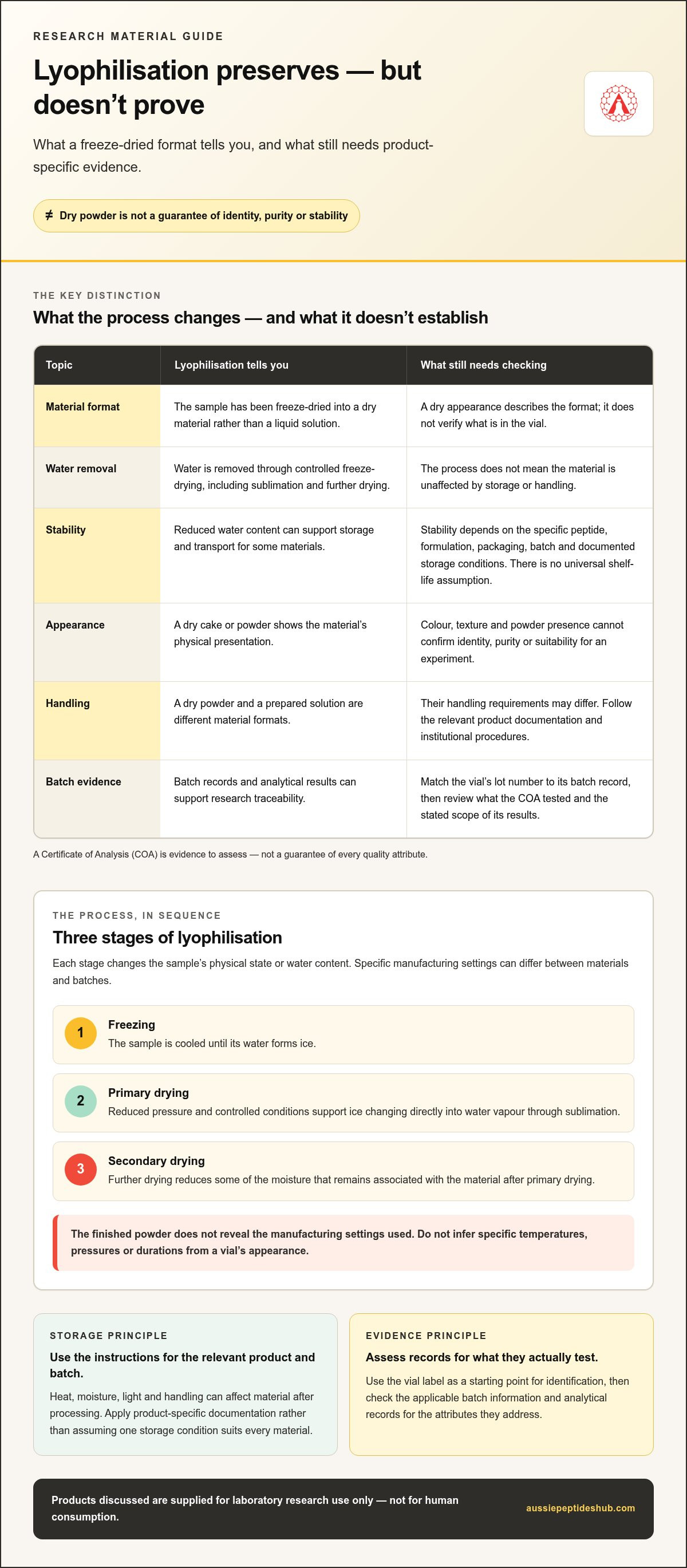
Lyophilisation follows a sequence: freezing, primary drying, then secondary drying. Each stage changes the sample’s physical state or water content. The general principles are consistent, but formulation and manufacturing parameters can differ between materials and batches. The finished powder doesn’t reveal which settings were used.
- Freezing: The sample is cooled until its water forms ice.
- Primary drying: Reduced pressure and controlled conditions support the removal of ice as water vapour through sublimation.
- Secondary drying: Further drying reduces some of the moisture that remains associated with the material after primary drying.
Pressure supports the transition of ice directly to vapour, while controlled conditions help manage the drying process. These are process principles, not a recipe. Specific temperatures, pressures and durations are manufacturing parameters. They shouldn’t be inferred from a vial’s appearance or assumed to be identical for every peptide.
What happens during primary and secondary drying?
Primary drying removes frozen water through sublimation: ice changes directly into vapour without becoming liquid. Secondary drying targets some of the moisture that remains. The stages have different roles, but final water content and product stability depend on the material and process. The sequence alone doesn’t establish universal settings or shelf life.
What does the finished lyophilised format tell a researcher?
A dry cake or powder identifies the material’s physical presentation. It isn’t a test result. Consider appearance and vial condition alongside batch documentation, which can identify what was tested and by which method. Formulation and processing details may vary between materials and batches, so visual similarity doesn’t establish equivalence.
Lyophilisation removes water; it doesn’t replace batch testing. That distinction matters when assessing lyophilised peptides australia researchers may encounter in a dry format. A powder’s presence alone doesn’t confirm identity, purity or stability. Those attributes require relevant evidence, interpreted within the stated scope of the analytical records.
For a research workflow, separate what the process explains from what the records demonstrate. Review the applicable batch information and product documentation rather than inferring manufacturing conditions from the finished vial. To view research-use peptide options, assess the associated product and batch information alongside the format.
Lyophilised peptide stability: what the powder does not guarantee
A dry powder is not immune to heat, moisture, light or handling. Lyophilisation reduces water content, but stability still depends on the specific compound, formulation, packaging, batch and documented storage conditions. A storage assumption that suits one material may not apply to another.
Environmental exposure can matter at several points in a research workflow. Moisture may enter if packaging is compromised or a vial is accessed repeatedly. Temperature variation and light exposure are also factors to assess against product documentation. Packaging condition matters because packaging helps protect the material from its surroundings.
There is no universal room-temperature allowance or post-opening lifetime for every lyophilised peptide. Use current product-specific records and institutional procedures. Don’t infer storage limits from the powder’s appearance, a general rule for another compound or a purity result.
Which factors can affect lyophilised material?
Review documented storage conditions alongside packaging condition and handling history. Changes in temperature, exposure to moisture or light, and repeated vial access may affect the material. These factors don’t establish that a particular vial has degraded; they show why storage records and product-specific instructions matter. For lyophilised peptides Australia researchers should assess these factors against the relevant batch documentation, not generic guidance.
What can an HPLC result establish, and what can it not?
High-performance liquid chromatography (HPLC) separates components in a sample under a specified method. A reported purity value describes the result within that method’s scope. It doesn’t automatically confirm every quality attribute, including identity, sterility or stability. Each requires evidence suited to the attribute being assessed.
Read the analytical record closely. Check that the batch identifier matches the vial, note the method and reported result, and identify what the report does and doesn’t cover. A matching Certificate of Analysis (COA) supports traceability, but its conclusions should stay within the stated test scope.
Lyophilisation can support preservation; it cannot replace evidence about a specific batch. Keep storage instructions, packaging observations and analytical records distinct. Together, they provide a clearer basis for assessing the material than a powder format or a single purity figure alone.
Handling and storage in an Australian research workflow
Handling should follow a documentation-led workflow, not a universal protocol. Product records describe the applicable storage conditions; institutional procedures govern how materials are received, logged and managed in the laboratory. Keep those sources together so the handling history stays traceable to the vial and its batch.
Use the lot-specific instructions, because requirements can differ by material. Don’t substitute a general rule or another peptide’s storage guidance. Record the handling and storage information required by your laboratory’s procedures, and limit unnecessary exposure to environmental conditions during routine work.
What should researchers record when a vial arrives?
At receipt, log the product identifier, printed lot number and receipt date. Retain the associated product documentation and Certificate of Analysis (COA). Compare the vial identifier with the batch information and COA before filing the records together. This links the physical vial to the evidence used to assess its batch.
Inspect the packaging and vial as part of the laboratory’s established quality process. If you observe damage or another packaging concern, document it through that process rather than relying on memory or informal notes.
How should storage instructions be applied?
Use the storage conditions in the relevant product documentation. Don’t assume one temperature applies to every peptide or that guidance for a different material transfers across. Organise storage so the applicable instructions remain accessible, and keep storage and access records consistent with approved laboratory procedures.
Routine handling can introduce avoidable exposure to environmental conditions. Follow laboratory procedures for managing access and returning materials to controlled storage. Record relevant events in the format your institution requires. This supports traceability without turning general handling considerations into an unsupported product-specific protocol.
For Australian research workflows, the chain of records matters alongside physical handling. The vial lot number can connect the material to its batch details; the matching COA and product instructions provide context for review. Aussie Peptides packages products in Australia and uses cold storage, with cold-chain packaged domestic dispatch. These are fulfilment practices, not a guarantee of a particular transit condition or outcome.
Keep the receipt record, lot details and storage documentation accessible as one traceability set. To review research-use peptide documentation, start with the product and batch records relevant to the material.
Batch verification for lyophilised peptides in Australia
Batch verification links a physical vial to the records associated with its production and testing. For lyophilised peptides Australia researchers can use a simple sequence: match the printed lot number, locate the corresponding batch record, compare identifiers, then review what the analytical report covers. Each step answers a different question. A traceable record is useful, but it doesn’t by itself establish suitability for a particular experiment.
How do vial lot numbers and COAs support traceability?
Start with the lot number printed on the vial. Use it to locate the corresponding online batch details, then compare the identifiers on the vial, batch record and Certificate of Analysis (COA). Record the matching details with the material in line with laboratory procedures. If an identifier differs or a record can’t be matched, don’t treat the documents as evidence for that vial.
Aussie Peptides provides batch details that can be checked online using the vial lot number, alongside a matching COA. Independent HPLC testing provides analytical documentation for assessment. Read the COA’s reported result and method within its stated scope. HPLC data may support assessment of sample components under that method, but a COA doesn’t automatically establish every quality attribute or prove that the material is appropriate for a specific research application.
What does Australian fulfilment add to the record?
Australian packaging and cold storage, followed by cold-chain packaged domestic shipping, provide fulfilment context for the material. Dispatch information can complement the batch record by documenting handling and shipping practices. It doesn’t replace analytical records, product-specific storage instructions or the laboratory’s own receipt and storage logs. Nor does it establish a particular transit outcome.
Keep the records connected: vial identifier, lot number, matching COA, batch details and relevant receipt or storage information. This creates a reviewable trail from receipt to research storage while keeping each document’s evidentiary limits clear.
Products are supplied for laboratory research use only and are not for human consumption. To review research-use peptide information and batch documentation, use the relevant product records as part of your laboratory’s verification process.
Make batch evidence part of your workflow
Lyophilisation describes a preservation format, not a guarantee of indefinite stability. Storage and handling depend on the specific material and its product documentation, so avoid applying generic assumptions across batches. A vial’s appearance or a purity result alone can’t establish every quality attribute.
For lyophilised peptides australia, traceability starts by matching the vial’s printed lot number to its batch record and Certificate of Analysis (COA). Review the analytical method and report scope, then follow the relevant storage instructions and your laboratory’s procedures. Aussie Peptides provides independent HPLC testing with matching COAs, online lot-number verification and Australian packaging.
These records support a systematic assessment, but should be interpreted within their stated limits. Products are supplied for laboratory research use only and are not for human consumption. Review research-use peptides and batch documentation to apply the same documentation-led approach to your next research workflow.
Frequently Asked Questions
What are lyophilised peptides?
Lyophilised peptides are peptide materials that have been freeze-dried to remove water under controlled conditions. During drying, ice is removed as vapour, leaving a dry cake or powder rather than a prepared solution. This format describes how the material is presented, not a guarantee of indefinite stability. Appearance alone can’t confirm identity, purity or suitability for a research experiment; refer to the relevant batch records and analytical documentation.
Does lyophilised mean a peptide can be stored at room temperature?
No. Lyophilised doesn’t automatically mean suitable for room-temperature storage. Requirements can differ with the peptide, formulation, packaging and batch. Follow the product-specific storage instructions and your institution’s procedures instead of applying a general rule or borrowing guidance for another material. Temperature variation, moisture, light and handling can all be relevant considerations. Keep the instructions and storage records linked to the vial’s lot number for traceability.
How long do lyophilised peptides last?
There isn’t a universal shelf life for lyophilised peptides. Stability depends on the specific material, formulation, packaging and documented storage conditions. Use the expiry or retest information stated in the relevant product and batch documentation, where provided. Don’t infer a usable period from the powder’s appearance, an unrelated product’s guidance or a general storage claim. After receipt, follow the applicable instructions and record storage in line with laboratory procedures.
Does lyophilisation guarantee peptide purity?
No. Lyophilisation is a drying and preservation process, not a purity test. A purity result requires analytical evidence, such as high-performance liquid chromatography (HPLC) performed under a stated method. Read the result alongside the batch identifier and method scope. HPLC data doesn’t automatically confirm identity, sterility or stability, and no single purity figure should be treated as proof of every quality attribute.
How can I verify a lyophilised peptide batch in Australia?
Start with the lot number printed on the vial. Locate the matching online batch record, then compare its identifiers with the vial and associated Certificate of Analysis (COA). Review the test method and report scope before recording the material in your laboratory system. Aussie Peptides provides online lot-number verification and matching COAs, with independent HPLC testing. Traceability supports assessment, but doesn’t establish suitability for a particular experiment.
Are lyophilised research peptides for human use?
No. Research peptides supplied by Aussie Peptides are for laboratory research use only and are not for human consumption. A research-use label does not make a product a medicine or establish that it is appropriate for personal use. Keep the material within its stated research context and follow your institution’s applicable procedures. This information is not medical advice and does not describe a treatment or therapeutic alternative.
What should I check on a peptide COA?
Check that the product and batch identifiers on the COA match the vial, particularly its printed lot number. Then review which test was performed, the reported result and the method’s stated scope. For an HPLC result, establish what the reported purity measurement represents. Don’t assume the COA confirms identity, sterility, stability or other attributes unless those are explicitly assessed. File the matching report with the batch record.