TB-500 Lab Supplies Australia: A Batch-Verification Buying Guide
October 9, 2026 · 17 min read
When assessing tb 500 lab supplies australia, a Certificate of Analysis (COA) can help you evaluate a batch, but it has limits. A batch-specific report documents the findings for the sample or batch it identifies. It does not validate claims beyond the tests performed or establish suitability for human use.
To assess a product consistently, connect the information on the listing to the lot number on the vial, then check the matching batch record and how the product is handled. In Australia, TB-500 is a Schedule 4 prescription-only medicine, but it isn’t approved by the TGA or listed on the Australian Register of Therapeutic Goods. A “research use only” label does not make it a product for human consumption.
This guide explains how to review batch-level evidence, including HPLC results and matching COAs, and what a lot-number lookup can establish. It also covers Australian vialling and cold storage, plus cold-chain packaging for national dispatch. The aim is to help you distinguish what the records show from what they cannot establish.
Key Takeaways
- Assess tb 500 lab supplies australia by comparing product identity, batch linkage, COA access and dispatch information.
- Match the compound and lot number on the vial to the report before interpreting its analytical results.
- HPLC evidence relates to chromatographic purity under the stated method. It does not establish every quality attribute.
- Distinguish single-compound TB-500 from blends. Use documented product details rather than inferring ingredients from a name.
- Review the batch record alongside fulfilment details, including Australian vialling, cold storage and cold-chain packaging for national dispatch.
TB-500 lab supplies in Australia: what a careful buyer needs to assess
When comparing tb 500 lab supplies australia, look beyond the product title. A useful listing connects three records: what the product is represented to be, what analytical evidence relates to its batch, and how it is packaged and dispatched. Each answers a different question, so none should be treated as proof of the others.
This guide concerns research sourcing only. TB-500 products discussed here are not for human or veterinary use. The Australian regulatory context also matters: the TGA has not approved TB-500 for human or veterinary use, and TB-500 is a Schedule 4 substance. A research-use label does not establish approval or suitability for personal use.
Background on structure and research scope can help clarify what a listing refers to, but it cannot verify a particular vial. The TB-500 Wikipedia page provides general context, including discussion of claimed uses and concerns about limited human research. For a more focused account of structure and evidence, see this TB-500 research peptide structure and evidence guide.
What does a TB-500 research-supply listing need to make clear?
Start with identity and intended scope. The listing should identify TB-500 and state that the product is intended for laboratory research, not human or veterinary use. Then assess the product description, analytical report and fulfilment information separately. The description identifies the item; the report records findings for a tested sample or batch; fulfilment details describe handling, packaging and dispatch. These records are related, but they are not interchangeable.
Be cautious when broad terms such as “research grade” are presented as though they were test results. The phrase is not a reported method, measurement or experimental outcome. A product category or claim cannot establish composition, batch consistency or performance in a research protocol. Those questions require evidence that relates to the product and relevant batch.
Why does batch-level traceability matter?
A lot number printed on a vial can link physical stock to its batch record. Compare the identifier on the vial with the identifier in the associated documentation. A report that names the compound but has no clear link to the vial may describe a different sample or batch. The product name alone does not confirm a batch match.
Traceability supports record-keeping; it does not guarantee experimental performance. A matching report helps identify the batch covered by the available evidence, but it cannot establish every property of every vial or predict results under a laboratory’s specific conditions. Keep the distinctions clear: product identity tells you what is represented as supplied, batch documentation links evidence to a lot, and fulfilment records describe handling. A sound assessment considers all three rather than relying on a single claim or document.
How to assess TB-500 COAs and batch-specific HPLC evidence
A Certificate of Analysis is useful when its identifiers and reported results can be tied to the relevant TB-500 batch. Check the document systematically rather than treating a polished PDF or a single percentage as complete proof. Establish what the report covers, which sample it describes and what its analytical method can support.
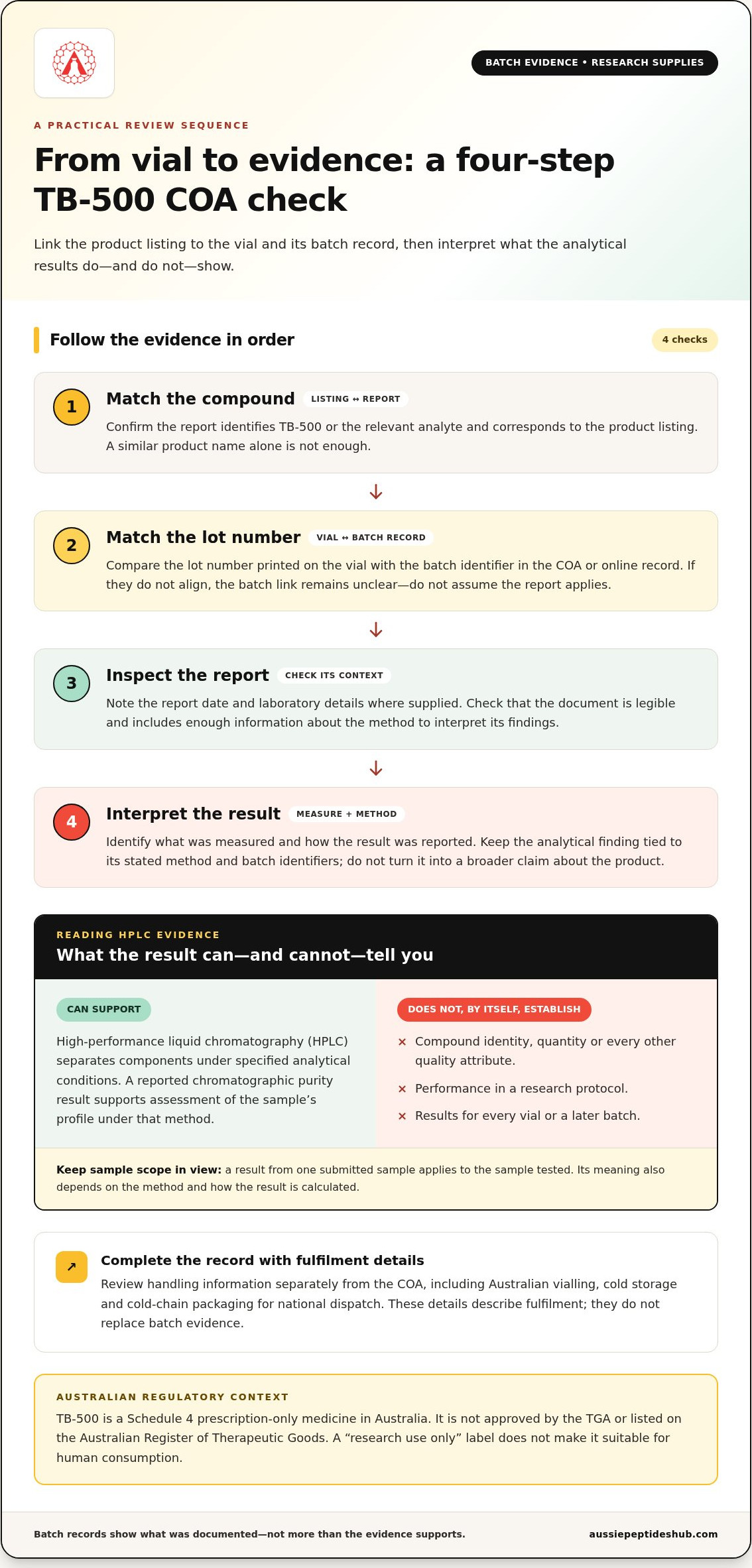
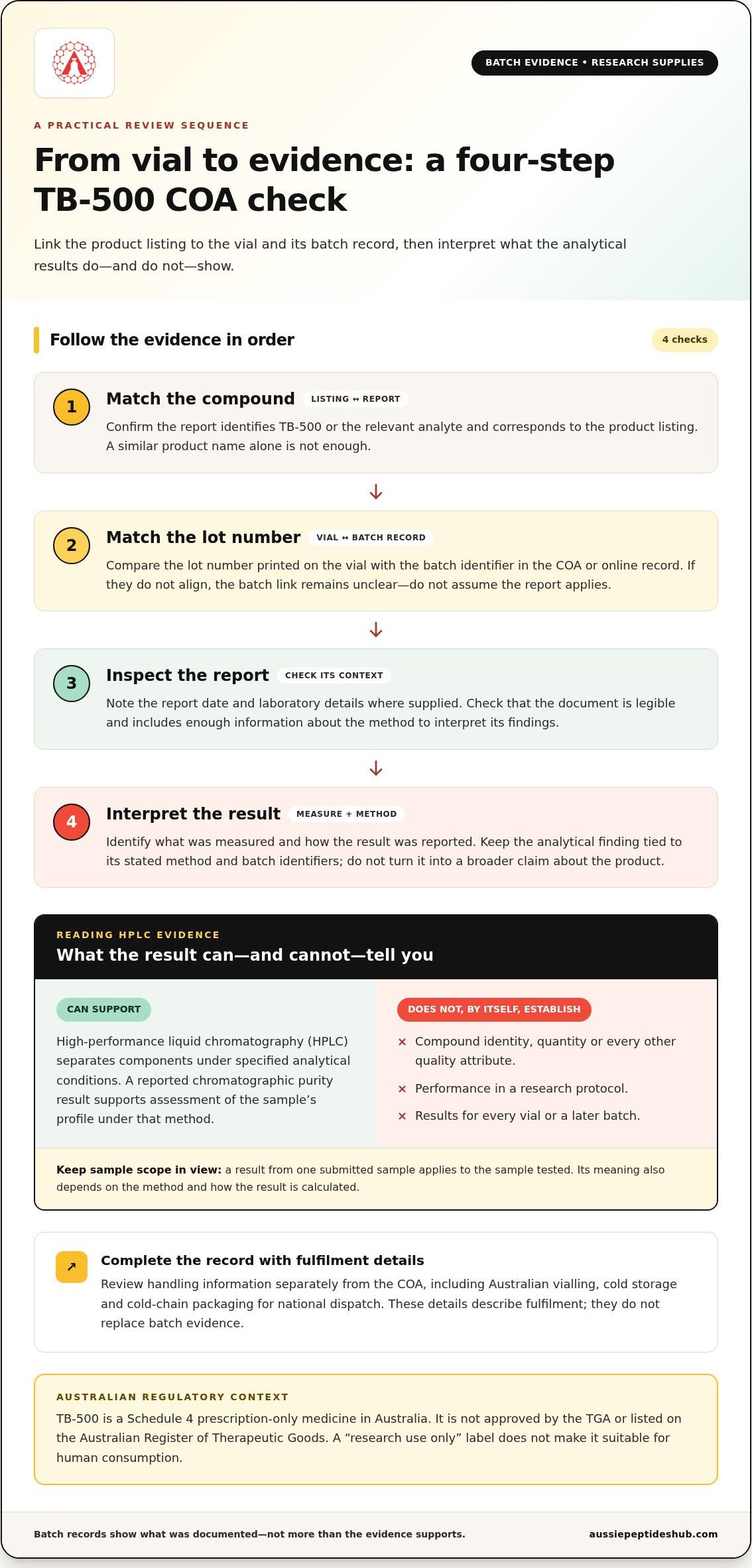
A COA is useful only when its identifiers connect clearly to the supplied batch. Review the record in this order:
- Match the compound. Confirm that the report identifies TB-500 or the relevant analyte and corresponds to the product listing. A similar product name is not enough.
- Match the lot. Compare the lot number printed on the vial with the batch identifier in the COA or online record. Record any discrepancy rather than assuming the report applies.
- Review the report. Note the report date and laboratory details where supplied. Check that the document is legible and gives enough method information to interpret the findings.
- Read the result in context. Identify what was measured and how the result was reported. Do not turn an analytical result into a broader claim about the product.
Which identifiers should a buyer match?
Start with the physical vial, not a search result or product title. Its printed lot number should correspond to the batch identifier in the matching record. Confirm that the report names the relevant analyte and relates to the listed product. Where provided, note the report date and laboratory details in your records. If the identifiers do not align, the batch link remains unclear.
What does an HPLC result establish, and what does it not?
High-performance liquid chromatography (HPLC) separates components under specified analytical conditions. A reported chromatographic purity result supports assessment of the sample’s profile under that method. Its meaning depends on the method and how the result is calculated; it is not a universal measure independent of those details.
Keep different attributes separate. A chromatographic purity result alone does not necessarily establish compound identity, quantity or every other quality attribute. Those require relevant methods and results to be documented. Nor does a result establish performance in a research protocol. A percentage without its associated method and batch identifiers provides limited context.
Sample scope matters. A result from one submitted sample applies to the sample tested; it does not establish the result for every vial or a later batch. Aussie Peptides supplies TB-500 for laboratory research use with independent HPLC testing and matching COAs. The lot number on each vial can be used to check batch details online. For TB-500 research supply information, compare the record with the vial’s lot before relying on its result.
Compare TB-500 lab supplies by evidence, product clarity and fulfilment
Compare listings using the same criteria, not the strongest-sounding claim. A structured comparison shows whether product identity, analytical documentation and dispatch details are clear, and where information is missing. For tb 500 lab supplies australia, this helps distinguish verifiable records from broad product language without treating any one result as a universal benchmark.
How to compare product and analytical details
Use the listing and its supporting report as separate records. Compound naming and format should be clear and consistent. For a blend, rely on the stated ingredients rather than guessing from the name. For a single-compound listing, do not assume a blend is equivalent. Mark the evidence type precisely: batch-linked, sample-specific or product-level. A numerical result belongs to the report, sample and batch it cites, not to other listings by default.
A published sample result is not evidence tied to the supplied lot unless the identifiers make that connection. This distinction prevents a result shown on a product page from being treated as a standing benchmark for future stock or other suppliers. Compare like with like, and leave unsupported performance or quality rankings out of the assessment.
How to compare dispatch and traceability information
Check whether the listing explains where handling takes place and how the product is dispatched. A clear route from the vial’s lot number to a batch record makes later documentation checks practical. Aussie Peptides states that peptides are vialled and cold-stored in Australia, with national dispatch using cold-chain packaging. These details describe the supply process; they do not establish a particular parcel’s transit temperature or delivery time.
Use a consistent comparison record for each listing: note the identity, evidence scope, report access, format and dispatch details. This keeps the assessment neutral and makes information gaps visible. Do not fill those gaps with assumptions about purity, performance or handling conditions that the available records do not establish.
A pre-purchase checklist for TB-500 research supplies in Australia
Use this sequence to assess tb 500 lab supplies australia before making a purchasing decision. Record what each document establishes rather than relying on the product title or a general quality claim. This checklist is for laboratory research sourcing only. TB-500 products discussed here are not for human or veterinary use.
Five checks to complete before ordering
- Confirm the research-use scope. Check that the listing identifies TB-500 and clearly states laboratory research use only. Treat that scope as a boundary, not as a claim of suitability for personal, therapeutic or veterinary use.
- Check the product identity and format. Compare the compound named in the listing with the product described in its documentation. If the listing describes a blend, use its stated ingredient information. Do not infer contents from the product name or assume it is equivalent to single-compound TB-500.
- Locate the relevant COA and match the lot. Compare the lot number printed on the vial or associated batch record with the identifier on the COA. A report that names TB-500 but has no clear link to the relevant batch does not complete this check.
- Review the report’s scope. Note the reported method, result and sample scope. Keep the finding specific to the sample or batch identified in the document. Do not extend it to other lots or treat an analytical result as proof of every quality attribute or research outcome.
- Read the fulfilment information. Look for stated Australian packaging and storage details, and the described dispatch method. Aussie Peptides vials and cold-stores peptides in Australia, then sends them nationally using cold-chain packaging. Record these process details separately from assumptions about a parcel’s transit conditions or arrival time.
What should prompt a pause in the evaluation?
Pause if the product identity is unclear, if the listing and report name different compounds or formats, or if the vial’s lot number does not match the batch record. These gaps prevent a clear link between the physical product and the evidence presented. A general COA for a product category does not resolve a batch mismatch.
Broad purity language also needs supporting documentation. Without a report tied to the relevant sample or lot, it should not be treated as batch-specific evidence. Even a matching HPLC result has a defined analytical scope; it does not establish every product attribute or predict experimental performance.
Keep the use boundary explicit throughout the review. Research-only product information must not be converted into human-use instructions or therapeutic claims. Once the identity, batch record, COA scope and dispatch details are documented, your assessment can rest on traceable records rather than assumptions. Review the TB-500 product information alongside the relevant batch documentation.
Aussie Peptides TB-500 supply: traceability from batch record to Australian dispatch
For tb 500 lab supplies australia, traceability depends on links between the product, its batch documentation and its fulfilment process. Aussie Peptides’ TB-500 supply follows a defined sequence: contract manufacturers synthesise the peptides, independent HPLC testing is conducted, and vialling and cold storage take place in Australia. These stages describe the supply process. They do not, by themselves, establish every quality attribute or predict a laboratory result.
From synthesis to batch documentation
Contract manufacturers synthesise the peptides. The process includes independent HPLC testing, with a matching Certificate of Analysis supplied for the product. The COA provides analytical information associated with the relevant batch. Its value depends on whether it can be connected to the physical stock being assessed, not simply whether it shares a compound name.
Each vial carries a printed lot number. Use that identifier to check batch details online and compare the vial with its matching COA. Read the lot number from the vial, locate the corresponding batch information, then confirm that the report relates to the product and lot. This creates a clearer documentary link between the item and its reported analysis.
Keep the scope of the evidence precise. An HPLC report records results under its stated analytical method; it does not establish every possible attribute or guarantee a particular experimental outcome. A batch lookup supports traceability, not a promise of research performance. For laboratory records, retain the lot identifier and associated documentation together so the evidence stays connected to the specific supply received.
Australian packaging and the next step
Vialling and cold storage take place in Australia. Peptides are packaged for cold-chain dispatch to customers nationally. This describes the handling and fulfilment pathway, which is separate from analytical testing. It does not establish the temperature experienced during every stage of transit, specify an arrival time or guarantee experimental results.
Review the evidence as a sequence: contract-manufacturer synthesis, independent HPLC testing, matching batch documentation, Australian vialling and cold storage, then cold-chain packaged dispatch. Each stage answers a different question. The COA and lot lookup address batch-level documentation; packaging and dispatch details describe fulfilment. Keeping these functions distinct makes the record easier to assess without extending claims beyond the evidence provided.
TB-500 is supplied for laboratory research use only and is not for human consumption. Review Aussie Peptides TB-500 research supplies and assess the product information alongside its batch details.
Make batch evidence part of your next decision
Before assessing a listing, define what your laboratory needs to document at receipt. Set a record-keeping process for product identity, batch reference and the analytical documents associated with that lot. Record fulfilment information alongside those details. A consistent procedure makes future comparisons clearer and helps identify gaps before they enter your research records.
For tb 500 lab supplies australia, Aussie Peptides provides independent HPLC testing with matching Certificates of Analysis, online batch-detail checks using the lot number printed on each vial, and Australian vialling with cold-chain packaged shipping nationally. Treat each as a specific evidence or fulfilment detail, not as a broader claim about performance. TB-500 products are for laboratory research use only, not human consumption.
Use your documented criteria to assess the product information and batch record together. Review Aussie Peptides TB-500 research supplies as your next step, and keep your evaluation grounded in records you can trace and retain.
Frequently Asked Questions
What should a TB-500 Certificate of Analysis include?
Look for clear compound identification, a batch or sample identifier, the analytical method, the reported result and a report date where supplied. Compare the identifiers with the vial’s lot record; a report naming TB-500 alone may not establish which stock it covers. Keep a copy with your laboratory records and note the lot it relates to. A COA documents its stated findings, not every product attribute or experimental performance.
Does an HPLC purity result prove that every TB-500 vial has the same result?
No. An HPLC result applies to the sample and batch identified in its report. Do not extend it to unrelated or later batches without corresponding evidence. For example, a report for one lot does not establish the result for a vial bearing a different lot number. Compare the vial identifier with the batch record, then interpret the reported method and result within the limits described in that document.
How can I verify a TB-500 batch number?
Read the lot number printed on the vial, then compare it with the online batch details and matching COA. Check the characters carefully, including any letters or leading zeroes, as a small mismatch can break the traceability link. Save the relevant record with your receiving documentation. Matching identifiers support batch traceability, but they do not independently establish every product attribute or predict how material will perform in a research setting.
Is TB-500 sold as a laboratory supply for human use?
No. Aussie Peptides’ TB-500 products are for laboratory research use only and are not for human consumption. Research-supply descriptions are not medical or therapeutic advice, and this information does not provide instructions for personal use. If you have a medical question, seek advice from an appropriate health professional. For a question about Australian regulatory requirements, consult an official Australian regulator. Do not treat a research-use label as evidence of approval for human use.
What does cold-chain delivery information tell a TB-500 buyer?
It describes the supplier’s stated approach to packaging and dispatch, such as using cold-chain packaging for national delivery. That information is distinct from an analytical report: it describes fulfilment, not a measured laboratory result. It does not prove the condition of every parcel at every point in transit. For receiving records, document the packaging observed on arrival separately from the COA and batch information.
Can one TB-500 COA be used to verify a different batch?
Not automatically. Read a COA in relation to the sample or batch identifiers it names. If a vial has a different lot number, a report for another batch does not verify it. Locate the record relevant to that vial and compare the identifiers before filing the document as supporting evidence. If the report’s scope is unclear, do not extend its findings beyond what the document states.
What is the difference between TB-500 product information and batch evidence?
Product information describes the item being offered, while batch evidence records analytical findings associated with an identified sample or lot. A listing can help identify the stated compound and format, but it cannot replace a report linked to the relevant batch. For tb 500 lab supplies australia, keep the listing and batch record as separate entries in your procurement notes. Do not infer identity, purity or performance beyond the documentation provided.