Reconstituting Research Peptides: A Controlled Laboratory Guide
October 10, 2026 · 17 min read
Could the solvent and preparation method that worked for one peptide compromise another assay? Reconstituting research peptides is an assay-specific laboratory task, not a universal recipe. The right approach depends on the material, the intended analysis and a validated protocol.
Caution is warranted. Uncertainty about solvent selection or handling can affect sample identity and experimental reproducibility, while incomplete records make results harder to interpret. A vial label alone is not the full evidence trail. Check the batch details and matching documentation before preparation begins.
This guide explains what to verify and control in a laboratory workflow, including product identity, batch records, protocol suitability and procedural documentation. It also clarifies the boundary between research guidance and clinical or human-use instructions. Research-use-only products are not for human consumption, and laboratory preparation information must not be treated as directions for personal use.
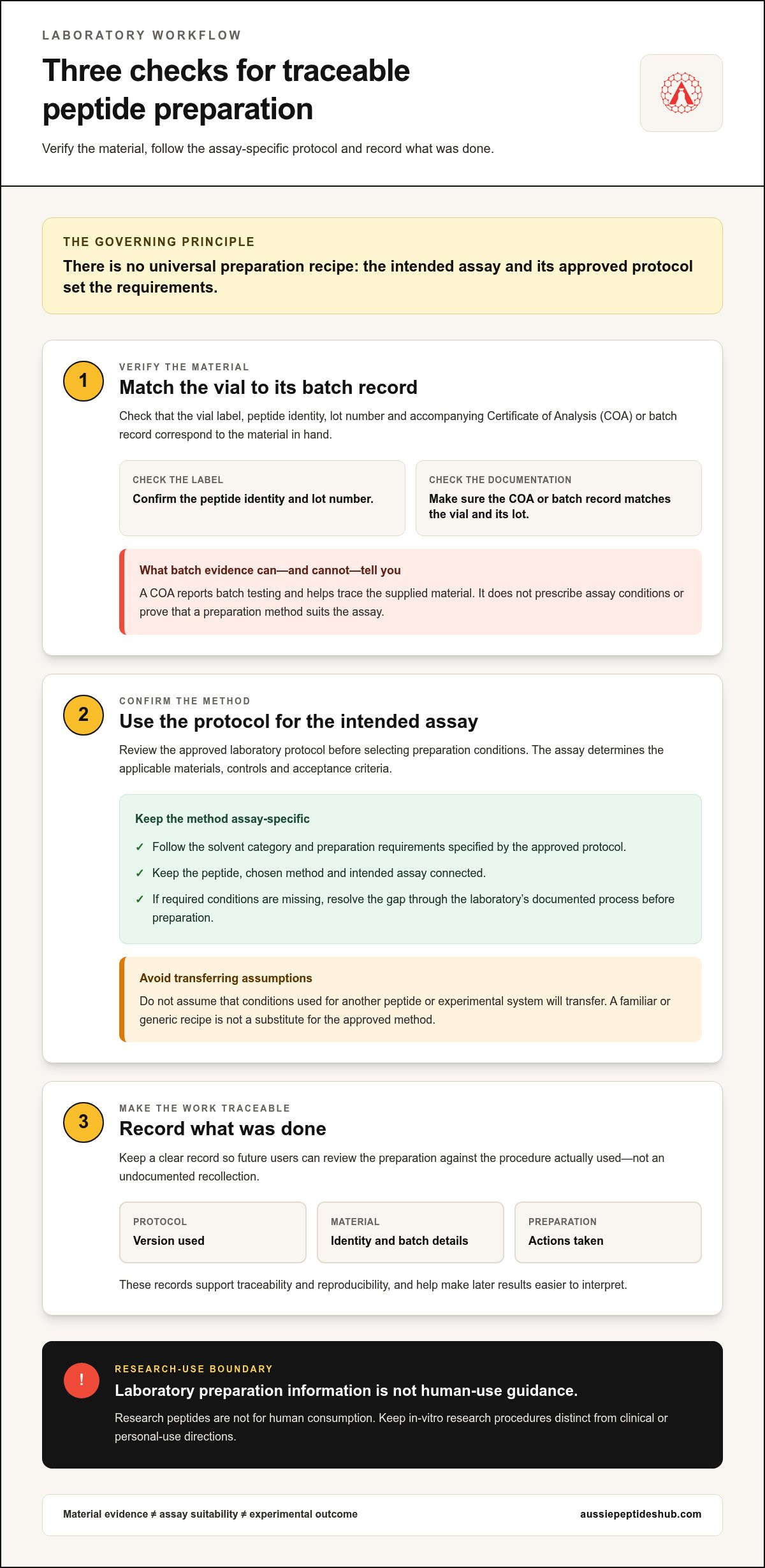
Use the steps below to structure a traceable process: verify the material, follow the assay-specific protocol and record what was done. That discipline supports accountability and gives future users a clear basis for reviewing the work.
Key Takeaways
- Before reconstituting research peptides, match the vial identity and lot number to the label and accompanying documentation.
- Use the solvent category and preparation requirements specified by the approved protocol for the intended assay, not a generic recipe.
- Record the protocol version, batch details and preparation actions to support traceability and reproducibility.
- Batch analysis can help verify material documentation, but it does not establish assay validity, biological activity or experimental outcomes.
- Keep laboratory research guidance distinct from clinical or human-use directions. Research peptides are not for human consumption.
What does reconstituting research peptides mean in a laboratory?
Reconstitution is a laboratory preparation step that brings lyophilised material into the form specified by the method for a particular experiment. Lyophilised means the material has been freeze-dried. It describes the material’s physical format, not the preparation instructions for an assay. The protocol defines the required form and how it is to be assessed.
Quotable definition: Reconstituting research peptides means preparing lyophilised material into the protocol-specified form for a defined laboratory assay. No single preparation recipe applies to every peptide or assay.
The intended assay determines which preparation conditions matter. An in-vitro binding study and a cell-based assay may have different method requirements and acceptance criteria. A validated laboratory protocol should specify the applicable materials, controls and records. Applying an assumed, generic method can introduce variation, making experiments harder to compare and results harder to interpret.
Peptides are defined by their amino-acid sequences, and synthesis is separate from laboratory preparation. The overview of Peptide Synthesis provides background on how peptides are created. That context does not replace the assay method: synthesis information cannot establish which preparation conditions suit a particular experiment.
Why lyophilised research material requires protocol-specific preparation
Lyophilisation describes how material is presented; it does not establish a universal solvent, concentration or handling sequence. Preparation conditions can affect how consistently a sample enters an assay and how results can be compared. A label identifies the material and may provide batch information, but it does not define the assay design, controls or acceptance criteria. Those belong in the approved laboratory procedure.
Research preparation is not human-use guidance
Products discussed here are for laboratory research and are not for human consumption. Reconstitution in this context refers only to documented in-vitro research procedures. It is not medicine preparation, a treatment method or advice about dosing or administration. Keep product records, assay documentation and intended research use distinct from any clinical or personal-use context.
A controlled research workflow begins with a defined experimental purpose, not a familiar-sounding recipe. Before preparation, identify the assay and the approved procedure that governs the work. If the method does not specify the required preparation conditions, resolve the gap through the laboratory’s documented process before preparing the sample. Guessing introduces an uncontrolled variable.
For example, a researcher preparing material for an in-vitro binding assay should follow that assay’s documented method, rather than assume that instructions used for a different peptide or experimental system will transfer. Keep the sample’s identity, chosen method and resulting records connected. That makes it possible to interpret later results against the procedure actually used, rather than an undocumented recollection.
Reconstituting research peptides is not simply a matter of making dry material usable. It is a defined step within a broader analytical workflow. The assay sets the requirements, the validated protocol sets the controls, and the records show what was done. Keeping these elements separate from human-use directions protects the purpose of the research and the integrity of its results.
What to verify before reconstituting a research peptide
Before preparation, establish that the material, its batch record and the planned assay belong together. A pre-preparation check can catch identity mismatches before they become part of experimental data. It also separates evidence about the supplied batch from decisions that must follow the laboratory’s approved method.
Match the vial, lot number and Certificate of Analysis
Read the vial label and compare its lot number with the corresponding Certificate of Analysis (COA) or batch record. Check that the peptide identity is consistent across the records and that the documentation clearly corresponds to the vial in hand. Batch details for Aussie Peptides products can be checked online using the lot number printed on each vial. A COA reports batch testing; it does not prescribe assay conditions or preparation steps.
Quotable distinction: Product identity evidence can trace a vial to its batch, but it cannot prove that a preparation method suits a particular assay.
For an example of how lot-level records support product checks, the article TB-500 Lab Supplies Australia: A Batch-Verification Buying Guide discusses batch verification in a research-supply context.
Read the research protocol before selecting preparation conditions
Review the approved, assay-specific laboratory protocol before choosing preparation conditions. The research question and analytical method determine what the procedure must specify. Do not transfer assumptions about material, solvent or analytical requirements from another peptide or assay. JoVE’s overview of Reconstitution of Membrane Proteins illustrates reconstitution as a laboratory process, but its focus on membrane proteins does not make it a peptide-specific protocol.
Use this pre-preparation checklist:
- Identity: Confirm that the peptide name and other identifying details match across the vial label and its associated documentation.
- Lot traceability: Record the vial’s lot number and verify that it corresponds to the batch record or COA.
- Document legibility: Check that identifiers and reported batch information are readable and internally consistent.
- Protocol authority: Identify the approved procedure for the intended research question and assay, including its specified preparation requirements.
- Discrepancies: Stop if a label is unreadable, a lot number does not match or essential records are missing. Resolve the issue through the laboratory’s documented process before proceeding.
This pause is a control, not an administrative formality. If the label identifies one material but the accompanying record identifies another batch, the experiment’s starting point is uncertain. If a protocol is silent about a required condition, guessing introduces an undocumented variable. Record the discrepancy and its resolution so the preparation has a traceable basis.
Keep the evidence categories distinct. A matching COA supports batch-level traceability and reports testing associated with that batch. It does not establish that the chosen preparation will work for an assay, validate the assay itself or predict its outcome. The protocol governs the experiment; the batch record documents the supplied material.
For laboratory workflows that require traceable research materials, research peptide supplies can form part of the documented preparation record. Products are for laboratory research only and not for human consumption.
How to assess solvent suitability without relying on a generic recipe
Solvent selection is part of method design, not a standalone product choice. A solvent mentioned in a guide or familiar from another experiment is not automatically suitable for a different peptide or assay. Solvent choice is method-dependent because compatibility must be established for the material and analytical method, not assumed to be universal.
When reconstituting research peptides, assess the assay requirements, material documentation and approved laboratory procedure together. The method should identify the solvent category and any compatibility checks relevant to the experiment. If these details are absent or unclear, pause and resolve the gap through the laboratory’s documented process rather than importing conditions from an unrelated protocol.
What determines whether a solvent is suitable?
Start with the purpose of the assay and its documented analytical requirements. Then check that the material records and laboratory method support the proposed solvent category. A product name, online anecdote or protocol for another peptide does not establish compatibility. Research preparation requirements must also remain distinct from sterile clinical or injection products, which belong to a different context.
Protocol-defined solvent category
Compatibility check: Confirm that the approved assay method identifies the category for the specific material and analytical purpose. Do not infer suitability from another peptide’s procedure.
Documentation: Record the protocol reference and the rationale or method requirement supporting its use.
Alternative or specialised category specified by a method
Compatibility check: Check that the laboratory procedure addresses relevant material and assay requirements. If the method does not resolve compatibility, do not substitute a category based on convenience.
Documentation: Record the procedure version, any required review and the basis for the decision.
No category specified or requirements conflict
Compatibility check: Treat the condition as unresolved. Conflicting instructions or missing criteria prevent a reasoned selection.
Documentation: Log the discrepancy and its resolution before preparation proceeds.
Why bacteriostatic water is not a default research answer
Bacteriostatic water is a named laboratory supply, but its availability or use in another guide does not establish universal compatibility with research peptides. The solvent category must be supported by the relevant assay method and laboratory procedure. A clinical or injection context must not be carried over into in-vitro research instructions. Products discussed here are for laboratory research only and not for human consumption.
For compound context, TB-500 research peptide Australia: structure, evidence and research scope addresses the research scope of that material. It should not be treated as a solvent protocol. Keep compound information separate from method validation: a description of a peptide cannot establish which preparation conditions are appropriate for a particular assay.
Before proceeding, make the decision traceable in the record: identify the assay method, the solvent category it specifies and any compatibility review required by the laboratory. This shows why the selection was made. It does not replace experimental validation or prove that the assay will produce a particular outcome.
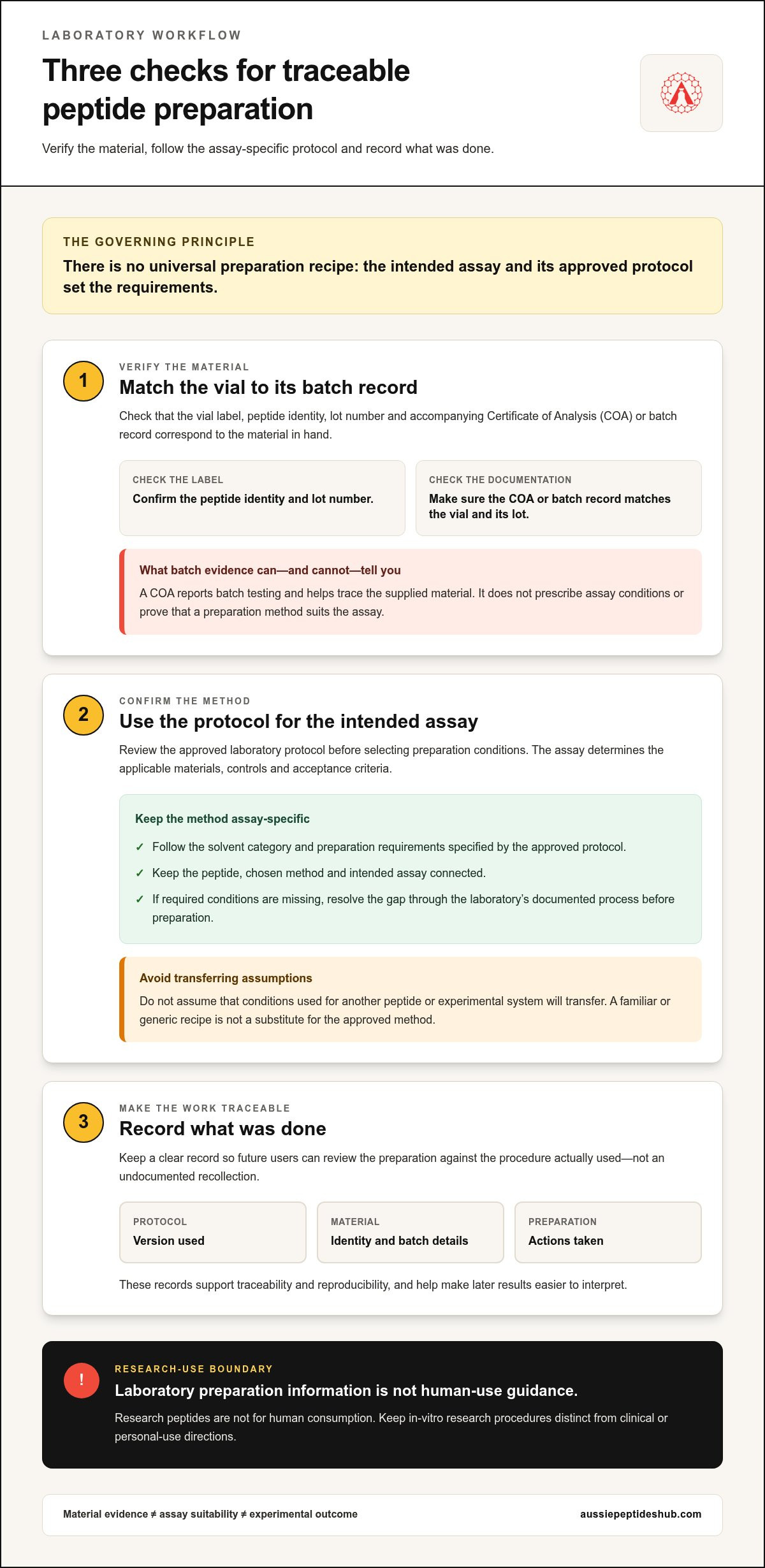
How to organise a controlled research-peptide preparation workflow
A controlled workflow makes each decision traceable without turning a general guide into a preparation recipe. Only appropriately trained laboratory personnel should perform the work, following their institution’s procedures and the approved method for the intended assay. The sequence below covers process control only. It does not specify quantities, temperatures, mixing techniques or ready-to-use instructions.
- Verify the records. Confirm that the sample identifier and vial lot number match the relevant batch documentation. Record any discrepancy and pause if the identity cannot be established.
- Review the approved protocol. Check that the procedure applies to the research material and assay in question. Confirm its version and that required preparation conditions and controls are defined.
- Prepare the workspace. Organise the work area and records in accordance with the institution’s procedure. Make sure the approved method and documentation are available to the responsible researcher.
- Document actions and observations. Use the laboratory’s approved record system to capture the protocol-defined materials, actions, relevant observations and any deviations.
Establish identity and procedural control
Before work begins, link the sample identifier and lot number to the protocol version, assay and responsible researcher. These details establish which material was handled, under which procedure and by whom. Confirm that the batch documents and protocol refer to the same research material and experimental purpose. If that relationship is unclear, stop and resolve it through the laboratory’s established process.
Pause and escalate if a label and batch record do not match, the protocol is unclear or an unexpected observation occurs. Do not improvise a correction or continue on the basis of an assumption. Record the issue, notify the appropriate laboratory supervisor or quality contact, and follow the institution’s deviation process. This preserves the original record and documents how the discrepancy was assessed.
Document preparation and experimental context
Enter the protocol-defined materials and actions in the approved laboratory record system. Log the protocol version, sample identifier, lot number, responsible researcher, date of work, relevant observations and any authorised deviation. Keep these factual entries distinct from interpretation. A preparation record documents what was done; it does not establish assay performance or a biological effect.
Clear records allow another authorised researcher to reconstruct the procedural context without relying on memory. For example, noting that a step followed a specified protocol version is more informative than recording only that preparation was completed. If an observation falls outside the procedure’s expectations, describe it objectively and preserve it for review rather than recasting it as routine. This matters when reconstituting research peptides because undocumented changes can make later comparisons difficult to assess.
Use this workflow as a control framework, not as a substitute for institutional training or an assay-specific method. For research materials used in documented laboratory workflows, explore research peptide supplies. Products are for laboratory research only and not for human consumption.
How batch traceability and records support reproducible peptide research
Reproducibility depends on more than following a preparation procedure. Researchers also need to identify the material and connect it to the experimental record. Lot-level traceability helps show which batch entered an experiment and lets the laboratory review the relevant batch documentation when assessing results later.
A useful research paper trail connects the sample identity, vial lot number, protocol version, assay and preparation record. If a deviation or unexpected observation occurs, documenting it alongside those details helps distinguish what the procedure specified from what happened in practice. This supports review and comparison; it does not guarantee that another experiment will produce the same result.
What a batch record can and cannot establish
A Certificate of Analysis (COA) is batch-specific analytical documentation. It reports testing associated with that batch, so matching the COA to the vial’s lot number helps trace the material used. Aussie Peptides supplies research peptides with matching batch COAs, and batch details can be checked online using the lot number printed on each vial.
Independent HPLC testing supports analytical characterisation of the batch. It does not validate a particular assay, establish biological activity or predict experimental outcomes. Nor does analytical testing establish suitability for human use. A COA is evidence about documented batch testing, not a guarantee of assay performance or a substitute for the laboratory’s own validation and controls.
For an experiment, the laboratory record should preserve the connection between the material and the work performed. Depending on the institution’s record system, relevant entries may include:
- Sample identity: the material identifier and vial lot number.
- Batch documentation: the matching COA or batch record reference.
- Experimental method: the assay and protocol version used.
- Preparation history: protocol-defined materials and actions, plus any documented deviations or relevant observations.
Keep these entries factual. The batch record documents material information; the preparation record documents laboratory actions; assay data and interpretation belong in their appropriate experimental records. This separation helps researchers review a result without treating batch analysis as proof of assay validity or biological effect.
A research-only sourcing and verification next step
Traceability starts before a sample reaches the experimental record. Check that the vial identifier corresponds to its batch documentation, then preserve that link in the laboratory’s approved record system. Australian packaging and cold-chain shipping are relevant product-handling context, but they do not replace the researcher’s own sample tracking, protocol controls or assay validation.
For research use only. Products are not for human consumption. To review research peptide and laboratory supply information, use the available batch and product documentation as part of a controlled research workflow. Keep material verification separate from conclusions about experimental performance.
Carry protocol control into your next experiment
Make the next step a review point, not an assumption. Before a new study begins, confirm that the method remains appropriate for its research question and that the sample record can be connected to the work performed. If the assay or procedure changes, update the documentation through your laboratory’s established process. That discipline keeps reconstituting research peptides within a controlled, research-only workflow.
Aussie Peptides supplies research peptides and related laboratory supplies for laboratory research only. Products are not for human consumption. Use product documentation alongside your institution’s procedures, and keep material verification separate from conclusions about assay performance or biological effects.
Review research peptides and laboratory supplies to support your documented research workflow. Consistent records and method-led decisions give your team a sound basis for the work ahead.
Frequently Asked Questions
Can one reconstitution protocol be used for every research peptide?
No. A protocol must fit the material, assay requirements and laboratory’s approved procedure. For example, a method validated for one assay should not be copied into a different experiment just because the peptide appears similar. When reconstituting research peptides, use the method authorised for the specific study and record its version. This article does not provide a preparation recipe, solvent ratio or instructions for human use.
Does a Certificate of Analysis tell me how to reconstitute a peptide?
No. A Certificate of Analysis reports batch-specific analytical information; it does not set experimental conditions. Use it to check whether the vial’s identifying details correspond to the documented batch, then consult the procedure governing your study. If the COA and vial identifiers appear inconsistent, do not use the document as a substitute for resolving the discrepancy. Keep the relevant record reference with the experiment’s sample documentation.
Can reconstitution change the results of a research assay?
Preparation conditions can affect consistency, so a difference between runs should prompt a review of the recorded method and any deviations. For example, compare the protocol versions and preparation records before attributing a changed result to the research material. That comparison can identify procedural differences for further assessment, but it does not prove their effect. Interpret results using the assay’s own controls and evidence, not an assumption about a single cause.
Is bacteriostatic water suitable for every research peptide?
No. Suitability depends on the specific material and assay method. A reference to bacteriostatic water in a general guide, supplier page or unrelated experiment is not evidence that it is compatible with your research procedure. Check the approved protocol’s solvent requirements and document the source of the decision. Laboratory research information must not be treated as advice for injection, clinical use or medicine preparation.
What should I do if the vial lot number and COA do not match?
Pause and keep the vial separate from materials with verified records. Note the identifiers shown on the vial and document, and record where the discrepancy was found. Follow your laboratory’s quality process to resolve it before the material enters an experiment. Do not rely on a similar peptide name, packaging or batch description as proof of identity. Retain the discrepancy record with the study documentation.
Are research peptide reconstitution instructions intended for human use?
No. Information from Aussie Peptides relates to laboratory research only; products are not for human consumption. An in-vitro procedure cannot be used as a basis for personal preparation, dosing, treatment or administration. If you have a human-use question, seek advice from a qualified health professional and consult the relevant regulatory authority. Keep research records and decisions within the scope of the documented laboratory study.