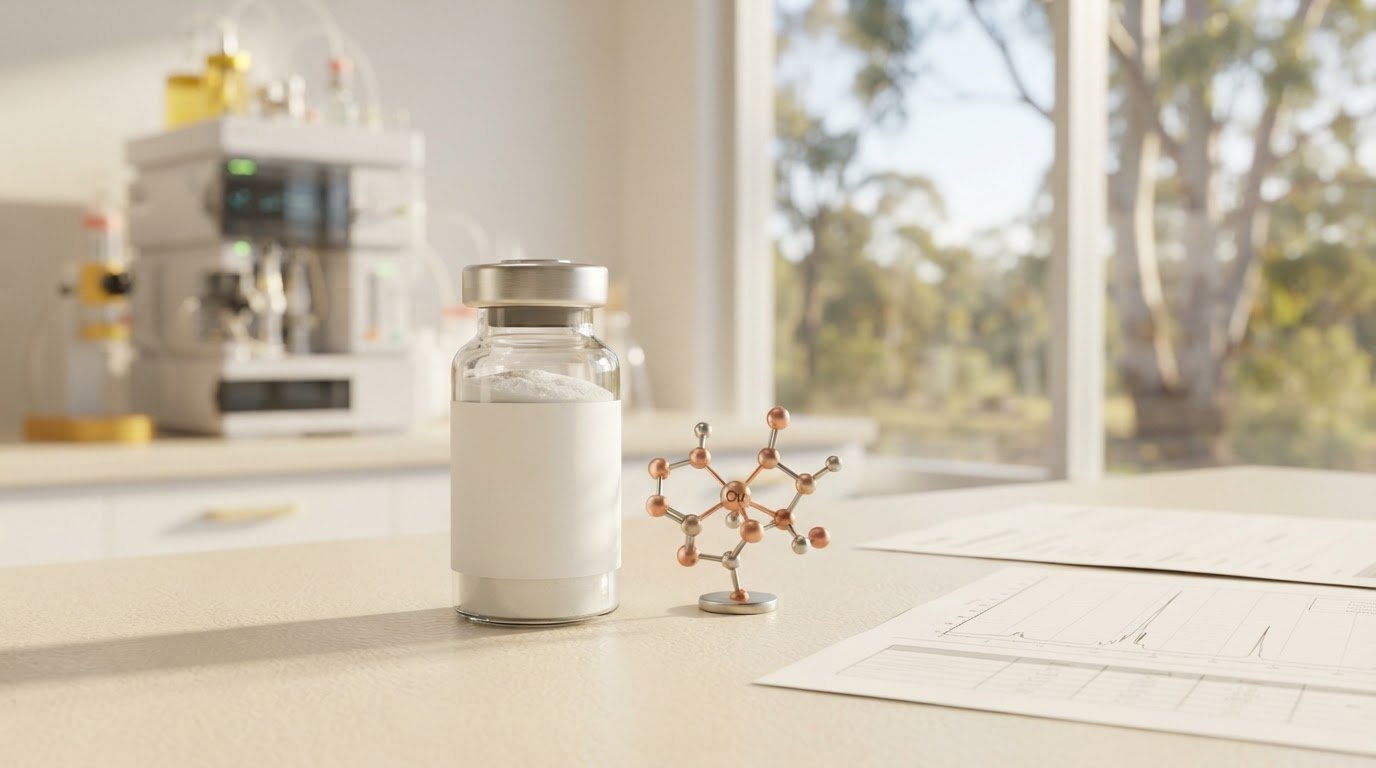
GHK-Cu Peptide Australia: Structure, Research and Assays
October 12, 2026 · 15 min read
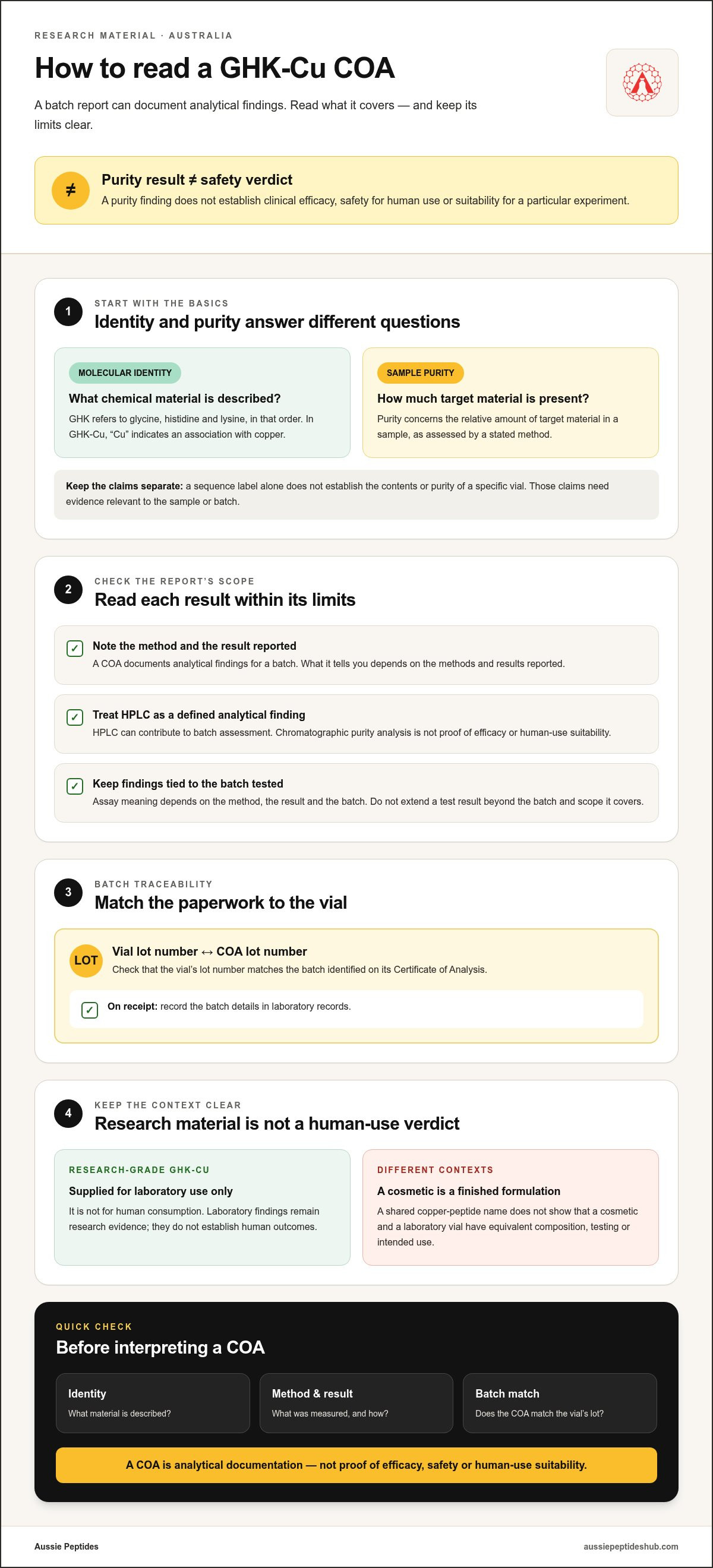
A purity result is not a safety verdict. For anyone assessing ghk cu peptide australia, that distinction matters: a research peptide, a copper-peptide cosmetic ingredient and claims about human use are not interchangeable. Confusion often starts when the same name appears in different contexts.
A Certificate of Analysis (COA) can document analytical findings for a batch, but what it tells you depends on the methods and results reported. It does not establish clinical efficacy or suitability for human use. Research-grade GHK-Cu is supplied for laboratory use only, not human consumption.
This article explains GHK-Cu’s peptide sequence and copper association, then looks at how assays such as HPLC contribute to batch assessment and what they cannot demonstrate. It also outlines how to read batch-matched COA information, check lot traceability and consider handling details when sourcing research material in Australia. The focus is a practical framework based on structure, analytical evidence and documentation, not broad claims.
Key Takeaways
- Distinguish GHK-Cu’s peptide sequence and copper association from claims about biological effects.
- Separate sequence identity from sample purity: they describe different aspects of the material.
- Read HPLC results within their stated scope. Chromatographic purity analysis is not proof of efficacy or human-use suitability.
- For ghk cu peptide australia research sourcing, match the vial’s lot number to its COA and record the batch details on receipt.
- Treat laboratory findings as research evidence only. They do not establish human outcomes.
GHK-Cu peptide in Australia: what the name describes
GHK-Cu is a copper-associated tripeptide studied in laboratory research. The name identifies a short peptide sequence, glycine, histidine and lysine, together with its association with copper. It describes the material’s basic chemical components, but does not predict biological effects or establish suitability for a particular use. Research-grade GHK-Cu is supplied for laboratory use only, not human consumption.
What do GHK and Cu refer to?
GHK abbreviates the amino acids glycine, histidine and lysine, in that order. Amino acids are small molecular units. A peptide is a chain of amino acids joined together, and a tripeptide is a peptide made up of three amino acids. In GHK, the order of those units forms the sequence used to describe the peptide.
Cu is the chemical symbol for copper. In GHK-Cu, it indicates an association between copper and the GHK peptide. The name helps identify the material, but does not specify every property of a particular sample or establish a biological outcome. A general overview of the terminology and reported contexts appears in Copper peptide GHK-Cu. Specific research claims still need to be assessed against their evidence.
Research peptide or copper-peptide skincare?
GHK-Cu terminology appears in discussions of both laboratory research and cosmetic products, but these are different contexts. Research-grade material is supplied as a laboratory research substance, while a finished cosmetic is a formulated product. A shared ingredient name does not show that two materials have equivalent composition, testing, presentation or intended use.
For example, a laboratory vial identified as GHK-Cu and a cosmetic product listing a copper peptide are not interchangeable descriptions. The cosmetic is a finished formulation, and its label refers to that product’s ingredient context. The research material’s identity and batch documentation relate to the laboratory sample. Neither the name alone nor an ingredient reference establishes that the materials share a formulation or analytical evidence.
This distinction is central when assessing ghk cu peptide australia. Read the product category and its documentation as separate pieces of information. A structural name helps identify what is being described; it does not turn research material into skincare or establish a personal-use purpose. Here, GHK-Cu refers to research-grade material for laboratory use only, not human consumption.
GHK-Cu structure: peptide sequence and copper association
The sequence notation gives a compact description of the peptide’s amino acid order. For GHK, the letters represent glycine, histidine and lysine. Once incorporated into a peptide chain, each amino acid unit is called a residue. The sequence tells a researcher which components are arranged in that order; it does not report how much target material is in a vial or whether a sample contains other substances.
How the GHK sequence is described
GHK is shorthand for glycine-histidine-lysine. This peptide sequence describes the order of its amino acid residues. Sequence notation supports identification, but it is not a complete quality assessment. A material labelled GHK may still require separate evidence to assess its composition and batch characteristics.
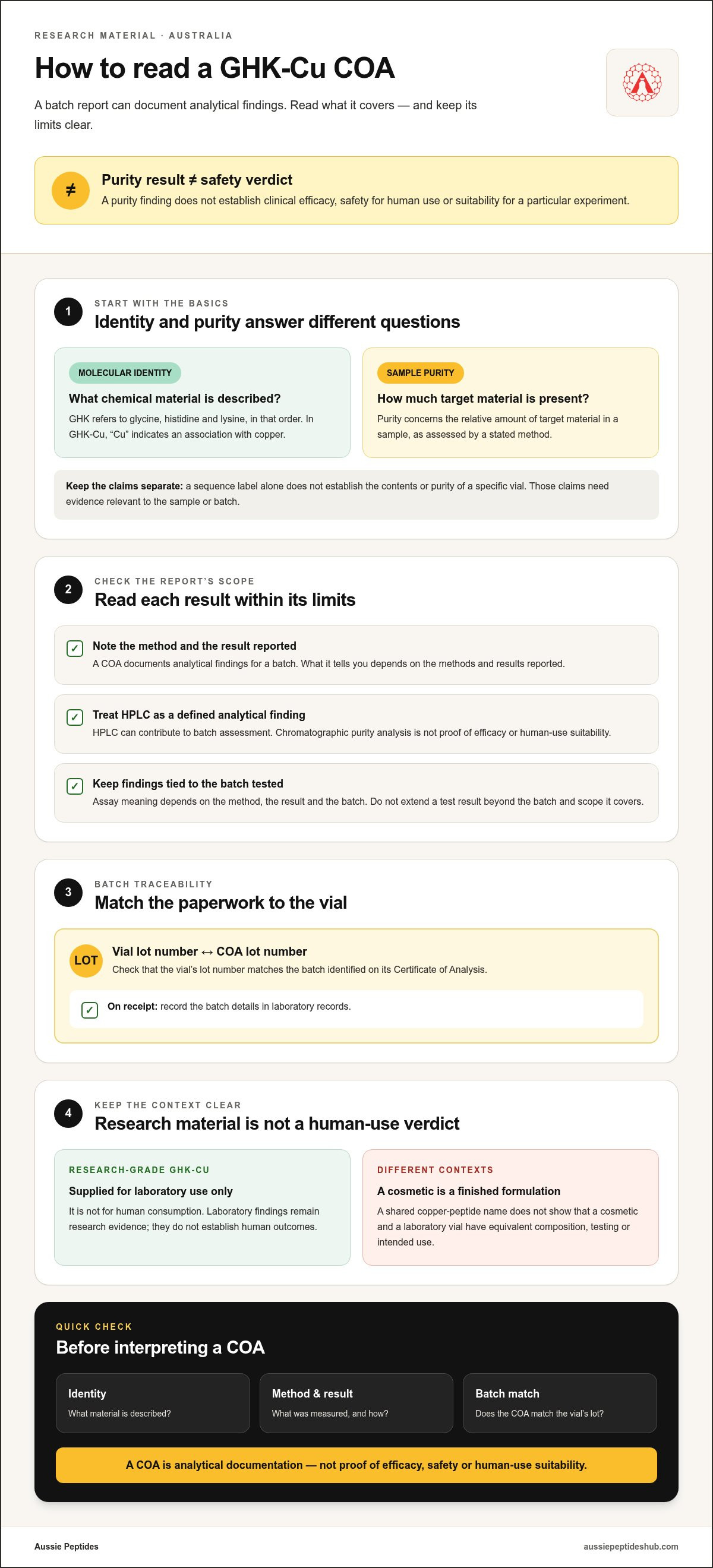
That distinction matters because molecular identity and purity answer different questions. Molecular identity concerns what chemical material is present; purity concerns the relative amount of target material in a sample, as assessed by a stated method. A matching sequence on a product description does not establish either result for a specific vial. Those claims need evidence relevant to the sample or batch.
Structure describes the molecule; an assay measures a sample against a defined analytical method. The first is a chemical description. The second produces evidence whose meaning depends on what was tested and how the result was reported. Keeping these terms separate prevents a structural label from being mistaken for proof of sample quality.
What copper association does, and doesn’t, tell a researcher
Cu is the chemical symbol for copper. A copper ion is a copper species with an electrical charge. The name GHK-Cu indicates an association between copper and the GHK peptide, but the label alone does not specify every detail of that association in a particular sample. Nor does it establish how the material behaves under particular storage or experimental conditions.
For a researcher, the practical limit is clear: a general structural description applies to the named compound, while a vial represents a particular sample. Claims about exact composition or copper association in that sample require suitable analytical evidence. A structural name cannot verify the vial’s contents, and a test result should not be extended beyond the method and batch it covers.
For ghk cu peptide australia research, treat the sequence as a starting point for identifying the material, not as a quality verdict. Keep the description, batch evidence and experimental findings distinct in laboratory records. For a laboratory project involving GHK-Cu, review the GHK-Cu research material alongside its batch documentation.
GHK-Cu research assays: what purity testing can establish
Analytical testing provides evidence about a sample under defined conditions. Its meaning depends on the method, the result reported and the batch tested. A purity figure is not a general quality score. It does not establish clinical efficacy, safety for human use or suitability for a particular experiment.
For ghk cu peptide australia research material, interpret assay findings alongside the matching Certificate of Analysis (COA). The report should relate to the vial’s batch, not simply to a general product description. Use numerical results from that batch documentation; do not infer a result from a label or another lot.
Purity, identity and content are different questions
Purity is an assay-specific measure of the target relative to what the method detects and reports. Identity concerns whether testing supports the expected chemical identity. Content concerns the amount of material present. These questions are related, but not interchangeable. A purity percentage alone does not necessarily report the quantity in a vial or independently confirm identity.
The COA’s method and stated result define what can reasonably be concluded. Avoid assumptions about accuracy, detection limits or sample attributes that the report does not address. If the documentation does not provide a value, do not substitute a typical figure or use a result from another batch.
| Question | What the evidence addresses | What it doesn’t establish by itself |
|---|---|---|
| Identity | Whether testing supports the stated material identity | Purity, quantity or human-use suitability |
| Purity | The sample profile measured and reported by the stated method | Every possible impurity or a complete safety assessment |
| Batch traceability | Whether documentation corresponds to an identified lot | Clinical efficacy or experimental outcomes |
What an HPLC result can and cannot say
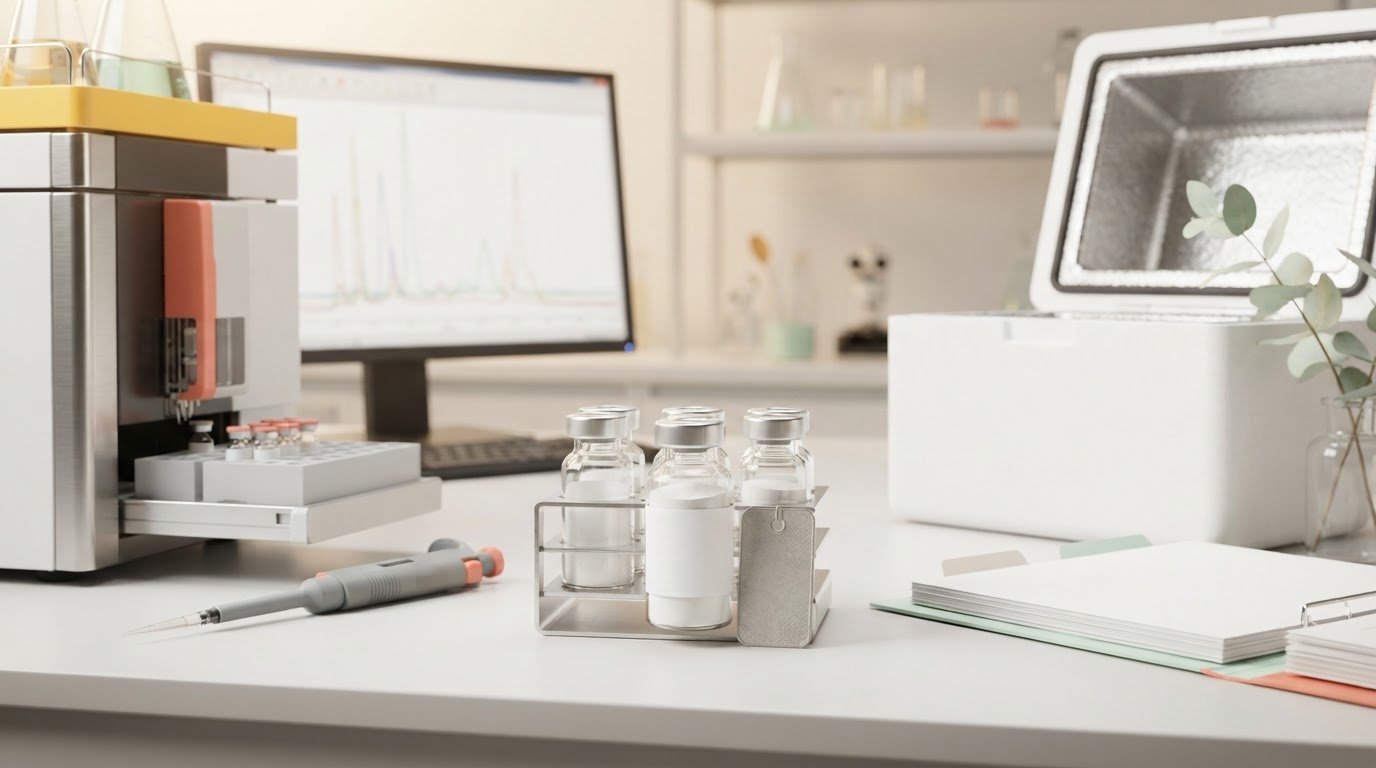
High-performance liquid chromatography (HPLC) is a chromatographic analytical method. It separates sample components under specified conditions so they can be assessed through the test’s reported output. A chromatographic purity result can indicate the relative signal assigned to the target under that method. It does not automatically identify every component or account for attributes the method was not designed to measure.
Read the stated method, batch identifier and reported result together. Aussie Peptides supplies independently HPLC-tested research material with a matching COA, and vial lot numbers can be used to check batch details online. Use the batch record as the reference for numerical claims. HPLC evidence does not demonstrate clinical efficacy or establish suitability for human use. The material is for laboratory use only, not human consumption.
For more detail on the method and its limits, the HPLC testing guide explains how to interpret chromatographic evidence without treating one result as a complete assessment.
Assessing Australian GHK-Cu research material: documentation and handling
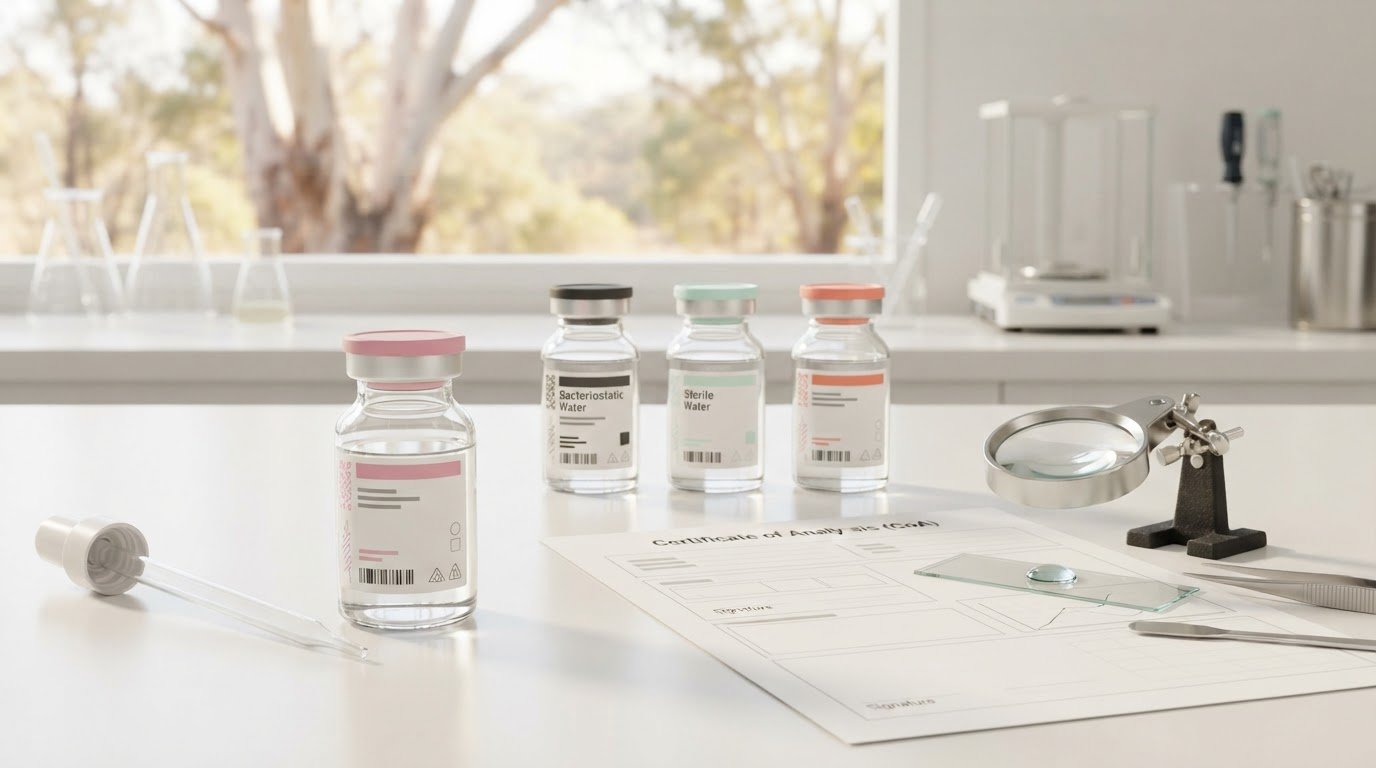
Traceability starts with the physical vial. For ghk cu peptide australia research material, use the lot number to connect the sample in hand with its batch documentation. A general product description may identify the category, but it cannot replace records tied to the specific lot. Keep the label, Certificate of Analysis (COA) and receipt record together.
Match the vial lot number to its documentation
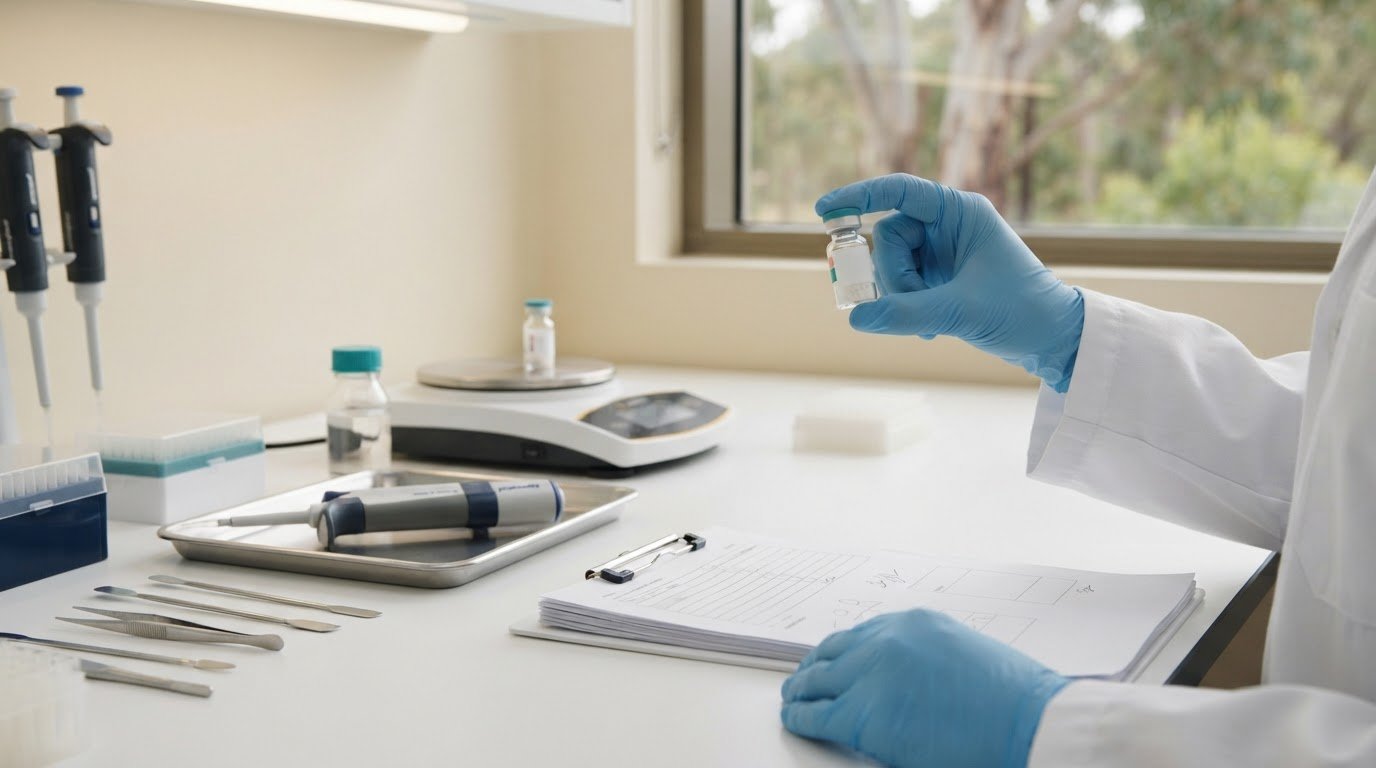
Use a consistent sequence when the vial arrives: identify its lot number, match it to the corresponding COA, review the stated analytical method and result, then record receipt in the laboratory’s documentation system. Aussie Peptides provides matching COAs, and vial lot numbers can be used to check batch details online. This connects the physical material to its batch record without extending the report beyond its stated scope.
Check that the lot reference on the vial corresponds to the batch identified in the COA. Note what the report covers, such as the stated assay and result. Do not assume a result applies to another lot or that a batch document establishes properties it does not report. The BPC-157 sourcing and verification guide provides a related example of batch-focused research sourcing checks.
Understand Australian research-only boundaries and delivery
GHK-Cu supplied as research-grade material is for laboratory use only, not human consumption. This is a clear use limitation, not a human-use protocol or health recommendation. Research documentation and analytical results do not establish suitability for personal use. For any specific Australian regulatory position, refer to current Therapeutic Goods Administration (TGA) guidance; this section does not provide legal advice.
Packaging and delivery are also part of the handling record. GHK-Cu is packaged in Australia, and domestic orders are shipped using cold-chain packaging. This describes the fulfilment process; it is not a guarantee of a particular temperature throughout transit. On receipt, record arrival details and follow the handling requirements established for the laboratory’s work and applicable procedures. Do not infer a transit condition that has not been measured or documented.
A clear paper trail makes review more straightforward: retain the lot identifier, matching COA and receipt entry as a single batch record. To assess the documentation alongside the material, view GHK-Cu research material and its batch details.
GHK-Cu peptide Australia: research scope and next steps
Assess GHK-Cu evidence in three distinct layers. Molecular description tells you which peptide and copper association the name refers to. Batch-level analytical evidence documents findings for a particular sample under a stated method. Research findings report observations from defined laboratory work. None of these layers can stand in for the others.
This separation matters when reading claims. An HPLC result concerns the tested batch and the scope of that analysis. An in vitro observation concerns a specified experimental setting. Neither demonstrates an outcome in people, establishes clinical efficacy or determines suitability for human use. GHK-Cu research material is for laboratory use only, not human consumption.
Keep research findings within their evidence limits
Interpret each finding in context: what was tested, what was measured and under what conditions? A result from cells or another laboratory model supports conclusions about that experimental system only. By itself, it does not justify conclusions about people, clinical use or treatment. Avoid turning a laboratory observation into a broader claim that the study did not test.
Apply the same discipline when comparing peptide research topics. The TB-500 research peptide overview offers a comparison of how research scope can be framed; it is not evidence that findings for one peptide apply to another. Keep claims tied to the compound, sample, method and study actually described.
A traceable next step for Australian laboratory research
For a practical review, start with the vial’s lot number. Match it to the batch-specific Certificate of Analysis (COA), then read the stated assay and result within their defined scope. Record the lot and receipt details in the laboratory’s documentation. If the vial identifier and COA do not correspond, the report cannot be confidently linked to that sample.
Aussie Peptides’ GHK-Cu is offered as research-grade material, independently HPLC-tested and supplied with a matching COA. Lot details can be checked online using the vial’s lot number. These records support batch traceability; they do not demonstrate clinical efficacy or human-use suitability. Products are packaged in Australia, and domestic orders are shipped using cold-chain packaging. This describes the fulfilment process, not a guaranteed temperature throughout transit.
For ghk cu peptide australia research sourcing, keep conclusions proportionate to the evidence: structure identifies, assays assess defined sample properties, and laboratory studies report findings within their methods. Review the GHK-Cu research material and its batch information as part of that assessment.
Make the next review evidence-led
For anyone assessing ghk cu peptide australia, the useful next step is to avoid inferring beyond the evidence. Treat product identity, batch documentation and experimental findings as distinct records, then assess whether the available information fits the requirements of your laboratory work. Research-grade GHK-Cu is for laboratory use only, not human consumption.
Check that the vial’s printed lot number connects to the online batch details and matching Certificate of Analysis (COA). Aussie Peptides’ products are independently HPLC-tested. Australian packaging and domestic cold-chain shipping are part of the handling record, but do not imply a guaranteed transit temperature. These details support traceability; they do not establish clinical efficacy or suitability for human use.
Keep the review practical: match the lot, read the stated assay and retain the records. Review GHK-Cu research material and its product information as a considered next step. An evidence-led approach gives laboratory decisions a clearer basis and helps keep conclusions within the limits of the available data.
Frequently Asked Questions
What is GHK-Cu peptide?
GHK-Cu is a copper-associated tripeptide: GHK represents glycine, histidine and lysine in sequence, while Cu is the chemical symbol for copper. The name describes molecular components, not a predicted biological effect. In Australia, Aussie Peptides supplies GHK-Cu as research-grade material for laboratory use only, not human consumption. This separates the material’s research context from products intended for personal use.
Is GHK-Cu the same as copper-peptide skincare?
No. Research-grade GHK-Cu and finished copper-peptide skincare belong to different product contexts. A cosmetic is a formulated product, while research material is supplied for laboratory use. Even when terminology overlaps, it does not establish equivalent composition, testing, formulation or intended use. A skincare product’s ingredient description cannot be used to infer the contents or analytical characteristics of a research vial, or vice versa.
What does an HPLC purity result for GHK-Cu show?
An HPLC purity result reports a sample assessment under the stated chromatographic method. It can indicate the relative chromatographic signal assigned to the target, as reported in the relevant batch documentation. The result should not be treated as a complete account of every sample attribute or possible contaminant. Check the method and batch identifier alongside the figure, and do not assume the same result applies to another lot.
Can a GHK-Cu Certificate of Analysis prove human-use safety or effectiveness?
No. A Certificate of Analysis (COA) records analytical information within its stated scope for a tested batch. It is not clinical evidence and cannot demonstrate effectiveness, establish safety for human use or show that the material is suitable for personal use. Those conclusions require evidence beyond a batch assay. Interpret the COA as a technical document about the reported testing, not as a health or treatment claim.
How can I match an Australian GHK-Cu vial to its batch documentation?
Compare the lot number printed on the vial with the batch identifier on its COA and online batch record. Check that the identifiers correspond before filing the documents together. For ghk cu peptide australia research sourcing, retain a copy of the matching record and note the lot in your laboratory receipt log. A general product page or a COA for another lot does not document the vial in hand.
What happens if the lot number on a GHK-Cu vial does not match its COA?
Pause research use until the discrepancy is resolved through your laboratory’s quality process. Record the vial’s printed lot number and the identifier shown on the COA, then retain the packaging and relevant documents together. Do not edit the label or assume the paperwork belongs to the sample. Clear documentation preserves the discrepancy for review and prevents an unrelated batch record from being assigned to the vial.
Is research-grade GHK-Cu intended for human consumption?
No. Aussie Peptides’ research-grade GHK-Cu is supplied for laboratory use only and is not for human consumption. A research-use description is not a personal-use instruction or evidence of human-use suitability. Keep the material within its stated research context, and do not interpret a sequence description, assay result or laboratory finding as guidance for use in people. The product information and batch records describe research material, not a treatment.