Bacteriostatic Water Australia: Laboratory Reference for 2026
October 11, 2026 · 16 min read
A preservative can define a water product category, but it can’t verify what’s in a particular vial. For anyone assessing bacteriostatic water australia, that distinction matters: “bacteriostatic” describes inhibition of bacterial growth, not an instruction for use or proof of a batch’s specifications.
Bacteriostatic water is easy to confuse with sterile water or saline, especially when product descriptions use similar terms. The difference lies in composition and documented purpose. A label can identify ingredients and state a product’s intended scope, while batch-specific evidence is needed to verify details such as composition and concentration.
This 2026 laboratory reference explains how bacteriostatic water differs from other water products, what the preservative does, and which product and batch records matter for research procurement in Australia. It also explains why research-use labelling matters and how to assess product information without treating it as a clinical use direction. The aim is to help you understand the terminology, identify relevant evidence and distinguish documented facts from claims.
Key Takeaways
- In bacteriostatic water australia, the term describes a product category involving a preservative. It isn’t a direction for use.
- Check the product label for identity and ingredients, then compare the lot details with supporting documents.
- A Certificate of Analysis is useful only when it matches the specific product and lot being assessed.
- Compare bacteriostatic water, sterile water and saline by their stated composition, preservative status and available documentation.
- Aussie Peptides supplies bacteriostatic water for laboratory research only, not for human consumption.
What is bacteriostatic water in Australia, and what does the term mean?
Bacteriostatic water is a product category in which a preservative is intended to inhibit bacterial growth. The term alone doesn’t establish the full composition, quality attributes or approved purpose of a specific product. Read those details on the label and in the supporting documentation.
This section concerns laboratory research supplies only. These products are not for human consumption or administration. “Bacteriostatic” describes an intended preservative effect. It doesn’t guarantee protection from contamination in all conditions or specify how a particular product should be handled.
What does bacteriostatic mean in product terminology?
In plain English, bacteriostatic means intended to inhibit bacterial growth. It doesn’t mean that all microorganisms are eliminated or that contamination cannot occur. Product integrity still depends on the specific formulation, packaging and documented handling conditions.
Benzyl alcohol is a common preservative named in some product information. Its presence, concentration and role must be established from the documentation for the product being assessed. Don’t infer a fixed concentration or preservation period from the word “bacteriostatic” alone. A general definition cannot replace a product label or batch record.
What does the Australian context change?
The phrase bacteriostatic water australia identifies a market context, not a verified specification. A product being sold in Australia doesn’t, by itself, establish its ingredients, concentration, manufacturing controls or regulatory classification. Each question requires relevant evidence.
Availability for laboratory research is separate from approval for therapeutic use. A research-use label describes the product’s stated scope; it doesn’t establish approval for human use. Similarly, a product’s presence in the Australian market isn’t proof of TGA approval or inclusion in the Australian Register of Therapeutic Goods (ARTG).
Check any TGA or ARTG claim against current, product-specific information. Confirm that the product identity matches the record being cited rather than relying on a broad category description, seller statement or search result. Regulatory status can’t be inferred from a familiar name, preservative claim or Australian availability alone.
For laboratory procurement, keep the distinction clear: terminology describes a claimed product type, while documentation supports assessment of the particular item. Record the label details and lot identifier, then compare them with supporting records for that product. A document that refers only to a general product category may not establish the composition or status of an individual batch.
This evidence-led approach avoids treating “bacteriostatic” as a complete specification. It’s a useful category term, but the product label and applicable records determine what can be stated about a specific research supply.
How bacteriostatic water specifications and batch evidence should be read
A product description states what a supplier claims. A label and batch-specific records help a laboratory assess which details are documented. For bacteriostatic water australia procurement, consider product identity, stated composition and batch evidence separately. A general description isn’t proof of every specification.
A document supports only the claims and batch it identifies. A record for another formulation, product name or lot can’t establish the details of the item under review. Check each document’s scope before relying on it.
Which label and batch details are useful?
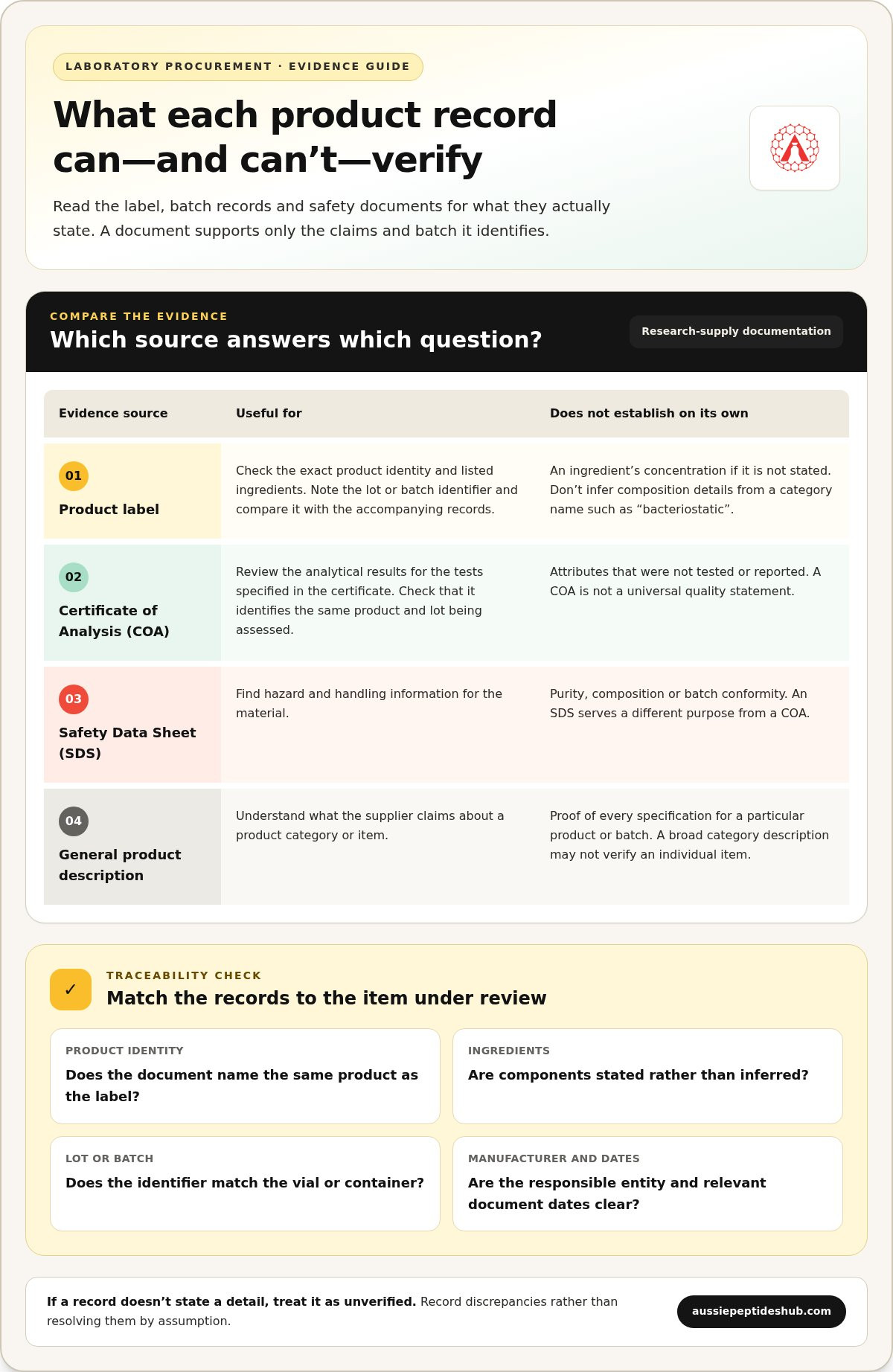
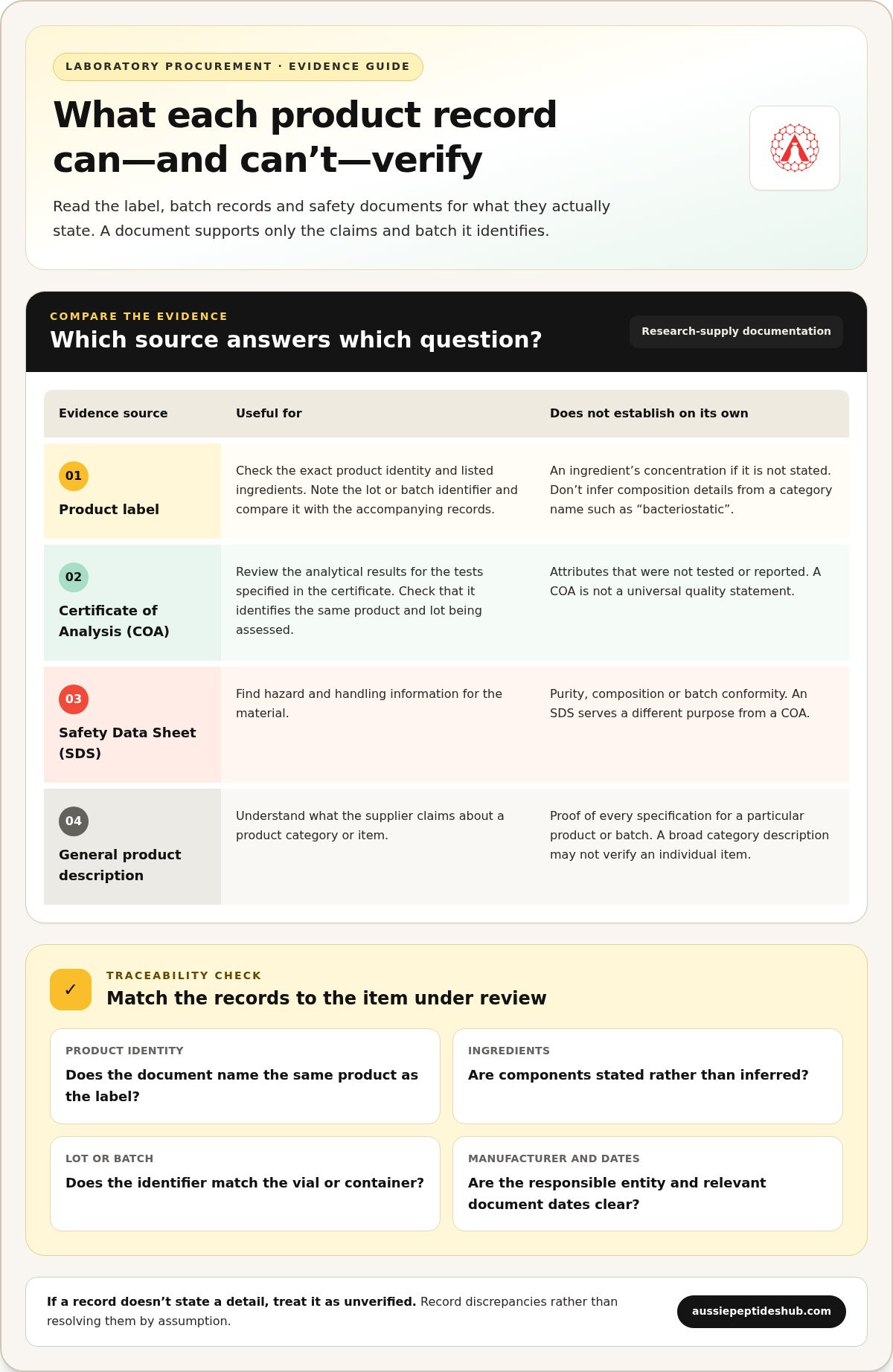
Start with the physical label, then compare it with the accompanying records. Note the exact product name and listed ingredients, lot or batch identifier, manufacturer named in the documentation, and relevant issue, revision or testing dates. Together, these fields provide a basic traceability check.
- Product identity: Does the document name the same product as the label?
- Ingredients: Are the components stated, rather than inferred from the category name?
- Lot or batch: Does the identifier match the vial or container?
- Manufacturer and dates: Are the responsible entity and document dates clear and relevant?
Record discrepancies instead of resolving them by assumption. A label that names an ingredient but gives no concentration doesn’t establish its concentration. Similarly, claims about sterility, shelf life or a particular intended application need product-specific support. If the records don’t state a detail, treat it as unverified.
What a COA and safety document can, and cannot, show
A Certificate of Analysis (COA) reports analytical results for specified tests. Its value depends on whether it identifies the same product and lot, and whether the tests and results support the claim being assessed. A COA isn’t a universal quality statement. It doesn’t establish attributes that weren’t tested or reported.
A Safety Data Sheet (SDS), sometimes called an MSDS, serves a different purpose. It provides hazard and handling information for the material; on its own, it isn’t evidence of purity, composition or batch conformity. Use each document to answer the question it is designed to address.
For general document-reading concepts, the article How to Read Peptide COA: Analytical Verification Metrics may offer a useful comparison, but don’t assume peptide-specific tests or certificates apply to bacteriostatic water. If a supplier refers to a compendial standard, confirm that the reference is relevant to the product and claim. The United States Pharmacopeia (USP) Standards are a standards resource; linking to USP alone doesn’t establish that a particular product complies.
For laboratory research supply, compare the product label with the lot records before adding the item to procurement documentation. Aussie Peptides supplies bacteriostatic water product information for research-supply assessment. Its research products are for laboratory use only, not human consumption.
Bacteriostatic water vs sterile water vs saline: what is different?
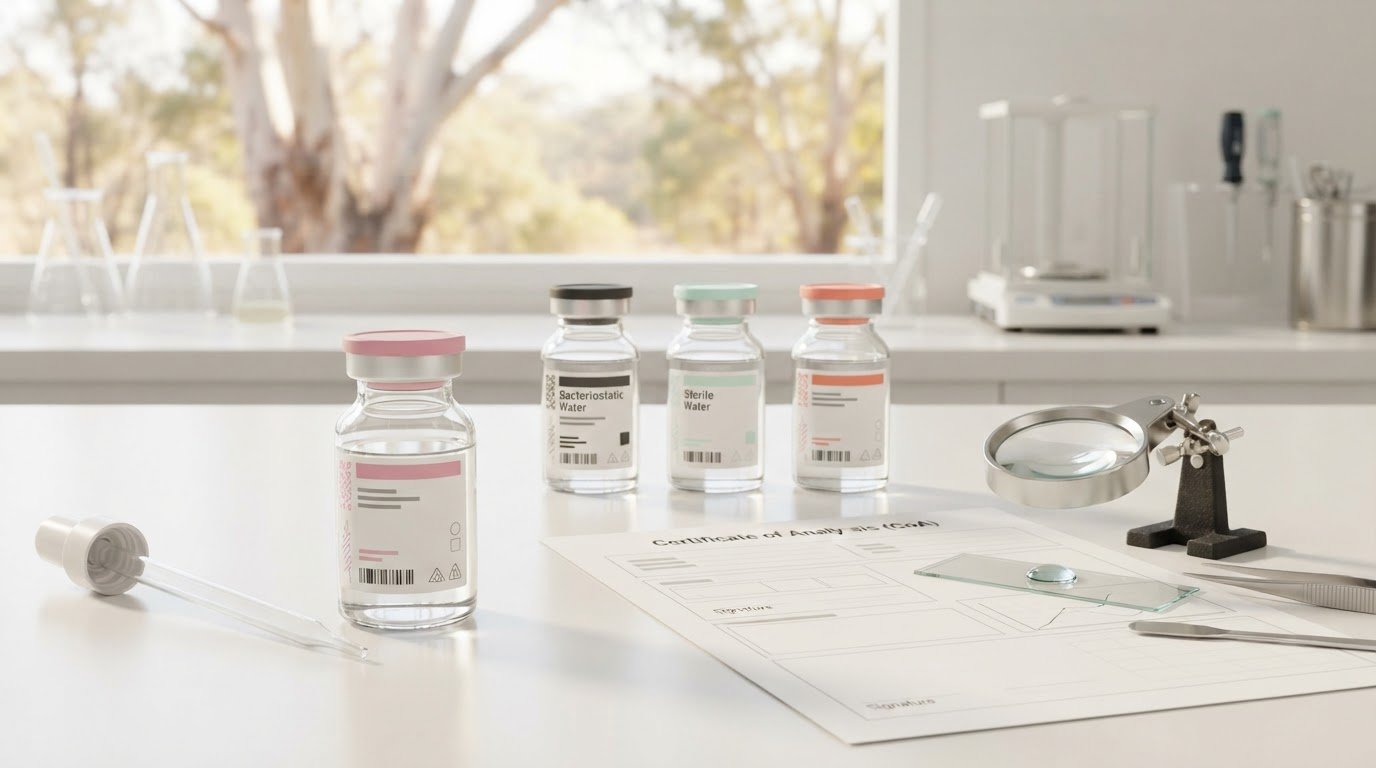
These labels describe different product attributes. “Bacteriostatic” refers to a stated preservative effect, “sterile” is a claim about the product’s sterility, and “saline” identifies a solution whose ingredients should be confirmed on its label. The terms don’t establish the same composition or scope. For bacteriostatic water australia procurement, compare the actual label and supporting documents, not just the product name.
Similar names do not establish equivalent composition or intended use. The table summarises what to look for, not a specification for every product in each category.
| Product label | Composition to verify | Preservative status | Documentation to check |
|---|---|---|---|
| Bacteriostatic water | Water and any listed ingredients | Check whether a preservative is named | Label, batch records and supporting product documents |
| Sterile water | Ingredients and any stated formulation | Check the label; don’t infer preservative status from the name alone | Evidence supporting the sterility claim and its scope |
| Saline | Confirm whether sodium chloride is listed, and note any other ingredients | Check whether a preservative is named | Label and batch-specific records for the stated formulation |
Bacteriostatic water and sterile water are not identical labels
A product label may identify a preservative or state that none is present. Check the specific label rather than assuming every sterile-water product has the same formulation as bacteriostatic water. A sterility claim also needs product documentation that identifies the product and defines what the claim covers. Neither label, on its own, establishes that the products are interchangeable.
How saline differs from water-based products
Saline denotes a sodium-chloride solution when the product label confirms sodium chloride as an ingredient. If the label also lists a preservative, that is a different ingredient profile from one listing sodium chloride without one. Compare every stated component. For separate research-context background, see Reconstituting Research Peptides: A Controlled Laboratory Guide; this comparison isn’t a procedural guide.
For each item under review, record the exact product name, ingredients and lot identifier. Then compare those details with the product’s documentation. A generic document may describe a category without supporting a specific batch or sterility claim. If the label or batch record doesn’t state an attribute, don’t infer it from a similar product name.
This distinction matters in laboratory procurement because familiar category terms can describe products with different documented formulations. Treat each product as its own specification. Compare the label, batch evidence and stated scope before recording it as suitable for a defined research requirement. These products are for laboratory research only, not human consumption or administration.
How to assess bacteriostatic water for Australian laboratory research
Use a consistent document review before recording a product as suitable for a defined research requirement. For bacteriostatic water australia procurement, trace each statement back to the label, a matching batch record or another relevant source. Keep the assessment at procurement and documentation level. It doesn’t establish instructions for preparation or administration.
A four-step document review
- Define the research scope. Record the laboratory requirement and intended research context before comparing product descriptions. This sets assessment criteria without turning a research specification into guidance for human use.
- Inspect the label. Capture the exact product identity, listed ingredients, stated purpose and lot identifier. Don’t fill gaps with assumptions based on a familiar category name. If concentration or another specification isn’t stated, record it as unknown.
- Match the batch documents. Compare the lot identifier and product name on the label with those in supporting records. Check document dates and the scope of any reported result. A matching Certificate of Analysis (COA) can support the analytical results it reports, but it doesn’t independently establish every sterility or regulatory claim.
- Assess handling claims. Separate analytical results from safety information and shipping or storage statements. A shipping claim should relate to the product and conditions described, with supporting information that makes its scope clear. Don’t treat a general dispatch statement as proof of a particular storage condition or product attribute.
This sequence creates an auditable record: what was required, what the label stated, which documents matched and which claims remained unsupported. Broader batch-verification criteria are discussed in TB-500 Lab Supplies Australia: A Batch-Verification Buying Guide. Apply the same principle of matching product and lot, while assessing each product’s own documents.
Questions the evidence cannot answer by itself
Documents have defined limits. A COA reports specified analytical results, not every possible quality attribute. An SDS describes hazards and handling information, not purity. A storage or shipping statement also needs product-specific support to substantiate a particular claim.
Regulatory status requires a separate check. Marketing language, Australian availability or a research-use label doesn’t establish TGA approval or ARTG inclusion. Verify any such claim against current official records, and ensure the record refers to the product being assessed. If the product identity or scope doesn’t match, the record doesn’t resolve the question.
Keep the conclusion narrow. State what the label and matching records support, identify what remains unverified, and retain the lot details used in the review. Laboratory documentation describes a product and its evidence; it isn’t advice for human use. Aussie Peptides’ research products are for laboratory use only, not for human consumption. Review bacteriostatic water product information in that research-supply context.
Aussie Peptides bacteriostatic water: research-supply information and next steps
Aussie Peptides supplies bacteriostatic water for laboratory research. Its research products are not for human consumption. Read product information within that stated scope, and use the specific label and relevant records to assess composition or batch claims.
For bacteriostatic water australia searches, country of supply and product category provide context, not a substitute for evidence. Review information attached to the water product itself. Documentation or testing described for a peptide doesn’t automatically apply to a separate laboratory-supply item.
What research-supply transparency means
A lot identifier supports traceability when corresponding records are available and identify the same item. The identifier is a reference point, not proof on its own. Compare it with the product name and scope shown on the record, then note exactly which details the document supports.
Aussie Peptides reports independent HPLC testing and matching Certificates of Analysis for its peptides. Keep those peptide-specific claims separate from bacteriostatic-water specifications unless evidence explicitly connects them to that product. A peptide result doesn’t establish the water product’s ingredients, concentration, sterility or other attributes.
The business packages products and conducts cold storage in Australia. This operational information isn’t a product-specific storage instruction or evidence of a particular delivery condition for bacteriostatic water. Use the water product’s own information for its composition, container format and handling scope. Where a detail isn’t stated, don’t infer it from another product.
Where to continue reading
Solvent specifications and peptide research are related procurement topics, but they answer different questions. The bacteriostatic-water label and batch information concern the water product. A peptide’s research context, analytical results and batch evidence concern that peptide. Keep those records distinct in procurement notes so a claim about one item isn’t attributed to another.
For a separate discussion of peptide structure, evidence and research scope, the article TB-500 research peptide Australia covers the peptide topic. It doesn’t replace the documentation review required for bacteriostatic water. Similarly, peptide-specific HPLC testing isn’t evidence for the solvent.
When reviewing bacteriostatic water product information, focus on what the label states and which supporting records refer to that product. Aussie Peptides’ research supplies are intended for laboratory research only, not human consumption or administration. That boundary applies regardless of how a product is described or what related research materials accompany it.
For a product-specific review within the laboratory-supply context, view the bacteriostatic water product information.
Make the next procurement decision evidence-led
For bacteriostatic water australia research procurement, apply a consistent recordkeeping standard. Log the product identity and lot information alongside the documents assessed, and keep unresolved specifications visible instead of turning assumptions into procurement facts. This gives future users of the record a clear basis for review.
Aussie Peptides packages products and conducts cold storage in Australia. When a vial’s lot number links to online batch details for the product being assessed, use the matching record to support traceability. Don’t extend peptide-specific testing or documentation claims to bacteriostatic water without product-specific evidence. Research supplies are for laboratory use only, not human consumption.
Review the product information in that defined research context, then record the evidence relevant to your laboratory requirements. Review bacteriostatic water for laboratory research and take the next step with a clear, documented procurement basis.
Frequently Asked Questions
What is bacteriostatic water?
Bacteriostatic water is a water-based product category with a bacteriostatic preservative when the product label specifies one. “Bacteriostatic” describes the preservative’s intended effect; it doesn’t mean contamination is impossible or protection is unlimited. For laboratory research, assess the individual product’s label and supporting records rather than relying on the category name. Research-supply products discussed here are for laboratory use only, not human consumption.
Is bacteriostatic water the same as sterile water?
No. The terms describe different product attributes and shouldn’t be treated as interchangeable. A product may claim sterility and also list a preservative, but that combination must be established from its specific label and supporting records. For example, a catalogue heading alone doesn’t show whether sterility applies to the contents, packaging or a defined batch. Don’t infer suitability or intended use from the product name.
What is the difference between bacteriostatic water and saline?
Saline refers to a sodium-chloride solution when its label specifies that composition; bacteriostatic water refers to a water product category with a preservative claim. Formulations can differ in their listed ingredients and supporting documentation. For a research-supply record, transcribe the ingredient statement rather than shortening it to “saline” or “water”. Similar-sounding labels don’t establish that products can be substituted for one another.
Does bacteriostatic water contain benzyl alcohol?
Some bacteriostatic-water product information names benzyl alcohol as a preservative, but that doesn’t establish the formulation of every product. Check whether the individual label lists it and whether matching documentation provides further detail. Don’t assume a concentration or post-opening period from a general description. If a specification isn’t stated in product-specific records, treat it as unverified rather than applying a figure from another product.
How can I check a bacteriostatic water product in Australia?
For bacteriostatic water australia procurement, compare the exact product identity and ingredient statement with its lot number and any matching records. Keep a copy of the documents reviewed so the basis for assessment is clear. Australian sale alone doesn’t establish therapeutic or regulatory status. For a regulatory claim, consult current TGA and ARTG records and check that the product identity and scope match the item being assessed for laboratory research.
Can bacteriostatic water be used for human consumption or administration?
This article concerns laboratory research supplies, which are not for human consumption. A product name or preservative statement doesn’t establish suitability for a person or clinical purpose. This FAQ doesn’t provide preparation, administration or dosing instructions. If you’re seeking medical care or advice about medicine use, consult an appropriately qualified Australian health professional and authoritative product information. Keep research documentation within its stated laboratory scope.
What does a Certificate of Analysis prove for bacteriostatic water?
A Certificate of Analysis can report specified analytical results for an identified product or batch, according to its contents and issuing laboratory. Check the product name, lot identifier, reported tests, results and document date. For example, a result for one lot doesn’t automatically establish details for another. A COA isn’t a substitute for an SDS, which provides safety information, or proof of every sterility, quality or regulatory claim.