GHK-Cu Copper Peptide Lab Standards: Assays, COAs and Batch Checks
October 13, 2026 · 16 min read
A high purity result can tell you less than you think. When assessing a ghk cu copper peptide lab report, the number matters, but so do the method, the sample identity and the link to the batch. A purity result alone doesn’t establish every aspect of a peptide’s quality or suitability.
A Certificate of Analysis (COA) should support the supplier’s claims, but its value depends on what it records. Check what was tested, whether the document matches the batch in hand and which questions remain unanswered. These distinctions matter when comparing analytical claims or reviewing research materials.
This article explains common GHK-Cu testing terms, including HPLC, and shows how to assess a COA and check batch traceability. It also sets clear limits around laboratory evidence: research-grade peptides are for laboratory use only, not for human consumption, and analytical results don’t establish therapeutic approval or human suitability. Aussie Peptides supplies research-grade GHK-Cu with independent HPLC testing, batch-matched COAs and lot-number lookup. The focus here is what the evidence shows, not what it might imply.
Key Takeaways
- Separate GHK-Cu’s chemical description from claims made in product names or marketing.
- Read HPLC results in context: the method, sample and calculation basis shape what a purity figure means.
- Compare evidence by purpose. Chromatographic data, identity testing and batch records address different questions.
- Use a consistent review sequence for a ghk cu copper peptide lab COA, then match its batch details to the vial lot number.
- Keep analytical documentation distinct from TGA status, therapeutic approval and human suitability. Research-grade peptides are for laboratory use only, not human consumption.
GHK-Cu copper peptide in the lab: what the name describes
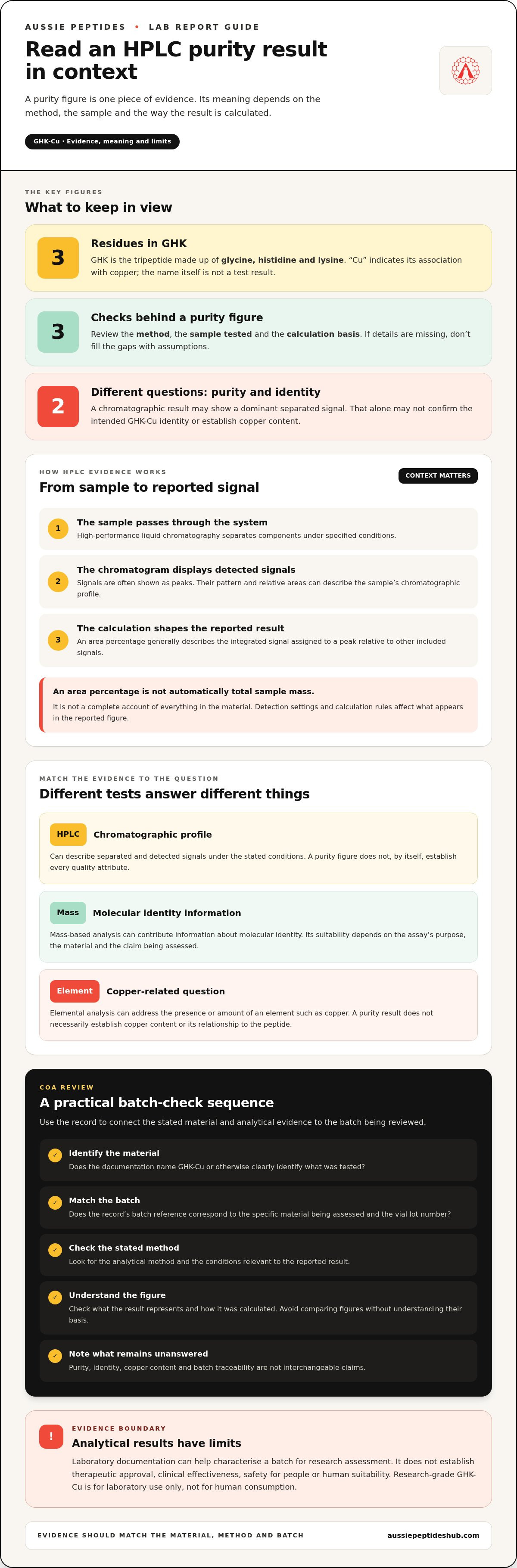
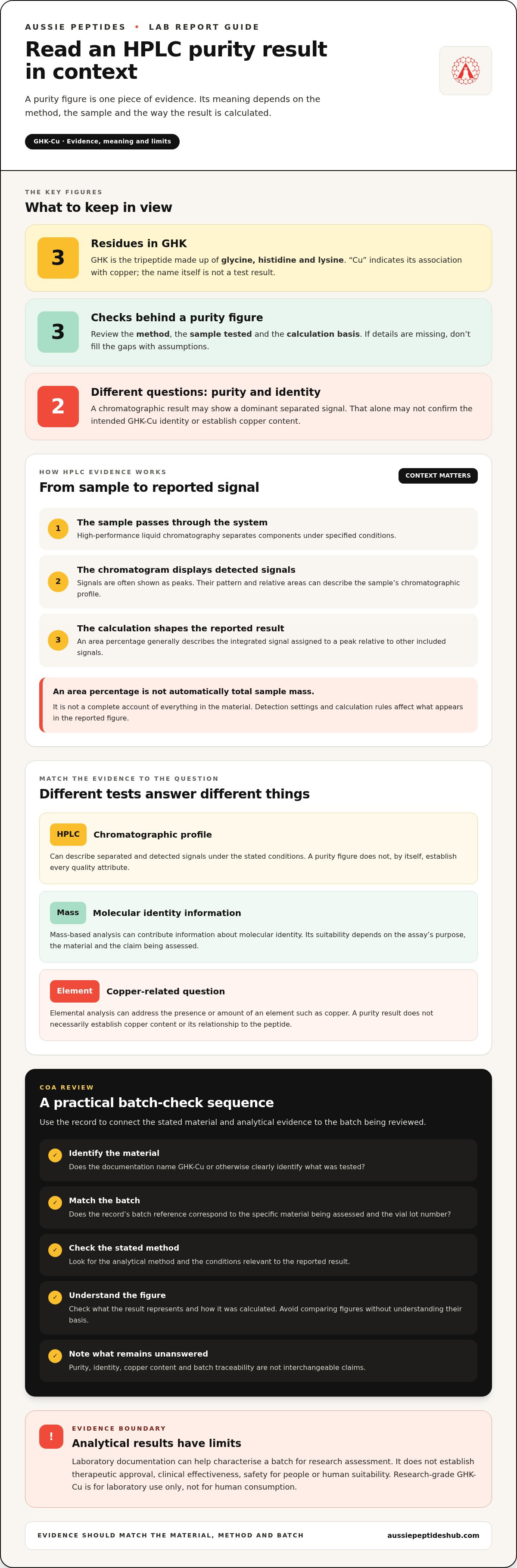
GHK-Cu is a copper-associated form of the tripeptide GHK, whose amino-acid residues are glycine, histidine and lysine. The name describes a peptide associated with copper; it is not a test result or a complete specification. In a ghk cu copper peptide lab assessment, the record needs to connect the stated material to analytical evidence for the batch being reviewed.
This distinction separates chemical description from marketing language. Terms such as “advanced”, “premium” or “high purity” don’t identify a sample or explain how it was assessed. A product name can state what is claimed to be in a container, but it cannot independently establish molecular identity, purity or consistency between batches. Those questions require records tied to the material under review.
GHK-Cu, copper peptide and naming conventions
GHK refers to the peptide component; “Cu” indicates its association with copper. The overview of Copper peptide GHK-Cu provides background on its chemical description. In a laboratory record, reconcile alternate labels with the material’s documented identity and batch. A cosmetic ingredient label or therapeutic claim is not a substitute for analytical evidence about a research sample.
Names can vary by context. A label may use GHK-Cu, copper peptide or another designation. Treat these as labels to verify, not automatic proof that two samples have the same composition or specification. Check how the record identifies the material and whether its batch reference corresponds to the item being assessed.
What “laboratory grade” can and cannot tell you
“Laboratory grade” signals an intended category of use, but the phrase alone doesn’t describe a test method, result or acceptance criterion. It also doesn’t establish regulatory approval, safety for people or clinical effectiveness. None of these can be inferred from a grade label or purity statement without relevant evidence.
A research designation must remain distinct from a human-use claim. Aussie Peptides’ research-grade GHK-Cu is supplied for laboratory use only, not for human consumption. Analytical documentation can help characterise a batch for research assessment; it does not make the material a therapeutic product or substantiate claims about treatment or human suitability.
Use the name as the starting point for document review, not the conclusion. Compare:
- Material identity: Does the documentation name GHK-Cu or otherwise clearly identify the tested material?
- Batch reference: Does the record point to the specific batch being assessed?
- Evidence type: Is the claim supported by a stated analytical method, rather than descriptive wording alone?
These checks establish a disciplined starting point. Next, consider what an assay actually measures, without treating one result as proof of every quality attribute.
GHK-Cu purity assays: what analytical results actually measure
An HPLC result is evidence about a defined measurement, not a universal quality verdict. High-performance liquid chromatography separates components in a sample as they pass through a system under specified conditions. The resulting chromatogram displays detected signals, often as peaks. Their pattern and relative areas can help describe the sample’s chromatographic profile, provided the method and calculation are understood.
For a ghk cu copper peptide lab assessment, interpret the reported result in context. Review the method description, the sample tested and the basis used to calculate the figure. If these details are absent, don’t fill the gaps with assumptions. The result may be difficult to interpret or compare with one generated under different conditions.
Reading an HPLC result without overstating it
A chromatogram can show signals that the method separates and detects. A reported area percentage generally describes the proportion of the integrated signal assigned to a peak relative to the other included signals. It isn’t automatically a direct measure of total sample mass or a complete account of everything in the material. Detection settings and calculation rules affect what appears in the reported figure.
An assay can establish only what its method measures, under the stated conditions, for the sample tested. That is why a purity figure without a method description, result definition or sample reference should be treated cautiously. A result from one batch also shouldn’t be assumed to represent another.
Identity and copper content require their own evidence
Purity and identity are related, but they answer different questions. A chromatographic result may indicate a dominant separated signal, yet that alone may not confirm that the signal is the intended GHK-Cu material. Nor does a purity figure necessarily establish copper content or the relationship between copper and peptide in the sample.
Complementary evidence may be relevant, depending on the question. Mass-based analysis can contribute information about molecular identity, while elemental analysis can address the presence or amount of an element such as copper. These are broad categories, not automatic endorsements of a particular method. Suitability depends on the assay’s purpose, the material and the claim being evaluated.
Keep biological literature in a separate evidence category. For example, The human tripeptide GHK and tissue remodeling discusses biological research on GHK; it doesn’t validate the identity or composition of a specific laboratory batch. A published biological study and a batch assay serve different purposes.
If a report omits method conditions, detector information, calculation basis or sample identification, record that limitation rather than inferring a missing value. Aussie Peptides supplies research-grade GHK-Cu for laboratory use only, not human consumption. Its independently HPLC-tested GHK-Cu comes with a matching Certificate of Analysis, so research customers can review the documented evidence for the supplied batch. Review research-grade GHK-Cu as a laboratory-use item, not as evidence of human suitability or therapeutic effect.
Comparing GHK-Cu lab evidence: method, result and limitations
Different records answer different questions. A chromatographic profile describes signals separated under a stated method; identity evidence addresses whether the material corresponds to the named substance; batch documentation links records to a particular lot. None substitutes for the others. For a ghk cu copper peptide lab review, start with the claim being made, then identify which evidence could support it.
Match each test record to the claim being made
Read the method name alongside its scope. A report may describe chromatographic data without establishing elemental composition. An identity result may support identification without describing the proportions of all components. Batch records help establish traceability, but don’t independently confirm a chemical property. If method conditions or the analyte being measured aren’t reported, record that as a limitation. It isn’t proof that the material failed a test.
| Evidence type | Question it may address | Limit to keep in view |
|---|---|---|
| Chromatographic purity data | What signals were separated and how were reported peak areas distributed? | Results depend on the method, detection and calculation basis. A peak-area percentage isn’t automatically a measure of total sample composition. |
| Identity evidence | Does the tested material correspond to the stated identity? | Interpretation depends on the technique, reference basis and scope described in the report. |
| Elemental-composition evidence | Was an element such as copper assessed, and what does the reported result represent? | A result must identify the analyte and reporting basis. It doesn’t, by itself, establish the identity of the peptide. |
| Batch documentation | Can the test record be linked to the specific lot under review? | Traceability supports record matching; it isn’t an analytical measurement of composition or purity. |
Table note: Percentage figures need method and reporting context before they can be interpreted or compared.
Analytical evidence does not establish regulatory status or biological effect.
Why purity figures are not automatically comparable
Two headline percentages may look directly comparable but come from different methods, samples or calculation rules. One report may state integrated peak area, while another may use a different defined basis. Sample preparation and the signals included in a calculation can also affect interpretation. Without those details, ranking batches by the largest percentage isn’t a sound comparison.
For a meaningful review, note the sample identifier, method, result definition and report scope for each record. Check whether the documents describe the same material and a comparable measurement. If a detail is absent, keep the uncertainty visible instead of assuming both results use the same conditions.
This is a comparison of evidence, not a verdict based on a single number. A clear record makes its limits easy to see: what was tested, what was reported and which questions remain unanswered.
A practical checklist for reviewing a GHK-Cu COA and batch
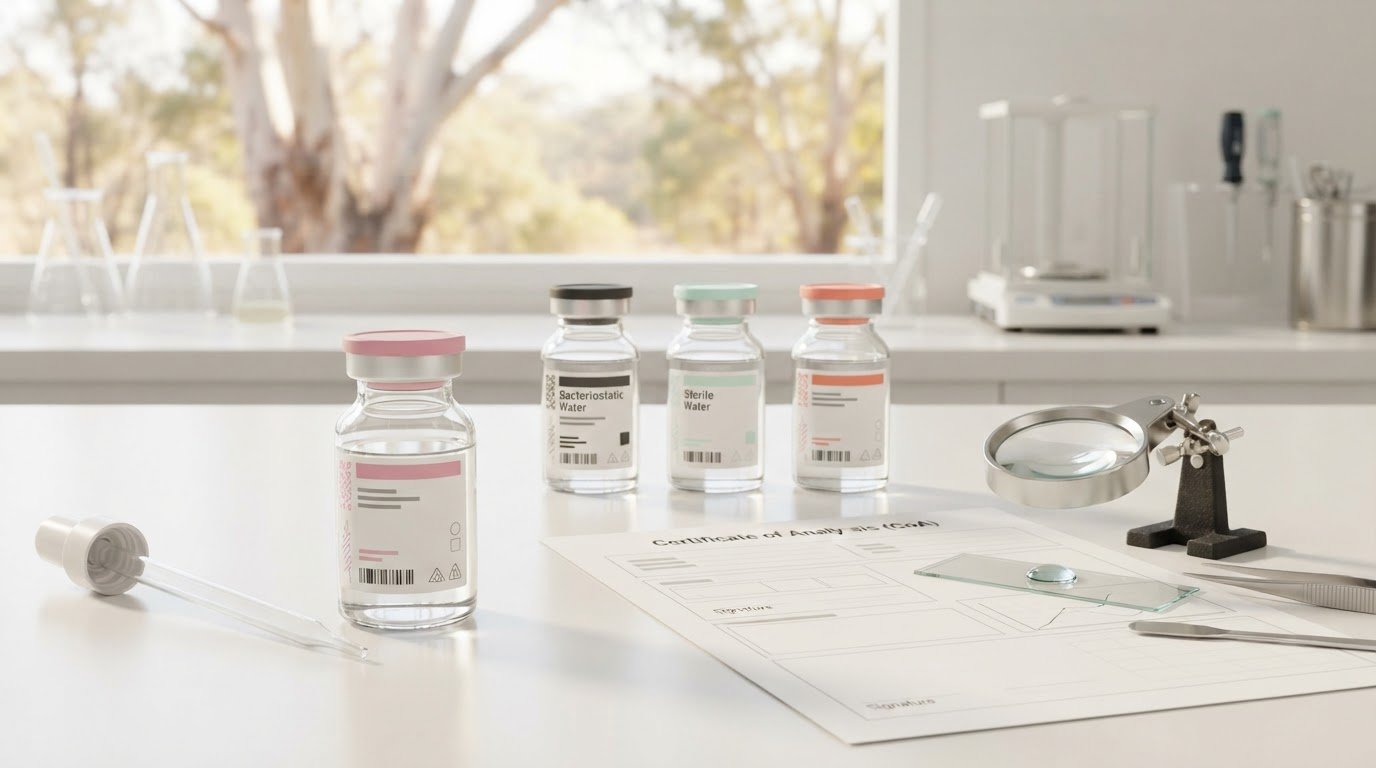
A Certificate of Analysis (COA) is useful when its contents can be connected to the material being assessed. Review it in sequence. Separate what the document states from what it leaves unresolved, and don’t treat missing information as a failed test result.
Check the COA fields and report scope
Start with the material name and batch identifier. Then locate the test date, named analytical method and reported result. Check whether the document explains how the result was calculated and what the analysis covers. If the COA omits a detail, that question remains unanswered; the omission alone doesn’t establish that the sample failed an assay.
- Confirm the stated material. Check that the COA identifies GHK-Cu, rather than relying on a broad label such as “copper peptide”. Note any difference in naming for reconciliation.
- Locate the batch identifier. Find the lot or batch reference on the report. A document without a clear batch link may not establish which material its results describe.
- Review the method and scope. Identify the method named and the attribute it was used to assess. A method label alone doesn’t show every condition or answer every quality question.
- Interpret the reported result. Look for its definition and calculation basis. If the report gives a percentage but doesn’t explain what it represents, don’t infer a broader composition claim.
- Record unresolved points. Distinguish unavailable details from an explicitly reported result outside a stated criterion. These are different findings.
Verify the vial-to-record match
Compare the lot number printed on the vial with the corresponding online batch record. Then check that the record and COA refer to the same material and batch. Similar product names aren’t enough. This matching step connects the test documentation to the item under review and helps prevent a result for one lot being applied to another.
For broader chemical background, the Copper peptide GHK-Cu overview describes the compound, while the linked research on GHK and tissue remodelling provides biological context. Neither source verifies a particular vial or batch. Apply the same batch-specific approach to any research material: connect each record to the specific item it describes.
Aussie Peptides provides matching COAs and online lot-number lookup for its research-grade GHK-Cu. Use the number printed on the vial to locate the batch details, then compare the record against the checks above. This GHK-Cu is for laboratory use only, not for human consumption. Review research-grade GHK-Cu for laboratory use with its batch documentation in view.
Australian GHK-Cu research sourcing: evidence, traceability and boundaries
Laboratory records and regulatory status answer different questions. An HPLC result or batch-matched Certificate of Analysis (COA) may document aspects of a tested sample. It doesn’t establish that a product is approved for therapeutic use, suitable for people or lawful for a particular human-use purpose in Australia. Keep these assessments separate.
Australian regulation is a separate assessment
For applicable Australian requirements, refer to the Therapeutic Goods Administration’s current guidance. Regulatory information can change, so consult current material rather than relying on a supplier’s assay report or an older summary. Analytical documentation is not a substitute for regulatory guidance, and this section does not provide medical, dosing or self-administration advice.
This distinction matters when interpreting the phrase “research grade”. It describes the supply context, not therapeutic approval, clinical effectiveness or human safety. Read a documented test result only within its stated analytical scope. It cannot support claims beyond the question the test was designed to address.
Batch traceability and research-only supply
A traceable record links a specific lot to its documentation. Aussie Peptides’ products are synthesised by contract manufacturers and packaged in Australia. Its research-grade GHK-Cu is independently HPLC-tested, with a matching COA and an online lot-number lookup using the number printed on the vial. These records support batch-level review; they don’t establish regulatory status or human suitability.
For a practical check, compare the vial’s printed lot number with the online batch record, then confirm the COA refers to the same material and lot. A mismatch is a traceability issue to investigate, not proof by itself of an analytical failure. Likewise, a COA supports document review but doesn’t show that every possible quality attribute was tested. Check what the report actually covers.
Products are shipped nationally in cold-chain packaging. This describes the packaging and shipping approach; it isn’t a guarantee about a particular transit condition or evidence of assay performance. Keep logistics records distinct from analytical results. Each supports a different part of a research-supply assessment.
In a ghk cu copper peptide lab review, the strongest conclusion is a bounded one: identify what the batch record shows, what the analytical method covers and which questions remain outside that evidence. Research-grade peptides are for laboratory use only, not for human consumption. COAs and lot lookup help assess traceability, but they don’t make research material a therapeutic product.
For laboratory research, review the GHK-Cu batch documentation alongside the intended research scope and applicable TGA guidance. This keeps the evidence, the batch and the use boundary clearly defined.
Put the evidence into your research workflow
Make batch review a documented step, not an informal judgement based on a headline figure. Before work begins, record the questions the analysis needs to answer and the evidence available for each one. Keep the COA and batch reference with the relevant research records. If a detail is absent or a record doesn’t match, log the discrepancy separately from any reported test result.
This process gives future reviewers a clear trail from the research material to the documentation used to assess it. It also keeps conclusions proportionate: a ghk cu copper peptide lab result supports only the claim within its stated scope. Research-grade peptides are for laboratory use only, not for human consumption; analytical documentation does not establish therapeutic approval or human suitability.
To continue, review the GHK-Cu research information and its batch records against your laboratory documentation requirements. Review Aussie Peptides’ GHK-Cu research information. A consistent evidence trail helps keep research decisions precise and reviewable.
Frequently Asked Questions
Is GHK-Cu the same as copper tripeptide-1?
Not necessarily as a complete specification. “Copper tripeptide-1” is used in cosmetic ingredient contexts for a copper-associated GHK peptide, while laboratory records may use GHK-Cu. Compare the exact material designation, batch identifier and any stated form or specification in the documentation. Shared or similar names alone don’t show that two materials have identical composition, analytical criteria, grade, regulatory status or intended use.
Can a COA guarantee that a GHK-Cu sample will perform identically in every assay?
No. A COA reports specified tests on a particular batch; it doesn’t certify identical behaviour under every experimental design. Different assay matrices, concentrations, instruments or acceptance criteria can produce different observations. Treat the report as a record of its stated scope, not a performance guarantee. For reproducibility, document the batch used alongside your own protocol, sample conditions, controls and deviations, then interpret findings within that experiment.
Does a lyophilised appearance prove GHK-Cu identity or purity?
No. Lyophilised form is a physical presentation, not an identity test. A powder or cake may be recorded as a visual observation, but appearance can’t establish peptide identity, purity, copper content or consistency between lots. Two vials may look similar while their traceable records or analytical evidence differ. Use appearance only as descriptive context, and rely on relevant method-based evidence for analytical conclusions.
Can two GHK-Cu purity percentages be compared if different laboratories report them?
Not from the percentages alone. A ghk cu copper peptide lab comparison needs the methods and reporting definitions behind each figure. Laboratories may analyse different samples, use different separation conditions or calculate percentages on different bases. Compare what each report measured and how it defines the result before drawing conclusions. A higher headline percentage doesn’t necessarily demonstrate stronger identity evidence, a particular copper composition or suitability for your research question.
Does HPLC testing establish that a GHK-Cu product is approved for human use in Australia?
No. HPLC testing describes an analytical assessment; it doesn’t determine Australian therapeutic approval or establish safety or suitability for people. Those are separate regulatory questions. Consult current Therapeutic Goods Administration (TGA) guidance for information relevant to Australia, rather than treating a COA as a regulatory determination. Aussie Peptides’ GHK-Cu is supplied for laboratory research only and is not for human consumption.
What does a missing test date mean on a GHK-Cu COA?
A missing test date makes the timing of the reported analysis unclear, but it isn’t itself a measured failure. Review whether the COA identifies the material, batch, method and result, and whether another linked record clarifies when testing occurred. If no record resolves the gap, note the evidence limitation in your assessment. Don’t convert absent documentation into a negative test result or assume the report is current.