Tesamorelin Vial Research: A Buyer’s Guide to Purity, Batch Checks and Storage
October 15, 2026 · 16 min read
What does a tesamorelin vial research claim prove if the supporting record can’t be linked to the vial in your hand? A product label alone isn’t batch evidence. Researchers need documentation that matches the vial, a clear understanding of what analytical testing can establish, and handling information relevant to delivery and storage.
This guide provides a practical checklist for assessing those details before ordering. It explains how a lot number connects a vial to its batch documentation, what an HPLC result can and can’t demonstrate, and which packaging and cold-chain delivery details matter when materials are shipped within Australia. It also keeps the research-use boundary clear: research-grade tesamorelin is not prescription medicine and is not for human consumption. Use the checklist to assess traceability and evidence without treating a certificate or purity claim as proof of sterility, concentration or suitability for a particular experiment.
Key Takeaways
- For tesamorelin vial research, start with the vial’s lot number when checking its batch record. The number alone is not proof of product quality.
- Compare the vial identifier with the matching Certificate of Analysis to assess whether the documentation relates to that batch.
- Read HPLC results within their limits. They don’t establish sterility, concentration or suitability for a particular experiment.
- Separate measurable evidence from broad product descriptions such as “premium” or “pharmaceutical-grade”.
- Review the stated packaging, Australian cold-chain delivery and product-specific storage information before making a research-use decision.
Tesamorelin research vials: what the product category does, and does not, mean
A tesamorelin research vial is laboratory material for research use only, not a medicine or treatment, and it is not for human consumption. That boundary is central to tesamorelin vial research. “Research-grade” describes the product’s stated intended use; it doesn’t establish clinical suitability, therapeutic effect or regulatory status.
A product page may name tesamorelin and describe testing or documentation, but those statements carry different evidentiary weight. General product details describe the category or supplier process. A batch-specific Certificate of Analysis (COA), matched to the vial’s lot number, provides evidence tied to a particular batch. Neither category wording nor a label alone establishes whether the material is suitable for a given experiment.
How research-grade material differs from prescription medicine
Intended use and regulatory status are separate questions. A “research use only” label does not make a product prescription medicine, nor does the label settle how a product is regulated in Australia. Don’t treat those terms as interchangeable.
Mayo Clinic describes tesamorelin in a prescription-medicine context for a defined clinical use. That is clinical background, not an endorsement of research vials. Information about a prescription medicine cannot be transferred to a separate research product as evidence of its composition, quality or effect. For a general overview of tesamorelin, see the Tesamorelin Wikipedia page.
Research-use tesamorelin is laboratory material only; its description or documentation does not establish suitability for human use.
What a vial description can establish
Read product wording as a set of claims to classify, not as a substitute for records. A description can state the named peptide and research-use boundary. It can also explain the supplier’s stated process. For example, Aussie Peptides states that its tesamorelin is synthesised by contract manufacturers, independently HPLC-tested, packaged in Australia and supplied with a matching COA. Researchers can use the vial lot number to verify batch details online.
These details are not interchangeable. A description of the testing process is not the test result for the vial’s batch. A label naming tesamorelin is not, by itself, batch-specific evidence. The lot number and associated record provide the practical link between the physical vial and its documentation. If the identifiers don’t align, the record can’t be confidently attributed to that vial.
Keep the evidence question narrow. An HPLC result supports only the analytical information shown in that result; it does not, by itself, prove sterility, concentration or suitability for a particular experiment. Words such as “pure” and “premium” add no analytical detail unless relevant records support them. The distinction between clinical background and research-vial verification is also covered in tesamorelin research context and evidence.
Before comparing products, note what each description states and identify which claims need batch-level support. This keeps clinical references in context and focuses the purchasing assessment on traceable documentation.
How to verify a tesamorelin vial’s HPLC report and batch record
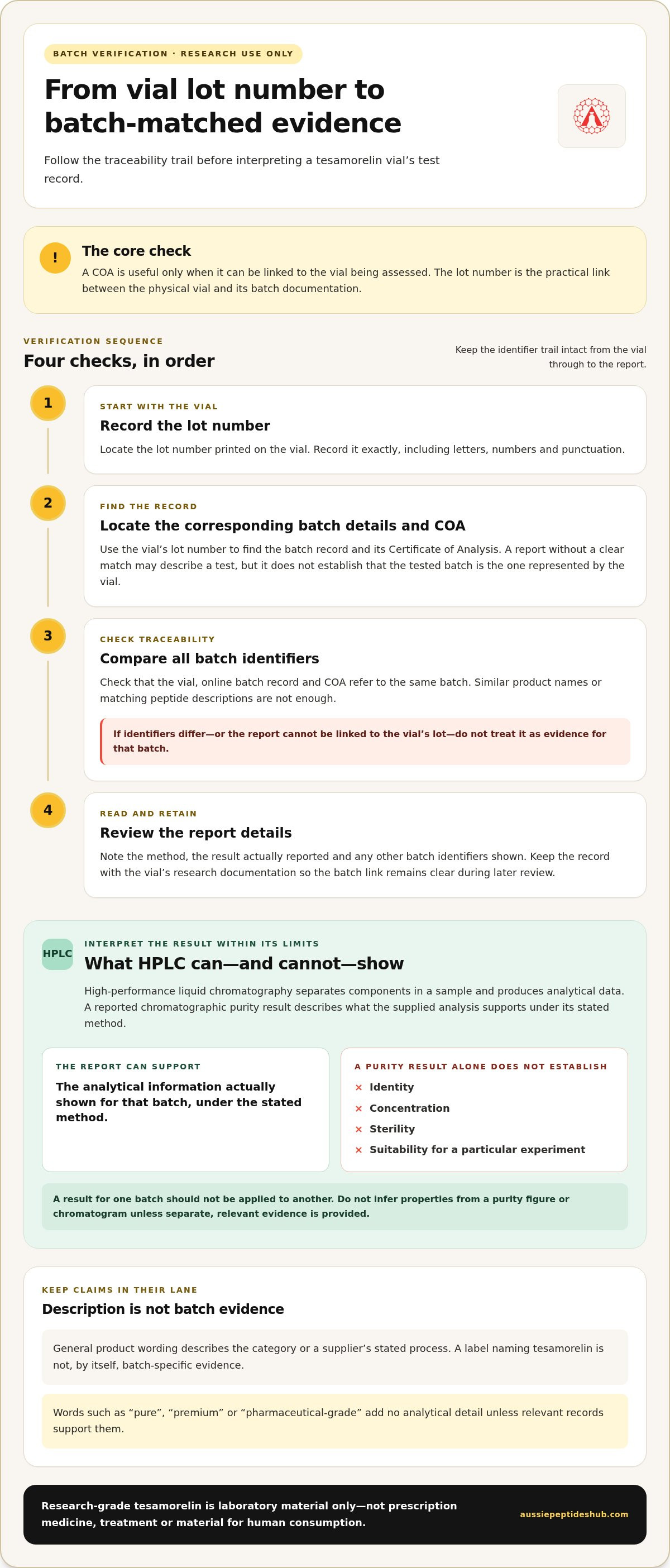
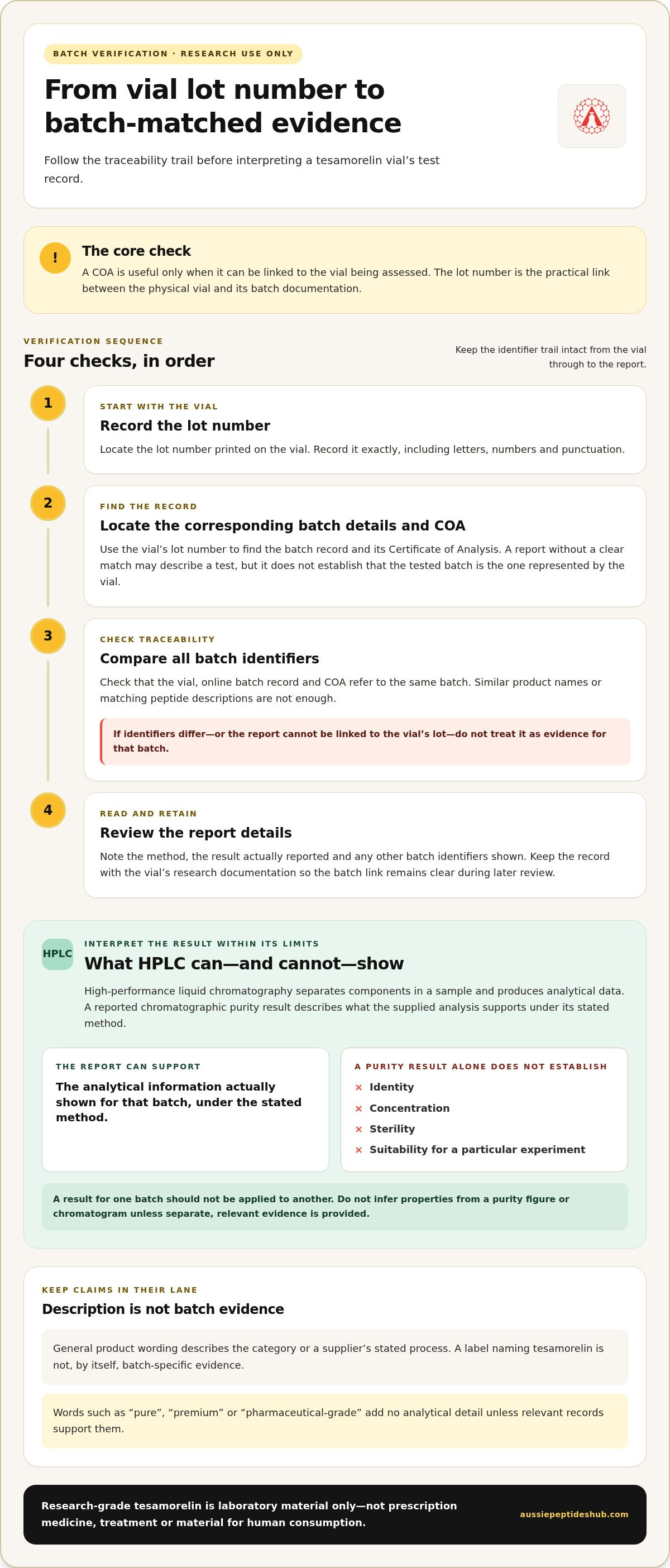
A Certificate of Analysis (COA) is useful only when it relates to the material being assessed. In tesamorelin vial research, start with traceability: connect the vial’s lot number to the corresponding batch record, then read the analytical result in context. A report without a clear match may describe a test, but it doesn’t establish that the tested batch is the one represented by the vial.
Match the vial lot number to its Certificate of Analysis
Use this sequence before interpreting the test data:
- Locate the vial lot number. Record the identifier printed on the vial, including its letters, numbers and punctuation.
- Find the batch record. Use the lot number to locate the corresponding online batch details and COA.
- Compare identifiers. Check that the vial, online record and COA refer to the same batch. Similar product names or matching peptide descriptions aren’t enough.
- Review the report details. Note the method, the result actually reported and any other batch identifiers shown.
Aussie Peptides provides online batch-detail verification using the vial lot number and supplies products with matching COAs. This creates a traceability path from the physical vial to its batch documentation. Keep the record with the vial’s research documentation so the batch link remains clear during later review.
A batch-matched COA matters more than a generic report because it connects the analytical result to the specific lot being assessed. If identifiers differ or the report can’t be linked to the vial’s lot, don’t treat it as evidence for that batch.
Read HPLC evidence within its limits
High-performance liquid chromatography (HPLC) separates components in a sample and produces analytical data. A reported chromatographic purity result describes what the supplied analysis supports under its stated method. It isn’t a universal quality certificate, and a result for one batch shouldn’t be applied to another.
An HPLC purity result alone doesn’t establish identity, concentration or sterility. It also doesn’t show that the material is suitable for a particular experiment. Don’t infer those properties from a purity figure or chromatogram unless separate, relevant evidence is provided. A supplier’s general statement that material is independently tested is not a substitute for reviewing the batch-specific report.
For broader context on how assay records and COAs fit into peptide batch checks, see GHK-Cu peptide laboratory assay and batch standards. The same evidence discipline applies: verify the record’s batch connection, then limit conclusions to what the method and result actually show.
Researchers assessing tesamorelin can review Aussie Peptides’ tesamorelin research vial documentation alongside the vial lot number and matching COA. Keep the intended use clear: this material is for laboratory research only and not for human consumption.
Compare tesamorelin research vials using evidence, not product wording
A consistent comparison framework helps prevent polished descriptions from outweighing verifiable records. Apply the same criteria to each tesamorelin listing, then record what is documented, what remains unclear and what the evidence supports. This makes differences visible without treating missing information as proof of a product defect.
Use the table as a screening tool. “Documented” means the relevant record or process is available to assess, not that the product is suitable for a particular experiment.
| Comparison point | Evidence to assess | What it can tell you |
|---|---|---|
| Batch-matched COA | Does the COA identify the same batch as the vial? | Whether the analytical record is linked to the vial’s lot. |
| Lot traceability | Can the vial lot number be used to locate matching batch details? | Whether there is a traceable link between the physical vial and its record. |
| Testing method | Is the method named, and is a result reported? | Which analytical finding is documented. Don’t infer tests that aren’t stated. |
| Delivery handling | Are packaging location and cold-chain handling described? | What handling process is stated for delivery, not a guarantee of product performance. |
Which documentation should a research buyer prioritise?
Start with the vial-level identifier and its corresponding batch record. Record the lot number, COA reference, analytical method and reported result together in your comparison notes. If a listing says “independently tested” but provides no batch-linked result, record the testing claim separately from the evidence you can inspect.
A missing or mismatched identifier leaves traceability unresolved. It doesn’t, on its own, prove contamination, mislabelling or another specific defect. The appropriate conclusion is limited: the available record hasn’t established a clear link to that vial.
What HPLC does not establish on its own
HPLC can provide chromatographic data, including a reported purity result, according to the method and information presented. It doesn’t automatically verify identity, concentration or sterility, and it can’t establish experimental performance. Treat each quality attribute as a separate question requiring relevant evidence. A COA documents reported results; it doesn’t certify every property a researcher may care about.
Apply that limit consistently across listings. Words such as “premium”, “pure” or “pharmaceutical-grade” are descriptions, not substitutes for a batch-matched record. Don’t give persuasive wording extra weight or assume an unreported test was performed. Compare like with like: match identifiers, note the method, capture the result, then distinguish documented facts from unsupported claims.
For tesamorelin vial research, Aussie Peptides independently HPLC-tests its products, supplies matching COAs and provides online batch-detail verification through the vial lot number. Its peptides are packaged in Australia and shipped nationally using cold-chain packaging. Assess these process details alongside the batch record, not as evidence of suitability for a particular experiment. Research use only; not for human consumption.
Assess tesamorelin vial packaging, storage information and Australian delivery
Packaging and delivery records help describe how a research vial was handled in transit. They don’t, on their own, establish the material’s stability or prove that its properties have been preserved. For tesamorelin vial research, keep observable delivery details separate from analytical evidence and the product’s own storage instructions.
Aussie Peptides packages its peptides in Australia and ships nationally within Australia using cold-chain packaging. This describes the fulfilment process, but it doesn’t specify a transit temperature, delivery timeframe or outcome. Don’t infer or promise those details. Cold-chain packaging is relevant handling information, not a guarantee of unchanged material or experimental performance.
What to record when a research vial arrives
On arrival, note the date received, the condition of the outer packaging and any visible damage. Record the vial lot number, then compare it with the corresponding online batch record and Certificate of Analysis. Keep these details together in the laboratory’s receipt records. This gives you a clear account of what arrived and which batch documentation you reviewed.
Describe only what you can observe. For example, document visible packaging damage without concluding that the material has degraded or remains unaffected. Follow the storage instructions stated in the product documentation. Don’t substitute guidance intended for a prescription medicine or infer a storage temperature, duration or handling step that the research product’s documentation doesn’t state.
How domestic cold-chain delivery fits the purchase decision
Cold-chain packaging is one part of fulfilment. It provides context about the stated delivery process, but it isn’t equivalent to a recorded temperature history or a test of material quality. Don’t assume a particular transit temperature or that packaging alone verifies the vial’s condition. Assess delivery handling alongside the lot record and the product-specific information supplied with the research material.
Domestic packaging and national delivery clarify where the packaging step occurs and the stated scope of shipment. Keep those operational facts distinct from claims about stability, activity or suitability for an experiment. The tesamorelin research and verification overview provides broader context for evaluating research materials and their documentation.
Use a simple receipt record to maintain a traceable connection between the delivered vial, its batch paperwork and the storage instructions followed. If a storage detail isn’t stated in the documentation, don’t fill the gap with a general recommendation. Record the gap instead of presenting an assumption as a product-specific instruction.
For Australian laboratory research use, review Aussie Peptides’ tesamorelin research vial details alongside the batch and storage documentation. The material is for research use only and is not for human consumption.
Ordering a tesamorelin research vial: a documented decision, not a clinical recommendation
Ordering should follow a documented research purpose, not an expectation of treatment or clinical effect. Before proceeding, assess intended use, batch traceability, analytical records and delivery information as separate points. This final check keeps tesamorelin vial research focused on the evidence available for laboratory material. It does not establish suitability for human use or for a particular study.
A final pre-order checklist for research buyers
Use this checklist to record the basis for your decision:
- Research-only purpose: Confirm the material is for laboratory research only and not for human consumption.
- Lot-to-COA match: Identify the vial lot number and locate the corresponding batch record and Certificate of Analysis (COA). Check that the identifiers align.
- HPLC evidence limits: Note the method and reported result. Don’t infer identity, concentration, sterility or experimental suitability from an HPLC purity result alone.
- Delivery details: Record the stated packaging and cold-chain handling process. Don’t assume a transit temperature, delivery timeframe or product-performance outcome that isn’t documented.
If an identifier is absent or doesn’t match, record the evidence gap as unresolved. Don’t turn it into a conclusion about a specific defect. Likewise, distinguish a statement that testing was performed from a batch-specific result you can review. A clear file should show what you checked and what the evidence doesn’t establish.
Keep the checklist with your laboratory purchasing records. That paper trail preserves the rationale for selecting a batch and makes it easier to review the vial’s documentation when it arrives. It also prevents product wording from being treated as proof of a quality attribute that hasn’t been documented.
Next steps for Australian laboratory purchasing
Aussie Peptides commissions tesamorelin synthesis from contract manufacturers, independently HPLC-tests its products, packages them in Australia and supplies them with matching COAs. The vial lot number can be used for online batch-detail verification. Peptides are shipped nationally within Australia using cold-chain packaging. These are process and fulfilment details; they don’t guarantee a particular analytical result or research outcome.
Review the batch record and product-specific documentation as part of the purchasing decision. Follow only the storage information stated for the product, and keep its research-only boundary explicit in laboratory records. A product description, COA or delivery process is not a clinical recommendation.
For research-use product information, View Aussie Peptides research products.
Make verification part of your research workflow
Before your next procurement, define what documentation your laboratory needs and how it will be recorded. A simple, consistent review process helps researchers assess materials against the same criteria across orders, rather than relying on memory or persuasive product wording. Keep the decision tied to your documented research purpose. Evidence can inform a purchasing assessment, but it isn’t a clinical recommendation or a substitute for your laboratory’s own requirements.
Use the tesamorelin vial research checklist as a starting point. Record the questions your team will apply before ordering, then retain the relevant product and batch records with your research documentation. This gives your team a clearer basis for review as work progresses, while keeping conclusions within the limits of the evidence available.
For research-use product information, view Aussie Peptides research products. A measured, documented approach gives your team a practical foundation for its next laboratory purchasing decision.
Frequently Asked Questions
What should I check on a tesamorelin research vial before ordering?
Check that the listing identifies the material as laboratory research use only, then review the batch record, analytical documentation and stated handling information. For tesamorelin vial research, note what is available before purchase so you can compare it with the vial and paperwork received. Keep claims such as “premium” separate from verifiable details. The material is not for human consumption, and product descriptions don’t establish suitability for a particular experiment.
Does an HPLC result prove that a tesamorelin vial is pure and suitable for research?
No. An HPLC result reports analytical data under the method described, and a purity result should be interpreted within that scope. It doesn’t, by itself, establish identity, concentration, sterility or suitability for your specific research question. Read the report’s method and result as written. Don’t assume other tests were conducted or treat a purity figure as a complete quality assessment.
How do I match a tesamorelin vial to its Certificate of Analysis?
Use the lot number printed on the vial to locate its online batch record and corresponding Certificate of Analysis (COA). Compare the identifiers on the vial, record and COA character by character, including letters and numbers. If the details don’t align, treat the match as unresolved rather than assuming the report applies. Retain a copy of the record with your laboratory documentation for that vial.
Is a tesamorelin research vial the same as prescription tesamorelin?
No. A research vial is supplied for laboratory research use, while prescription tesamorelin belongs to a clinical medicine context. The categories aren’t interchangeable. Information about a prescription medicine doesn’t establish the composition, quality or clinical suitability of a separate research product. Research-grade tesamorelin is not for human consumption, and its documentation shouldn’t be interpreted as a treatment recommendation.
How should tesamorelin research material be stored after delivery?
Follow the storage instructions provided for the specific research product. Don’t substitute guidance for a prescription medicine or infer a temperature or storage period if the product documentation doesn’t state one. On receipt, record the vial lot number and the condition of the package, then file those observations with the batch paperwork. This preserves a clear receipt record without making unsupported claims about material stability.
Does cold-chain delivery guarantee a tesamorelin vial’s stability?
No. Cold-chain packaging describes a delivery-handling process; it doesn’t guarantee stability, unchanged material or a particular research outcome. Unless documentation provides them, don’t infer a transit temperature or continuous temperature history. Record observable packaging condition on arrival and follow the product-specific storage information. Treat handling details as one part of your assessment, separate from batch testing and other evidence.