Tesamorelin Peptide Australia: Research Context, Evidence and Verification
October 14, 2026 · 16 min read
A clean analytical report can document a test result, but it can’t establish that a vial is suitable for human use. That distinction matters when searching for tesamorelin peptide australia, where research listings, biological evidence and therapeutic claims can appear side by side.
It’s reasonable to want clear answers: what GHRH means, what tesamorelin research has examined, and what a Certificate of Analysis (COA) can actually show. Tesamorelin is a synthetic GHRH analogue, and its strongest clinical research context concerns HIV-associated lipodystrophy, not general weight loss or anti-ageing. In Australia, it isn’t listed on the Australian Register of Therapeutic Goods for therapeutic use.
This article explains GH and IGF-1 terminology, outlines the limits of mechanistic and clinical findings, and shows how to assess batch-matched documentation. Aussie Peptides supplies tesamorelin for laboratory research only, not human consumption. A test result supports evaluation of documented attributes; it doesn’t establish therapeutic suitability, safety or efficacy.
Key Takeaways
- For tesamorelin peptide australia research, distinguish pathway findings from evidence about outcomes in whole organisms or clinical settings.
- Compare analytical reports by identity, purity method, sample or batch identifier, and stated reporting limits.
- Use the vial lot number to locate its matching Certificate of Analysis, then compare the identifiers before recording batch details.
- Interpret a purity result in the context of the method used; it isn’t a complete identity or safety assessment.
- Aussie Peptides supplies tesamorelin for laboratory research only, not human consumption. Analytical documentation doesn’t establish therapeutic suitability.
Tesamorelin peptide in Australia: what the compound is and what research asks
Tesamorelin is a synthetic peptide analogue of growth hormone-releasing hormone (GHRH), studied for its effects on growth hormone signalling. For readers researching tesamorelin peptide australia, the difference between a laboratory question and a clinical conclusion is central. This section describes research context, not personal treatment, dosing or administration guidance.
A study might ask whether a molecule interacts with a receptor or changes a measured signal under defined conditions. That answers a specific experimental question. On its own, the result doesn’t show that the same effect occurs in people, leads to a particular outcome or is appropriate for an individual.
What does GHRH analogue mean in tesamorelin research?
Growth hormone-releasing hormone is a signalling molecule produced in the hypothalamus. It acts on receptors in the pituitary gland and stimulates the release of growth hormone. Tesamorelin is designed to act in relation to this signalling pathway. Growth hormone can then influence the production of insulin-like growth factor 1 (IGF-1), so studies may measure these signals as separate endpoints.
“Analogue” means a compound designed to resemble a naturally occurring molecule in relevant ways. It doesn’t mean the compound is identical to GHRH, or that a proposed mechanism predicts an individual response. The Tesamorelin Wikipedia page provides a general overview. Read mechanistic claims alongside primary research and clinical publications.
Which research questions does the tesamorelin literature examine?
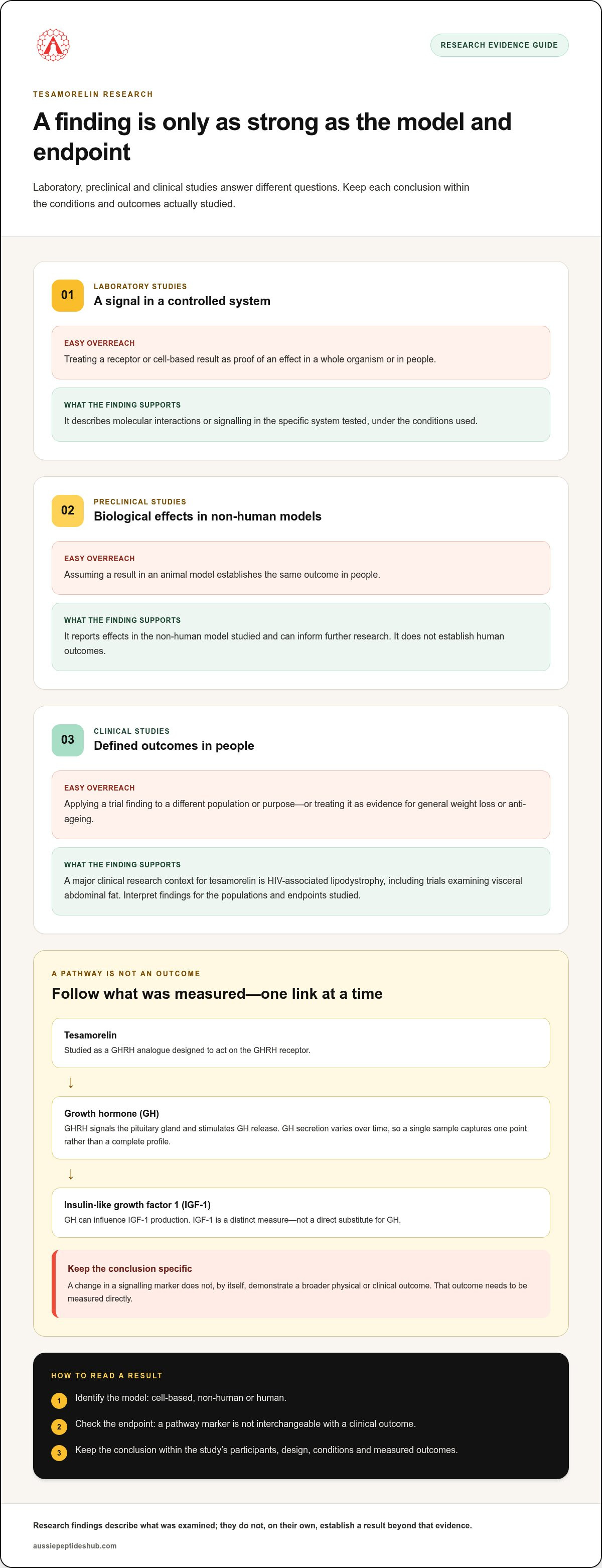
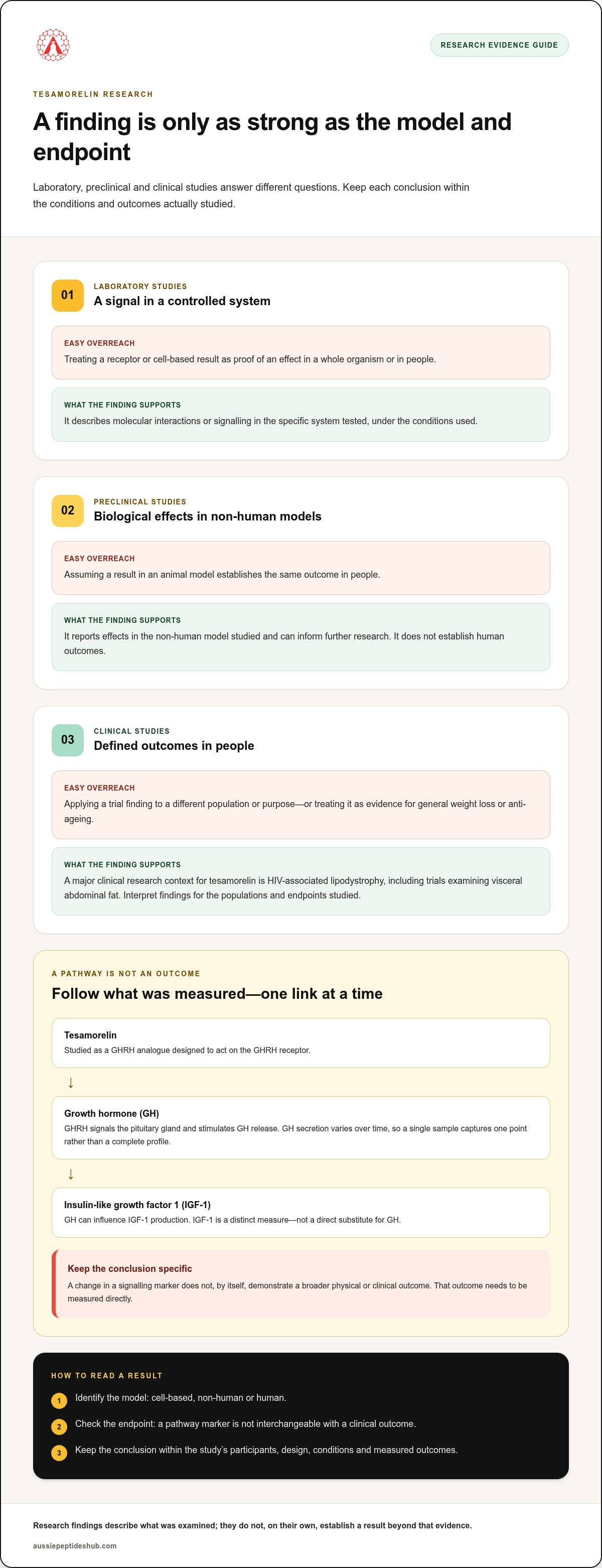
Research operates at different levels. Keep the findings distinct:
- Laboratory studies can investigate molecular interactions or signalling under controlled conditions. A receptor or cell-based result describes the system tested, not a whole-organism effect.
- Preclinical studies examine biological effects in non-human models. Their findings can inform further research, but they don’t establish human outcomes.
- Clinical studies assess defined outcomes in people. A major clinical research context for tesamorelin is HIV-associated lipodystrophy, including trials examining visceral abdominal fat. Those findings relate to the populations and endpoints studied, not general weight loss or anti-ageing.
A change in a signalling marker, for example, is not interchangeable with a measured clinical endpoint. An outcome reported in a specific trial also doesn’t establish that the same result applies to a different population or purpose. Published clinical trials, including work by Falutz and colleagues in the New England Journal of Medicine, need to be interpreted in light of their design, participants and measured outcomes.
When reading a study, ask what was measured, in which model and under what conditions. Keep the conclusion within those boundaries. A biological mechanism can explain why researchers investigate a compound, but it cannot substitute for evidence of a clinical outcome.
How tesamorelin research examines GHRH and downstream signalling
In simplified terms, tesamorelin is studied as a GHRH analogue that may stimulate pituitary growth hormone release, with IGF-1 sometimes measured as a downstream marker. This describes a research pathway, not a guaranteed response or a prediction of clinical benefit. Each link in the sequence needs evidence from a study designed to measure it.
GHRH is released by the hypothalamus and signals the pituitary. Tesamorelin is designed to act on the GHRH receptor. Researchers can then assess growth hormone (GH) and IGF-1, which is produced mainly in the liver in response to GH. This sequence provides a framework for research, but measuring one marker doesn’t prove every later effect.
From GHRH signalling to GH and IGF-1 measurements
Measurement matters. GH secretion varies over time, so a single sample captures one point rather than a complete profile. IGF-1 is a distinct measure, not a direct substitute for GH. If a study reports a change in IGF-1, it has measured that marker; it hasn’t necessarily demonstrated the precise pathway responsible or established a broader physical outcome.
Clinical research on tesamorelin has also measured endpoints beyond pathway markers. Trials in adults with HIV-associated lipodystrophy, for example, examined visceral adipose tissue alongside endocrine measures. The population and outcomes define what those findings can support. They don’t establish the same result for other populations or research aims.
Why research model and endpoint matter
Read evidence at the level at which it was collected. Cell-based work can examine receptor activity or changes in cellular signals. Animal studies can test effects in a whole organism, but species and model differences limit direct translation to people. Human trials can assess clinical endpoints, yet conclusions still depend on participants, study design, comparison groups, duration and the measures selected.
Duration affects interpretation too. A short observation may detect a temporary signal, but it can’t establish on its own whether that change persists. Likewise, a change in GH or IGF-1 doesn’t automatically demonstrate a change in body composition, function or health. Researchers need to measure those outcomes directly and use a design that supports the conclusion.
The Tesamorelin clinical trial on ClinicalTrials.gov illustrates why registry details matter. Review the stated population, intervention, endpoints and recruitment status before describing what a trial can show. A registered study is not itself evidence of a result. Its protocol sets out a question; results require completed analysis and appropriate interpretation.
For tesamorelin peptide australia research sourcing, keep pathway claims separate from evidence about study outcomes. Aussie Peptides supplies tesamorelin for laboratory research only, not human consumption. Researchers can review the tesamorelin research supply alongside the study literature, without treating product information as clinical guidance.
What tesamorelin evidence and analytical tests can establish
Research findings and vial documentation answer different questions. A study reports what happened under its experimental conditions. An analytical report describes results for a tested sample using stated methods. Neither should be stretched into a broader claim about safety, therapeutic effect or suitability for human use.
A Certificate of Analysis (COA) is relevant to a vial only when its identifier matches the exact lot being assessed. A report for a different batch cannot establish the measured attributes of the vial in front of you.
Purity, identity and method are different questions
Purity is a result produced by a specified analytical method. It isn’t a universal property that can be interpreted without knowing how the sample was tested and how the result was calculated. Identity asks whether the material corresponds to the named analyte; purity estimates the relative amount of detected material under the stated method. These are related, but separate, questions.
HPLC can separate and quantify components under defined conditions. On its own, it doesn’t prove a peptide’s full sequence, establish sterility or show suitability for any use. Detection and reporting limits matter too: a component not reported above a stated threshold isn’t necessarily absent.
How to read a tesamorelin research COA
Start with the analyte name and sample or lot identifier. Then check the method, test date, reported result and any stated reporting limits. Treat a percentage as method-specific. Differences in equipment, method conditions, sample preparation and calculations can make results from separate laboratories difficult to compare directly.
Online listings may report figures such as 98.591% or at least 99% purity. These are examples of listing claims, not independently validated benchmarks or proof that results from different batches and methods are comparable. A number without its analytical context has limited value.
| COA item | What it can indicate | What it doesn’t establish alone |
|---|---|---|
| Identity | The analyte tested and the identity method or evidence reported. | Every structural attribute, unless the method supports that conclusion. |
| Purity | A method-based estimate of the sample’s composition. | Absolute purity, safety or suitability for use. |
| Method | How the reported result was generated. | Comparability with results from another method or laboratory. |
| Sample or batch identifier | Which material the report covers. | That the report applies to a vial with a different or absent identifier. |
| Reporting limits | The level at which results may be detected or reported. | That unreported components are entirely absent. |
For tesamorelin peptide australia research supply, batch matching is a traceability check, not a therapeutic assessment. Aussie Peptides supplies research-grade peptides for laboratory use only, not human consumption. Its products are independently HPLC-tested and supplied with matching COAs. Use the lot number printed on the vial to verify the corresponding batch documentation online. This paper trail supports review of the reported analytical data, but it doesn’t establish clinical or safety conclusions.
How to assess tesamorelin research supply and batch records in Australia
A traceability check follows a clear sequence: identify the item, capture its lot number, find the corresponding Certificate of Analysis (COA), then compare the identifiers. This connects the vial in hand with the analytical record attributed to its batch. It does not establish therapeutic approval or suitability for human use.
Match the vial label to its batch record
Use the identifier printed on the vial as your starting point. A product name alone doesn’t identify a specific batch. Record the label details accurately, then use the lot number to locate the matching batch information online.
- Identify the product. Note the name shown on the vial and ensure the documentation refers to tesamorelin.
- Record the lot number. Transcribe the full identifier from the vial label, preserving letters, numbers and punctuation.
- Locate the matching COA. Find the analytical document associated with that lot, rather than relying on a general product description.
- Compare the records. Check that the vial’s product name and lot identifier match the COA. Review the stated method, test date and reported result as part of the record.
If an identifier is missing, incomplete or inconsistent, treat that as a documentation gap. Don’t assume why it differs, and don’t use a certificate for another lot as evidence about the vial being assessed. A batch match supports traceability; it doesn’t demonstrate clinical efficacy, safety or regulatory status.
What Australian cold-chain supply does and does not mean
Aussie Peptides independently HPLC-tests its products, supplies matching COAs and packages products in Australia. Peptides are shipped nationally in cold-chain packaging. These are supply and documentation details; they don’t establish an experimental result, a product-specific storage limit or suitability for therapeutic, veterinary or human use.
Cold-chain packaging describes the shipping approach. It isn’t a substitute for product-specific handling information or analytical evidence. Don’t infer a transit temperature or tesamorelin-specific storage parameter from that phrase alone. For laboratory records, keep the vial identifier linked to its matching analytical document in the relevant project documentation.
A COA guide can help explain what analytical reports contain, but use it as a guide to documentation, not as a substitute for checking the exact vial-to-batch match. Aussie Peptides supplies tesamorelin peptide australia research products for laboratory use only, not human consumption. To review the tesamorelin research supply, begin with the product and batch records, then assess the analytical information within its stated limits.
Tesamorelin in Australia: research-only boundaries and responsible next steps
A research listing and a therapeutic product are not interchangeable categories. Aussie Peptides supplies tesamorelin for laboratory research only. It is not for human consumption, and its product information is not personal treatment, dosing or administration guidance. This boundary applies even when a compound appears in published clinical research or is used in another country.
An online listing, a Certificate of Analysis or overseas use does not establish Australian therapeutic approval, legality or suitability for a person. Regulatory status can change, so consult current information from the Therapeutic Goods Administration (TGA) before drawing conclusions about tesamorelin in Australia. Don’t infer a legal or clinical position from a supplier’s wording alone.
Research material is not a prescription medicine
Laboratory research supply is intended for defined research settings; prescription medicines and therapeutic products are subject to separate regulatory requirements. A research-only label sets a clear limit on the product’s intended use. It doesn’t make the material a medicine, validate a treatment claim or make it suitable for human or veterinary use.
For tesamorelin peptide australia searches, keep three questions separate: what the literature studied, what the vial’s batch documentation reports, and what Australian regulatory sources currently state. Evidence in one category does not answer the others. A clinical study may report an outcome in a defined population, while a COA describes analytical results for a particular batch. Neither alone establishes that a research listing is an approved therapeutic product.
A practical close for researchers assessing documentation
Use a consistent sequence when assessing research material. First, define the research question and the model or endpoint relevant to it. Then read the evidence within the study design and its limits. Finally, match the vial’s lot number to its COA and check that the product and batch identifiers correspond. Record any gaps rather than filling them with assumptions.
This approach applies broadly to peptide research: a pathway observation, a clinical endpoint and an analytical result are different kinds of evidence, and each supports a different conclusion. A matching batch record can support traceability; it cannot establish therapeutic approval, efficacy or suitability for human use. To understand how research varies by compound, compare the methods and claims in published literature rather than treating all peptides as interchangeable.
Aussie Peptides products are for laboratory research only and are not for human consumption. To assess tesamorelin within that boundary, review the research-only product information and available batch documentation, then compare the recorded lot identifier with its matching analytical report.
Make the next research decision traceable
Before a project proceeds, define what its result would need to demonstrate and what it couldn’t establish. That boundary helps keep the research question, chosen measurements and interpretation aligned. It also makes the record more useful to colleagues reviewing or reproducing the work later.
For tesamorelin peptide australia, keep analytical documentation within its proper scope: it supports review of the documented batch, not a conclusion about human use. Aussie Peptides supplies products for laboratory research only, not human consumption. For regulatory questions, consult current Australian information from the Therapeutic Goods Administration.
For a research-sourcing review, review tesamorelin research information and batch documentation. Use the vial lot number to match the batch record and assess the analytical details within their stated limits.
Frequently Asked Questions
Is tesamorelin a GLP-1 peptide?
No. Tesamorelin is discussed as a GHRH analogue, while GLP-1 compounds act through the glucagon-like peptide-1 pathway. These are distinct signalling systems, not interchangeable labels. Published tesamorelin research describes its relationship to GHRH signalling, while Australian Therapeutic Goods Administration information explains the separate regulatory framework for therapeutic products. This is a research distinction, not a comparison of effectiveness, safety or personal treatment options.
Does a tesamorelin purity percentage prove the peptide’s identity?
No. A purity percentage reports a result generated under a particular analytical method; it doesn’t independently confirm every aspect of identity or quality. A COA might report an HPLC result, for example, but the figure needs to be read alongside the analyte name, method and sample identifier. Compare those details with the vial’s batch record. A percentage alone is neither a universal benchmark nor evidence of suitability for human use.
Can findings from tesamorelin laboratory research predict human outcomes?
Not on their own. A cell experiment may show a response in a particular laboratory system, while an animal study examines a different model. Neither automatically predicts what happens in people. Human research also needs to be interpreted in light of its participants, design, duration and measured endpoints. A study provides evidence within those limits; it can’t stand in for the full body of research or establish an outcome beyond what it measured.
What does “lyophilised” mean on a tesamorelin research listing?
Lyophilised means material has been freeze-dried to remove water through a controlled process. The term describes a processing format, not a complete product specification. It doesn’t establish identity, purity, stability or suitability for human use. Seeing “lyophilised” on a listing, for instance, doesn’t tell you the particular material’s handling requirements. Use the product’s own documentation for those requirements, and don’t infer storage conditions from the word alone.
Is tesamorelin listed on the Australian Register of Therapeutic Goods?
Check the current TGA Australian Register of Therapeutic Goods rather than inferring status from an online research listing or use in another country. Search for the exact product and relevant indication, then review the register entry. The tesamorelin peptide australia research context isn’t a substitute for regulatory advice or a prescription. Register details can change, so verify them with the TGA close to the time you need the information.
What does “research use only” mean for tesamorelin supplied by Aussie Peptides?
It means the product is supplied for laboratory research, not human consumption. It isn’t presented as a prescription medicine, treatment or personal-use product. A listing or analytical document doesn’t change that boundary. A batch result can describe the tested material, for example, but it doesn’t provide clinical evidence for an individual. Keep product documentation within its research scope and don’t use it as a basis for personal-use decisions.