Peptide Storage Cold Chain: A Laboratory Handling Guide
October 16, 2026 · 16 min read
A refrigerator setting alone doesn’t establish cold-chain integrity. The peptide storage cold chain depends on the material’s documented requirements and a traceable record of how it was received, transferred and stored. A temperature excursion can raise questions about material integrity, but without a time-stamped record and product-specific instructions, its significance is difficult to assess.
Lyophilised and reconstituted peptides can have different handling requirements, so a general temperature assumption may not apply to every material. Before setting storage conditions, review the relevant product documentation. Record conditions at key hand-offs and document any deviation for review.
This guide explains how to organise those steps, from checking shipment records and packaging on receipt to monitoring storage and recording temperature excursions. It also covers batch traceability, including how matching Certificates of Analysis and lot-number verification support a documented workflow. Aussie Peptides supplies research-grade products for laboratory research only, not for human consumption. The aim is a practical process based on records and product-specific evidence, not assumptions.
Key Takeaways
- Review product-specific storage instructions before setting conditions. Don’t assume one temperature suits every peptide.
- Build the peptide storage cold chain around documented receipt, inspection, transfer and storage steps, not a refrigerator setting alone.
- Record monitoring results and temperature excursions, then assess them against applicable product documentation.
- Keep storage records distinct from assay results. Each provides different evidence, and neither replaces the other.
- Use lot numbers, matching Certificates of Analysis and online batch verification to support traceability. Aussie Peptides’ research-grade products are for laboratory use only, not for human consumption.
Peptide storage cold chain: what it protects and where it begins
A cold chain is not simply a destination temperature. It is a controlled, documented sequence of handling conditions intended to protect material across relevant storage and transfer stages. For research peptides, the peptide storage cold chain begins at receipt and continues through inspection, storage, monitoring and any later transfer. Each stage should align with the applicable product documentation.
Definition: Cold-chain control is the documented management of product-specific conditions across handling stages. A single storage temperature is only one part of that process.
A refrigerator display shows a reading at a particular point. By itself, it doesn’t establish the conditions the material experienced before arrival, during transfer or elsewhere in storage. Nor does it prove that a particular material remains stable under those conditions. A cold-chain statement describes a handling approach; evidence of continuous temperature monitoring requires records covering the relevant stages. These are related, but not interchangeable, claims.
What does cold chain mean for research peptides?
Cold chain describes linked handling steps, not just equipment. On receipt, staff identify the shipment and inspect its packaging. They then transfer the material to designated storage, monitor relevant conditions and document what they do. A clear record connects the material’s identity, lot and location with receipt and storage details.
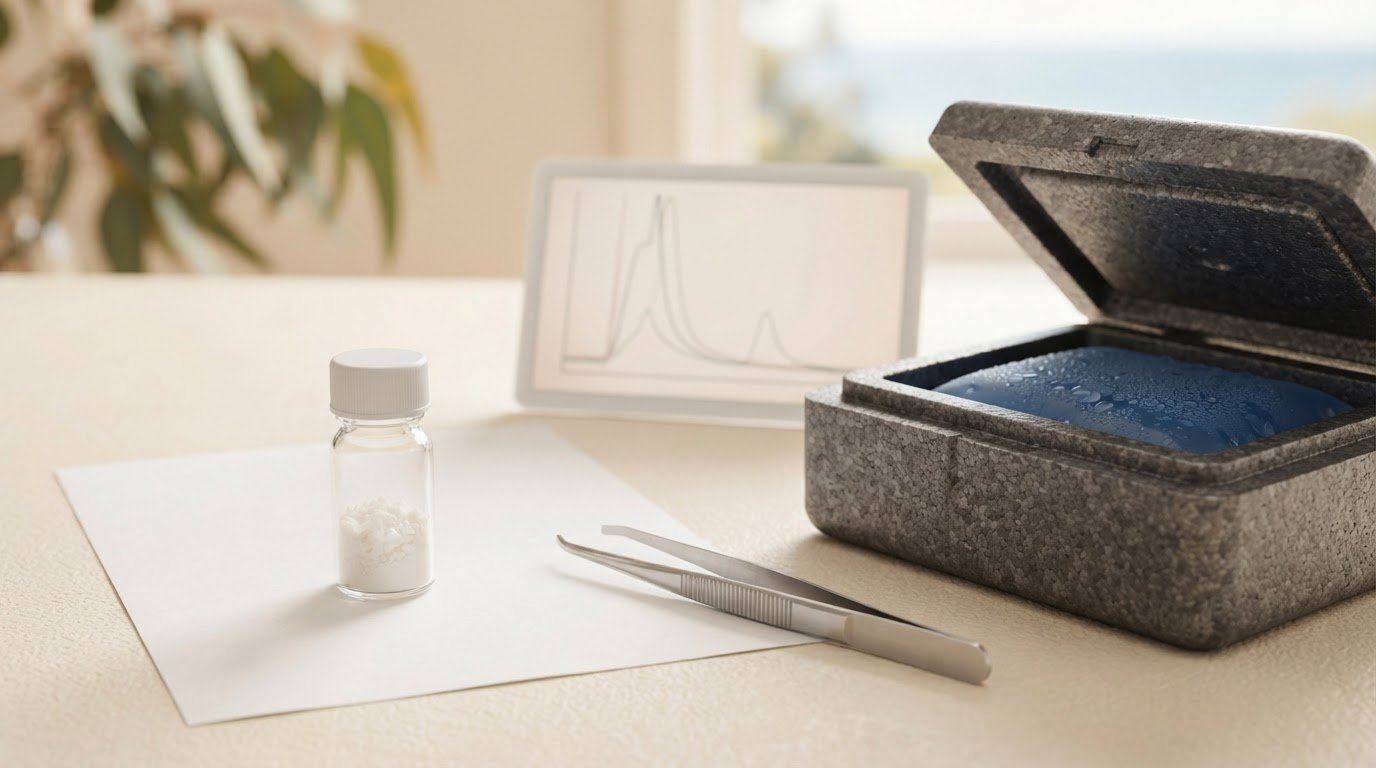
Required conditions depend on product-specific technical documentation. General principles are explained in What is a Cold Chain?, but a broad definition cannot determine the storage requirements of an individual peptide. Packaging designed to support cold-chain shipping is one part of the sequence. It doesn’t document every condition before or after delivery. Record what was observed and measured, rather than implying monitoring that did not occur.
Why material form changes the storage question
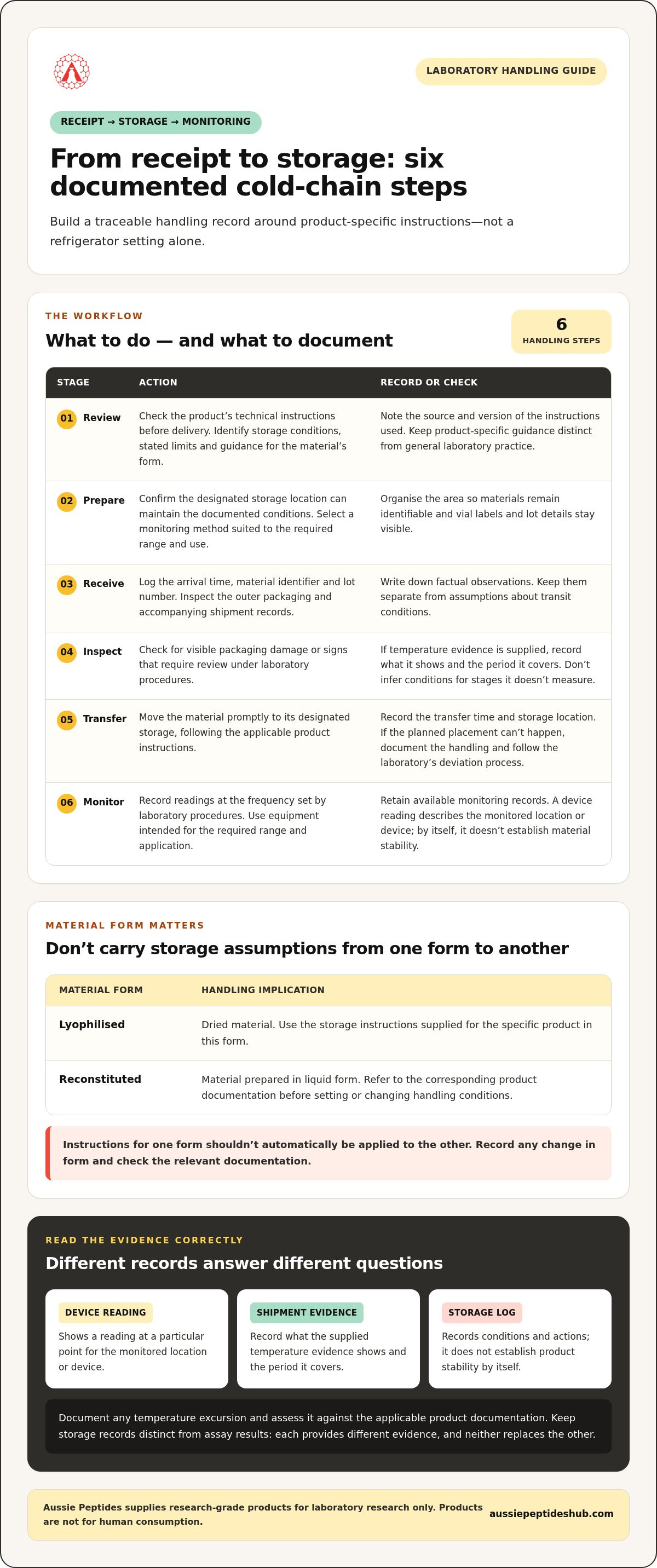
Lyophilised material is dried, while reconstituted material has been prepared in liquid form. That difference changes the storage question. Instructions for one form shouldn’t automatically be applied to the other, and there is no universal storage regime to assume for every peptide. Use the instructions supplied for the specific product and its current form.
For example, recording a storage location for a lyophilised vial doesn’t establish that the same conditions apply after reconstitution. Record any change in form and refer to the corresponding documentation before setting or changing handling conditions. This is the starting point for material-specific handling. A dedicated guide to lyophilised-peptide handling can examine that form in more detail.
Aussie Peptides supplies research-grade peptides for laboratory research only. Products are not for human consumption. Treat cold-chain packaging, storage records and product documentation as complementary evidence, each with a distinct role in traceability.
How to maintain peptide cold-chain integrity in the laboratory
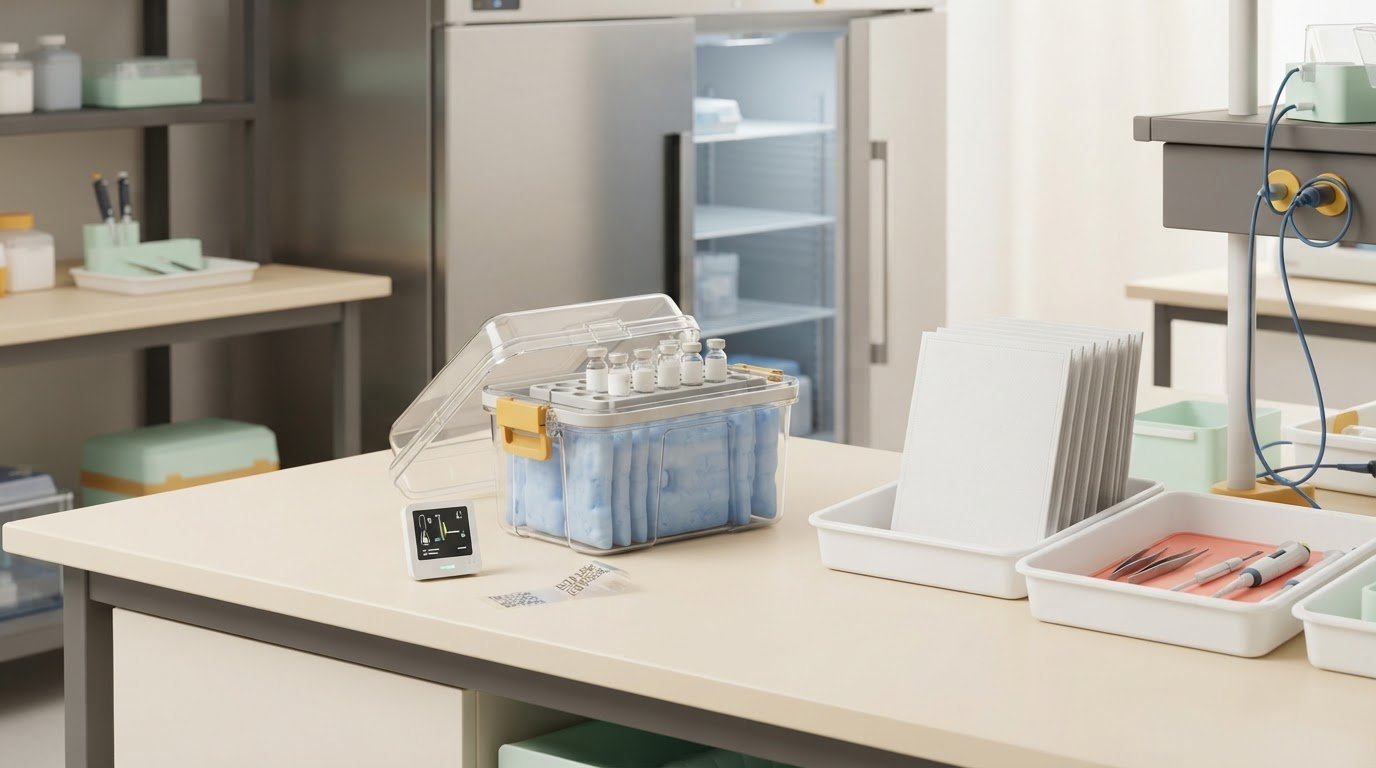
A repeatable receipt-to-storage procedure makes handling decisions traceable. The steps below identify what to verify and record without imposing a generic temperature. Use the product’s technical documentation to determine conditions for the specific material and its form. Keep the procedure accessible to staff who receive and store research materials.
- Review the instructions. Before delivery, identify the documented storage conditions, any stated limits and instructions relevant to the material’s form. Record the source and version of the instructions used, so staff can distinguish product-specific guidance from general laboratory practice.
- Prepare the storage location. Confirm that the designated location can maintain the documented conditions. Select a monitoring method suited to the required range and use. Organise the storage area so materials remain identifiable and vial labels and lot details stay visible.
- Record receipt. Log the arrival time, material identifier and lot number. Note the visible condition of the outer packaging and relevant details on accompanying shipment records. Keep observations factual and separate them from assumptions about transit conditions.
- Inspect the shipment. Check packaging for visible damage or signs that require review under laboratory procedures. If temperature evidence is supplied, record what it shows and the period it covers. Don’t infer conditions for stages it doesn’t measure.
- Transfer the material. Move it to its designated storage promptly, following the applicable product instructions. Record the transfer time and storage location. If the material can’t be placed in the designated location as planned, document the handling and follow the laboratory’s deviation process.
- Continue monitoring. Record readings at the frequency set by laboratory procedures, and retain available monitoring records. Use equipment intended for the required range and application. A display reading describes the monitored location or device; it doesn’t, by itself, establish the material’s stability.
A storage log records conditions and actions, not product stability by itself. It helps reconstruct handling and identify where review is needed. Stability conclusions require suitable product-specific supporting data. A record of storage conditions is not an assay result.
Monitoring equipment supports the process only when its range, placement and recording method suit the documented requirements. Check that the record identifies the monitored location and covers the period under review. Don’t represent a reading from one point as continuous evidence for a different location or an unmonitored transfer.
Keep receipt logs, product instructions and lot records together or cross-referenced. Staff should be able to review handling history without relying on memory. If monitoring identifies a deviation, record the observed information and follow the laboratory’s established assessment procedure. Don’t assume the material is either unaffected or compromised.
Aussie Peptides supplies research-grade peptides for laboratory use only. Products are not for human consumption. Laboratories can review research peptide information and connect batch details with their own handling records.
Temperature excursions, monitoring and storage equipment: what the evidence means
A temperature record describes what a monitoring point measured over a defined period. It doesn’t automatically establish the condition of every vial or show whether a peptide remains suitable for its intended research use. Assess an excursion against the product’s documented limits and relevant stability evidence. Don’t assume that freezing, thawing or a brief departure from a stated condition is harmless or damaging across all materials.
Passive packaging and active cooling are not equivalent
These approaches serve different functions. Passive packaging can slow temperature change during transfer, but it doesn’t actively regulate conditions. Active cooling uses powered equipment to control temperature within its operating conditions. Monitored laboratory storage adds readings and records, but neither the equipment nor its display proves material stability without product-specific supporting data.
| Approach | Control and monitoring | Evidence limitation |
|---|---|---|
| Passive insulation | Reduces the rate of temperature change; monitoring depends on included or separate devices. | Packaging alone doesn’t show the temperature reached throughout transit. |
| Active cooling | Uses equipment to regulate conditions; readings depend on device operation and monitoring. | A setpoint or display doesn’t confirm the vial’s temperature or peptide stability. |
| Monitored laboratory storage | Records readings at the monitored location, subject to sensor placement and recording method. | Records need product-specific limits and stability information for interpretation. |
For the peptide storage cold chain, choose monitoring equipment suited to the documented range and the intended use. Check that the record identifies the monitored location and covers the period under review. Don’t represent a reading from one point as continuous evidence for a different location or an unmonitored transfer.
What to do when a temperature excursion is recorded
Keep the response factual and traceable. Record the observed reading, time, duration if known, material and lot, along with relevant handling events. Preserve the original monitoring record. If the duration or actual exposure is uncertain, state that rather than estimating it.
Identify affected material and keep it separate from routine use pending an evidence-based assessment under laboratory procedures. This is a control measure, not a conclusion that the material is compromised. Don’t create a discard threshold or infer acceptability from a single reading. Refer to product-specific stability information and applicable procedures, then document the assessment, decision and responsible reviewer.
Interpret the evidence as a set: product instructions define relevant conditions, monitoring records describe measured conditions, and stability data informs what those conditions may mean for the material. If supporting evidence doesn’t address the recorded exposure, document that limitation. A device reading is not a substitute for a material-specific assessment.
A practical peptide storage cold-chain checklist for routine handling
A repeatable record helps laboratory staff connect each material with its instructions, location and handling history. Use this checklist for research materials and adapt it to the laboratory’s established documentation and deviation procedures. The peptide storage cold chain should be traceable from receipt through storage, without relying on memory or assuming a standard condition applies to every product.
- Confirm product identity. Record the product identifier and lot number, then check that the vial label is legible and remains visible in storage.
- Document receipt. Enter the receipt date and, where recorded, the time. Note the visible package condition and retain any accompanying temperature evidence without inferring unmeasured conditions.
- Record storage location. Identify the designated storage unit and location clearly enough for another staff member to retrieve the material and understand where it was held.
- Capture monitoring observations. Make records in line with laboratory procedures. Include relevant readings and identify the monitoring point or record source.
- Log handling or equipment events. Record transfers, interruptions, maintenance or other events that may help explain the material’s handling history. Document deviations using the laboratory’s established process.
- Keep supporting documents connected. Link product instructions, lot details and analytical documentation to the storage record, using the laboratory’s document-control method.
Build a repeatable storage record
A useful record lets staff reconstruct what happened without treating assumptions as observations. Include the product identifier, lot number, receipt date and storage location, then add monitoring observations and relevant handling or equipment events. If a detail is unknown, mark it as unknown rather than estimating. Follow established laboratory documentation and deviation procedures so records remain consistent and reviewable.
Keep identity and analytical documentation connected
Match the vial’s lot details to its corresponding Certificate of Analysis (COA). Independent HPLC results describe analytical testing of the material; they don’t establish future stability under storage conditions. Storage records and assay results answer different questions, so retain both without treating either as a substitute for the other. A separate tesamorelin vial research guide addresses storage and batch checks, while the GHK-Cu copper peptide lab standards article covers COA and batch-check context.
For Aussie Peptides research-grade products, lot numbers support online batch verification, and products have matching Certificates of Analysis. Products are for laboratory research only and are not for human consumption. Keep these records within the laboratory workflow and assess storage conditions against product-specific documentation.
For research materials with batch documentation, view Aussie Peptides research peptides and keep the relevant product records connected to your laboratory storage process.
How Aussie Peptides supports traceability across research-peptide handling
Supplier documentation gives laboratory staff identifiable batch information to carry into their own receipt and storage records. Aussie Peptides supplies research-grade peptides that are independently tested using high-performance liquid chromatography (HPLC), with a matching Certificate of Analysis (COA) and lot-number-based online batch verification. These records support traceability; they don’t replace the laboratory’s responsibility to follow product-specific storage instructions and document handling after delivery.
Batch records support identity and analytical transparency
The lot number on a vial links the physical material to its batch details online. Staff can use it to check that the vial’s identity aligns with the corresponding batch information and COA, then retain those records alongside the laboratory’s receipt and storage documentation. This creates a clearer audit trail than a product name alone, particularly when a laboratory handles more than one lot.
A matching COA documents analytical information for the relevant batch. HPLC testing provides analytical results; it doesn’t establish every condition the material experienced in storage or transit, or determine a universal stability period. Keep those claims distinct. The COA supports batch identification and analytical transparency, while product-specific instructions and laboratory records address storage and handling. Neither replaces the other.
For a practical record set, connect the vial’s lot information to the COA and online batch details, then cross-reference it with the laboratory’s receipt date, designated storage location and relevant monitoring observations. If a later review raises a handling question, these records help show what was supplied and what was documented after receipt.
Cold-chain packaging is one stage, not the whole process
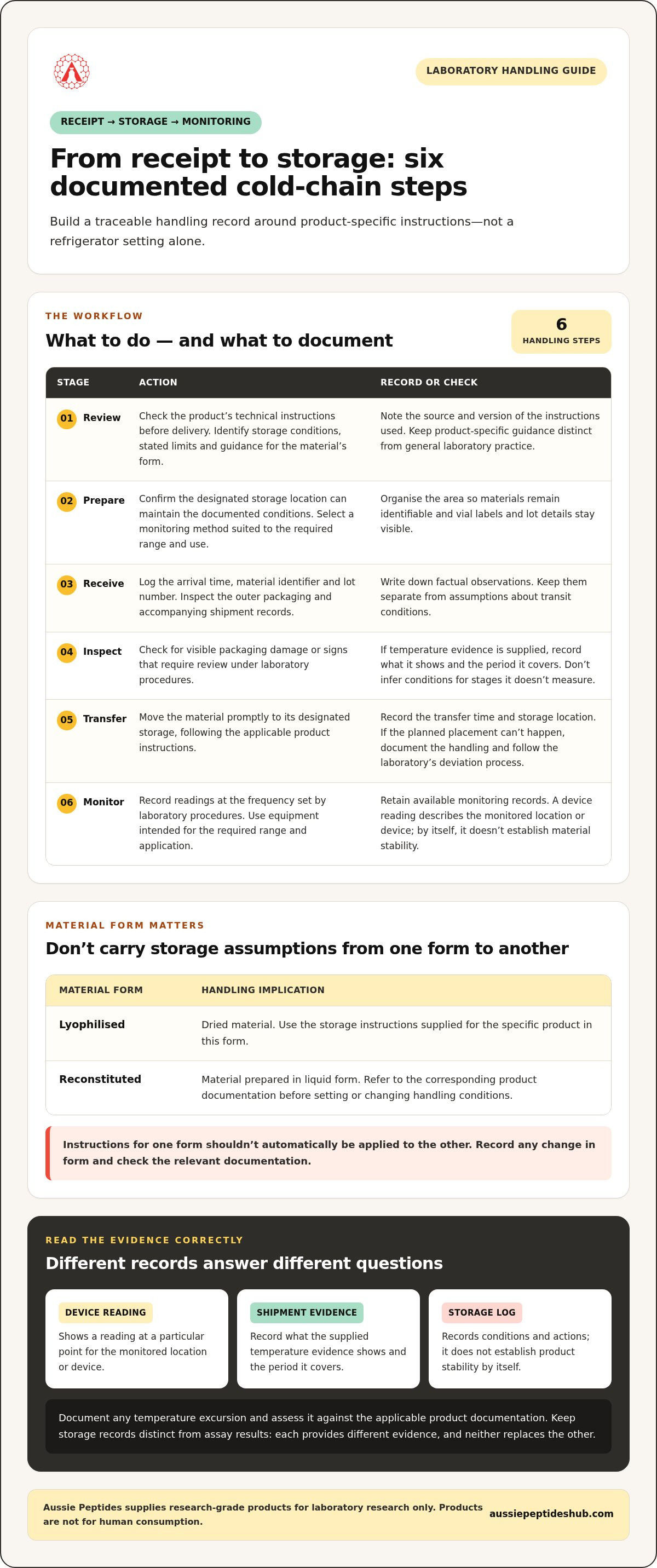
Aussie Peptides ships research peptides in cold-chain packaging across Australia. This describes a packaging and shipping measure, not a specific temperature, transit duration or claim of uninterrupted temperature monitoring at every stage. Packaging is one part of the broader handling sequence. It cannot replace the laboratory’s receiving checks or establish that every stage has a continuous temperature record.
At receipt, inspect the shipment, record its visible condition and capture any temperature evidence provided without inferring conditions that weren’t measured. Then transfer the material to its designated storage promptly, following its product-specific documentation. Connect the lot number and COA to the laboratory record so supplier batch information and local handling history remain traceable.
Aussie Peptides’ products are for laboratory research only and are not for human consumption. Review research-only peptide information for supplier and product details relevant to research handling.
Make the next handling decision traceable
Use this guidance to review your laboratory’s handling procedure. Identify who records receipt, who verifies storage instructions and where staff document a deviation. A clear hand-off reduces reliance on informal assumptions and gives the team a consistent basis for reviewing records when conditions change.
Apply the same discipline when introducing a new research material: establish its documented requirements first, then align identification, storage and monitoring records with those requirements. The peptide storage cold chain is strongest when each step can be reviewed against evidence, not when a familiar setting is treated as a universal rule.
Aussie Peptides supplies products for laboratory research only. They are not for human consumption. Review product information and connect the relevant batch details to your laboratory workflow.
Review research-only peptide information and take the next step with a clear, documented handling process.
Frequently Asked Questions
What temperature should research peptides be stored at?
There isn’t one storage temperature that applies to every research peptide. Use the product-specific technical instructions for the material’s form, and don’t treat a general laboratory setting as a substitute. Check whether the stated condition refers to the storage unit or the material itself. In your records, distinguish the unit’s setpoint from the temperature actually measured by its monitoring system.
Do lyophilised and reconstituted peptides have the same storage requirements?
No. Lyophilised material and material after reconstitution are different forms, and their storage instructions may differ. Follow documentation for the specific product and form being handled. Don’t carry instructions across from one form to the other without supporting guidance. If a protocol changes the material’s form, update its identity and handling records so the instructions used can be matched to the material at that stage.
Can research peptides be frozen for storage?
Only freeze a research peptide when its product-specific documentation supports that condition. Freezing isn’t a universal safeguard, and repeated freeze-thaw handling should be avoided unless the relevant protocol provides a reason and method for it. Before changing storage conditions, check the instructions for the material’s current form. Record any freeze, thaw or transfer event, including its timing, in the laboratory record.
How can I tell whether a peptide shipment stayed within its cold chain?
Look for temperature evidence that identifies what was measured and the period it covers, such as a shipment monitoring record. A package arriving intact or containing cooling materials doesn’t by itself confirm the temperature throughout transit. Check whether the evidence covers the relevant journey and note any gaps. If no monitoring record is available, document that limitation rather than stating that continuous temperature control was verified.
What should I record when storing research peptides?
Record enough detail for another staff member to reconstruct the handling history: material identifier, form, lot number, receipt date, storage location and relevant readings. Add the record time, monitoring source and staff initials where laboratory procedures call for them. For example, identify whether a reading came from a unit display or a separate logger. Document transfers or unusual events rather than relying on verbal handover.
Does an HPLC Certificate of Analysis prove a peptide’s storage stability?
No. An HPLC Certificate of Analysis (COA) provides analytical information for the relevant batch; it doesn’t, on its own, establish how the material will behave over time under particular storage conditions. Stability assessment requires suitable evidence for the specific product and relevant conditions. Keep the COA linked to the lot, but use product-specific storage documentation and laboratory records to address handling. Aussie Peptides products are for laboratory research only, not for human consumption.