Cold Chain Peptide Delivery Australia: 2026 Handling Guide
October 17, 2026 · 16 min read
A parcel marked “cold-chain” doesn’t, by itself, show what temperatures it experienced in transit. That distinction matters when assessing cold chain peptide delivery australia: packaging, transit evidence and analytical testing each answer a different question.
When a shipment arrives, a clear inspection process helps you record what you can observe and separate it from what the documents establish. This guide explains the stages of temperature-conscious delivery, how to review packaging and batch records, and what to check on receipt. It also distinguishes transit handling from the storage instructions provided for a product.
Aussie Peptides supplies research-use-only peptides in cold-chain packaged domestic deliveries across Australia. Products are independently HPLC-tested and supplied with matching Certificates of Analysis (COAs). You can use the lot number printed on each vial to look up batch details online. These records support batch traceability and analytical review, but they are not proof of a parcel’s temperature history. The sections ahead set out a practical arrival check, explain how to assess different forms of information, and outline how to follow product information and laboratory procedures after delivery. These products are for laboratory research only, not human consumption.
Key Takeaways
- Understand what cold chain peptide delivery australia describes, and why cold-chain packaging alone doesn’t prove monitored or validated transit.
- Review the shipment stages from fulfilment and packing through receipt to researcher-controlled storage.
- Inspect the parcel and vial on arrival, record batch details, and follow product-specific instructions and laboratory procedures.
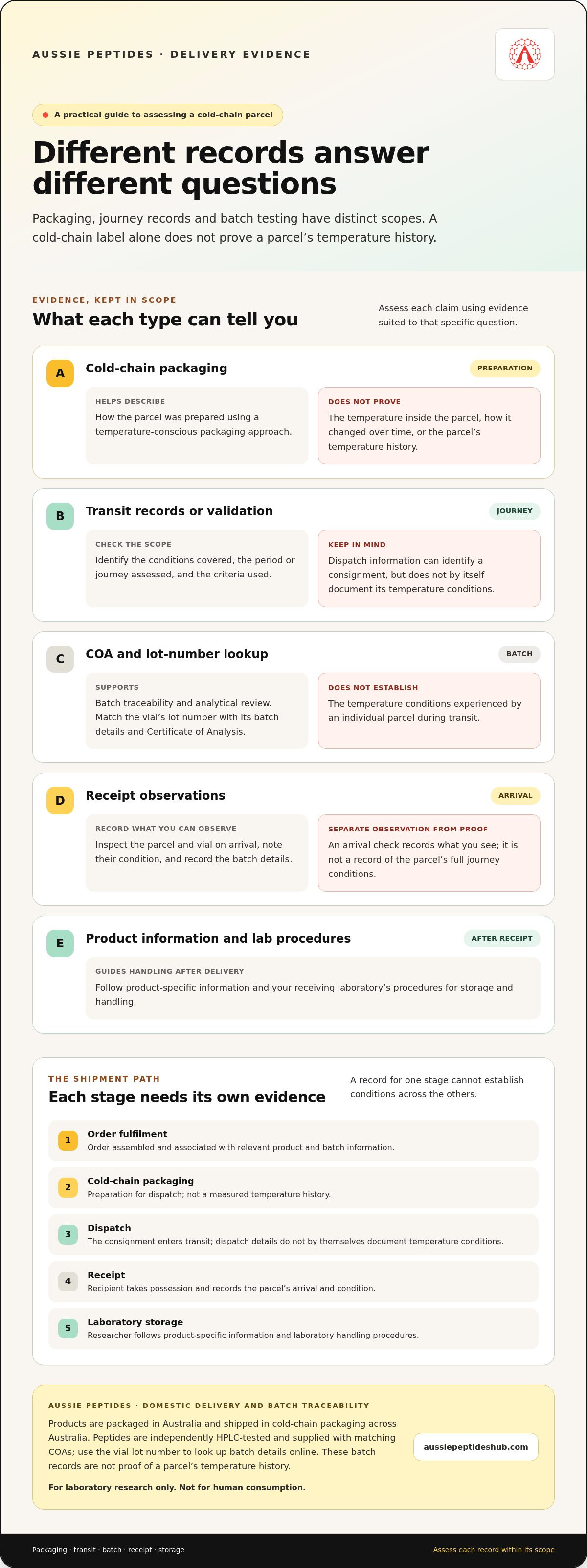
- Keep evidence in scope: packaging describes preparation, transit records concern a journey, and a COA and lot-number lookup support separate batch checks.
- Learn how Australian packaging, domestic cold-chain delivery and batch traceability apply to research-only peptides.
Cold chain peptide delivery in Australia: what the term means
Cold-chain delivery describes temperature-conscious handling during relevant fulfilment and transit stages. It is an approach to managing temperature conditions, not a complete record of what happened to an individual parcel. For research materials, assess temperature-related handling against the product information and your laboratory’s procedures.
Quotable definition: Cold-chain delivery is temperature-conscious handling across relevant supply stages. General parcel protection helps guard against physical damage, but neither description alone proves a shipment’s temperature history.
In practice, a cold-chain claim may describe how goods are packed for dispatch. It does not automatically mean temperatures were measured throughout the journey or that the route was validated. Read delivery descriptions for what they say, rather than treating a packaging label as a transit record.
The wider concept of cold chain logistics covers the handling and movement of temperature-sensitive goods through connected stages. For an individual parcel, the practical question is more specific: what evidence, if any, describes the conditions during that journey?
Cold-chain packaging versus validated transit
Temperature-conscious packaging is intended to help manage exposure to temperature changes during handling and transit. It can form part of a cold-chain approach, but its presence does not show the temperature inside a parcel or how conditions changed over time. A cold-pack label alone is not a temperature measurement or history.
Transit validation is different. It refers to documented evidence that specified conditions were maintained across a defined journey, according to stated criteria. To understand the scope of such evidence, identify which conditions it covers, the period or journey assessed, and the criteria used. Without that context, “cold-chain” wording should be understood as a handling description, not proof of continuous monitoring or validation.
General parcel protection addresses other risks, such as physical impact. It may help keep a shipment intact, but it cannot establish whether temperature requirements were met. These are separate questions, and each needs evidence suited to the claim being assessed.
Why domestic delivery context matters
Domestic delivery involves fulfilment and transit stages between packing and receipt. Transit duration and handling can vary, so a general packaging description cannot establish the conditions of every parcel’s journey. Don’t assume a particular route or delivery experience from the phrase “across Australia”.
Aussie Peptides packages products in Australia and ships cold-chain packaged peptides across Australia. This describes the domestic fulfilment context and packaging approach. It does not mean that each parcel has a temperature logger or that its transit is monitored or validated. Keeping these distinctions clear separates delivery information from evidence about a product’s batch or analytical testing.
For research use, assess each type of information within its proper scope. Packaging describes how a parcel is prepared; transit evidence concerns conditions during a journey; product information and laboratory procedures guide handling after receipt. Keeping these questions and records separate supports a more accurate review of temperature-conscious delivery.
How a research peptide shipment moves from packing to receipt
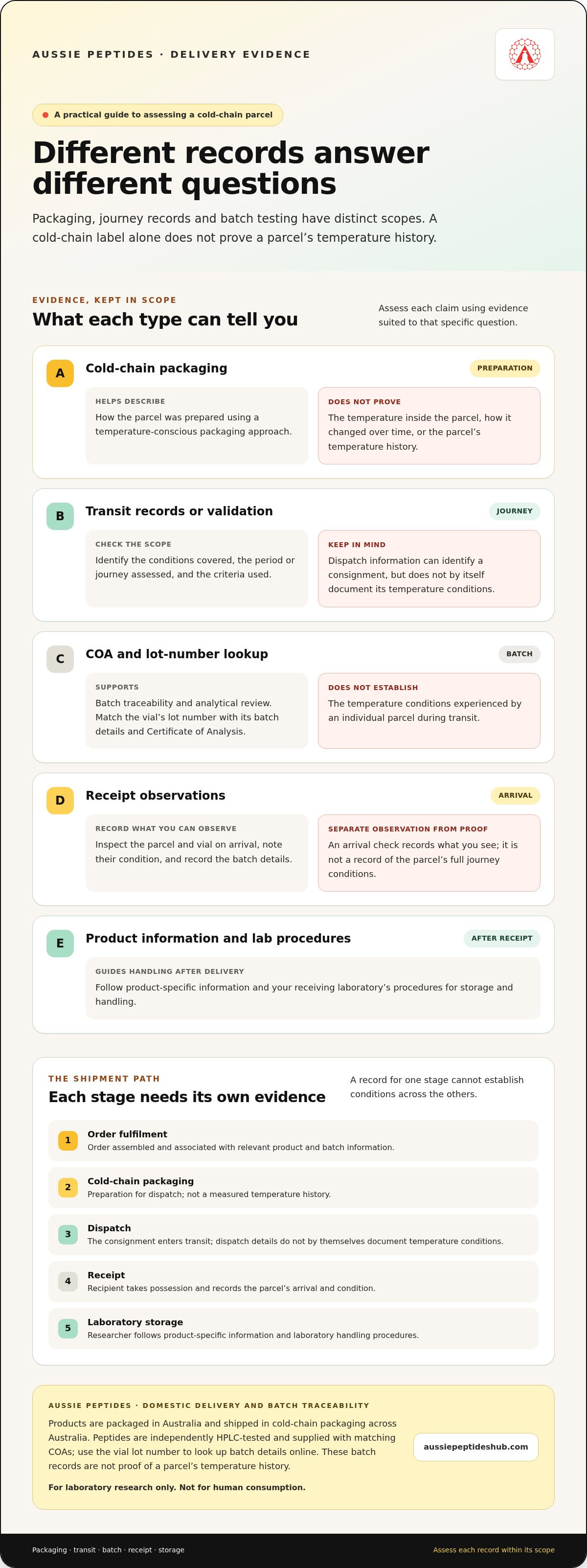
A shipment passes through distinct stages, and each answers a different handling question. Fulfilment information relates to preparing the order; packaging describes how it is prepared for dispatch; dispatch information identifies the consignment; and receipt marks the handover to the researcher. After receipt, storage and handling follow the receiving laboratory’s procedures. Each stage needs its own evidence or documentation. A record for one stage cannot establish conditions across the others.
Use this sequence to keep the stages distinct:
- Order fulfilment: The order is assembled and associated with relevant product and batch information.
- Cold-chain packaging: The parcel is prepared using a temperature-conscious packaging approach. This describes preparation, not a measured temperature history.
- Dispatch: The consignment enters transit. Dispatch information can help identify the shipment, but does not by itself document its temperature conditions.
- Receipt: The recipient takes possession and records the parcel’s arrival and condition.
- Laboratory storage: The researcher follows product-specific information and laboratory handling procedures after delivery.
This is a general framework, not a claim about a particular courier method or shipment-monitoring system. Australian deliveries may involve different transit durations and handling stages. Logistics Bureau discusses considerations affecting cold chain logistics in Australia, but general logistics context does not establish the conditions of an individual parcel.
What the sender’s process can establish
Fulfilment and packaging describe preparation, but do not necessarily provide a complete transit record. A dispatch record and batch documentation also serve different purposes: one relates to the consignment, while the other identifies product or batch information. Neither substitutes for evidence about the other stage.
Aussie Peptides packages products in Australia and ships cold-chain packaged peptides across Australia. These facts describe domestic packaging and fulfilment, not courier procedures, transit duration, temperature monitoring or validation. When assessing cold chain peptide delivery australia, consider what each statement actually records instead of extending a packaging description into a claim about the full journey.
What changes after delivery
Receipt marks the start of the next handling stage, under the researcher’s control. Note when the parcel arrives, inspect it, then follow the product-specific storage information and your laboratory’s procedures. Don’t infer a storage temperature or handling instruction from the parcel’s packaging alone.
Keep records distinct. Parcel and dispatch details relate to delivery; batch documents relate to the product; and laboratory records can document handling after receipt. For practical post-delivery steps, consult the peptide storage and cold-chain laboratory handling guide alongside the relevant product information. Aussie Peptides supplies research-grade peptides for laboratory use only, not human consumption. Researchers can explore the research peptide range in that laboratory-use context.
How to compare cold-chain claims, transit evidence and peptide testing
Different records answer different questions. A packaging claim describes preparation; a transit record concerns conditions during a journey; and analytical testing relates to the product batch. Treating them as interchangeable can lead to conclusions the evidence does not support.
Quotable distinction: Batch-quality documentation concerns analytical testing and batch identity; delivery-condition documentation concerns how a parcel was handled in transit.
| Evidence type | What it can support | What it cannot establish alone |
|---|---|---|
| Packaging claim | That temperature-conscious packaging was used or intended. | The parcel’s measured temperature history or validated transit conditions. |
| Transit record | Documented information about specified conditions during a defined journey, if the record covers them. | Batch identity or analytical characteristics of the peptide. |
| Batch Certificate of Analysis (COA) | Analytical documentation associated with a specific batch. | How the parcel was handled or the temperature it experienced in transit. |
| Lot-number lookup | A check of batch details associated with the number printed on the vial. | Transit temperature or packaging performance. |
Use the table as a scope check. A COA included with a parcel is relevant to batch review, but it is not a shipping record simply because it arrived with the product. Likewise, a cold-chain packaging description does not demonstrate that the product was independently HPLC-tested. For cold chain peptide delivery australia, separating these evidence types makes claims easier to assess without drawing conclusions beyond the documents.
What a Certificate of Analysis can and cannot show
A COA is analytical documentation associated with a batch. Its role is distinct from a record of delivery conditions. Aussie Peptides independently HPLC-tests products and supplies matching COAs. These support analytical review in relation to the batch; they do not document the parcel’s temperature history or validate its transit conditions.
Read a COA in context: check that it corresponds to the product and batch under review, then interpret its analytical information within the document’s stated scope. For a fuller explanation of analytical review, consult the existing guide to reading peptide COAs. Keep that assessment separate from any delivery-condition records.
How lot traceability supports batch checks
The lot number printed on a vial can be used to check batch details online. Compare the vial identifier with its matching batch documentation. If the identifiers align, that supports traceability between the physical vial and the associated batch information. It does not indicate whether temperature conditions were maintained before receipt.
This distinction applies to GHK-Cu as it does to other research peptides: a lot lookup concerns batch details, not the parcel’s journey or packaging performance. Aussie Peptides products are for laboratory research use only and are not for human consumption.
Receiving a cold-chain peptide parcel: a practical inspection sequence
A consistent receipt check creates a useful record before the parcel moves into laboratory storage. It also separates visible observations from conclusions about temperature exposure. An intact exterior does not prove that specified conditions were maintained, and visible damage alone does not establish that a temperature excursion occurred.
Use your laboratory’s documentation and handling procedures. The sequence below is a general inspection framework, not a substitute for product-specific instructions or local laboratory requirements.
What to inspect and record on arrival
Before opening the parcel, note the arrival date and time in the format your laboratory uses. Inspect the outer packaging and record visible damage, such as a tear or crushed area, without inferring its effect on the product. Then compare the vial label and printed lot number with the accompanying batch documentation. Record any mismatch or missing document as an observation.
- Note receipt: Record when the parcel arrived using your laboratory’s normal procedure.
- Inspect the exterior: Document the packaging condition before opening, including visible damage if present.
- Check vial identity: Compare the product label and lot number with the relevant batch documentation.
- Log the review: Record your observations and batch details in the laboratory’s designated records.
- Move to controlled handling: Follow the product-specific instructions and your laboratory’s procedures for storage and subsequent handling.
Keep the wording factual. “Outer packaging visibly damaged” records an observation; “temperature excursion occurred” is a separate conclusion that requires relevant evidence. A parcel’s appearance does not measure its internal temperature or document conditions throughout transit.
When packaging or documentation raises a question
If a label, vial or accompanying document appears inconsistent, record exactly what differs. Avoid correcting or interpreting the discrepancy from memory. Preserve the relevant packaging and records in line with laboratory procedures, then follow the laboratory’s process for reviewing receipt questions. Don’t infer temperature history from packaging appearance or treat batch documentation as transit monitoring.
For cold chain peptide delivery australia, keep three things distinct: what you observed, what the batch documents identify, and what is known about delivery conditions. This creates a clearer record for later review without introducing unsupported temperature assumptions or rejection rules. Use product-specific information to guide storage and apply laboratory handling procedures after receipt.
These products are supplied for laboratory research only and are not for human consumption. Parcel condition or batch paperwork does not provide a basis for human use or clinical decisions. For research workflows, view research peptide products and assess their accompanying product information within your laboratory’s procedures.
Aussie Peptides cold-chain delivery: domestic handling and traceable batches
Assess delivery and batch information as separate parts of the record. This describes domestic packaging and delivery. It does not, on its own, document a parcel’s temperature history or establish that transit conditions were monitored or validated.
Product records provide a separate line of evidence for research use. Independent HPLC testing and a matching COA support analytical review associated with a batch. A lot-number lookup helps connect the vial to its batch details. Neither a COA nor a lookup is a transit record.
What Aussie Peptides documents about its products
Products are independently HPLC-tested and supplied with matching COAs. Use the accompanying documentation to review analytical information associated with the relevant batch. The scope is specific: these records support batch-level checks, not claims about parcel temperature or packaging performance during delivery.
Each vial’s printed lot number provides a way to check batch details online. Compare that identifier with the accompanying documentation to assess whether the records correspond to the vial in hand. This is a traceability step. It does not show how the parcel was handled after dispatch or whether a particular temperature condition was maintained.
Keep the evidence categories distinct:
- Packaging and delivery description: relates to preparation and domestic fulfilment.
- HPLC testing and matching COA: relates to analytical information for the batch.
- Vial lot number and online lookup: supports checking the batch details linked to that vial.
This separation makes the documentation more useful. It limits each record to what it can support, rather than treating several different records as proof of one broad quality or handling claim. For cold chain peptide delivery australia, assess domestic packaging, analytical records and batch traceability without confusing them with evidence of transit conditions.
Research-only purchasing and next steps
Aussie Peptides products are for laboratory research use only and are not for human consumption. Packaging and batch documentation do not change that restriction. They are not evidence of suitability for human use, and parcel condition should not inform clinical decisions.
For a research workflow, review the relevant product information and matching batch documentation against your laboratory’s requirements. Check the vial lot number against the online batch details, then follow the product-specific handling information and your laboratory procedures. This keeps purchasing review, receipt checks and post-delivery handling within their proper scope.
Review the research peptide products and their associated batch information against your laboratory requirements. The records support defined checks; they don’t replace laboratory procedures or establish a parcel’s full temperature history.
Make the next check part of your research workflow
Build a consistent review process around the evidence you need, rather than relying on a single delivery label or document. For cold chain peptide delivery australia, keep transit-condition records distinct from batch information, and note what each source can and cannot establish. A consistent approach makes future receipt checks easier to compare and document.
Aussie Peptides provides independent HPLC testing with matching Certificates of Analysis, and customers can use the lot number printed on each vial to look up batch details online. Products are packaged in Australia and shipped cold-chain packaged domestically. These records support batch review and traceability, not verification of a parcel’s temperature history.
Before selecting a product, review the information relevant to your research requirements and plan how your laboratory will record receipt and subsequent handling. Products are for laboratory research only and are not for human consumption.
Review research peptides and batch information to support a considered, well-documented research workflow.
Frequently Asked Questions
What does cold-chain peptide delivery mean in Australia?
It describes temperature-conscious handling intended for relevant fulfilment and transit stages, but the phrase alone doesn’t define a temperature range or prove what conditions a parcel experienced. For cold chain peptide delivery australia, treat the wording as a handling description and assess supporting records separately. Note whether the information refers to packing, transport or storage after receipt. Use product-specific instructions and your laboratory’s procedures to guide handling.
Does cold-chain packaging prove a peptide stayed within a specific temperature range?
No. Packaging indicates an approach to temperature-conscious preparation, not a measured history of the parcel. To assess a stated range, identify what conditions were measured, the period or journey covered, and the criteria used for assessment. Don’t infer monitoring or validation from a label alone. Keep packaging statements separate from analytical batch records and follow laboratory handling procedures.
How can I check a research peptide parcel when it arrives?
Record the arrival details, inspect the exterior, then compare the vial label and lot number with the accompanying batch information. If the parcel contains multiple items, record any label or document discrepancy against the specific vial rather than making a general note about the whole order. Keep records in line with your laboratory’s process. Visible condition is an observation, not a measurement of transit temperature or a substitute for product-specific handling instructions.
Does an HPLC Certificate of Analysis verify cold-chain delivery?
No. An HPLC Certificate of Analysis concerns analytical information associated with a batch; it doesn’t document the parcel’s temperature history. Aussie Peptides products are independently HPLC-tested and supplied with matching COAs, and the vial’s lot number can be used for an online batch-detail lookup. Use those records for batch checks. Assess delivery conditions separately using relevant transit documentation, and don’t interpret analytical results as evidence of shipping conditions.
What happens if cold-chain packaging looks damaged on arrival?
Document what you can observe, such as the location and nature of visible damage, and retain the packaging and paperwork according to laboratory procedures. Don’t conclude from appearance alone that the contents experienced a temperature excursion, or that no excursion occurred. If a vial label or batch document also appears affected, record that separately. Follow the receiving laboratory’s documented review process and the product-specific information rather than applying an assumed universal rejection rule.
Are research peptides shipped cold-chain suitable for human use?
No. Cold-chain packaging describes a delivery-handling approach; it doesn’t establish suitability, safety or approval for human use. Aussie Peptides products are for laboratory research use only and are not for human consumption. Neither delivery information nor analytical batch documentation changes this restriction. Keep the materials within their stated research context and follow the laboratory’s applicable handling and safety procedures. Parcel condition should not be used to make clinical decisions or determine human-use suitability.